

Pakistan rejects reports FM assured US it wouldn't oppose India's bid for UNSC permanent membership

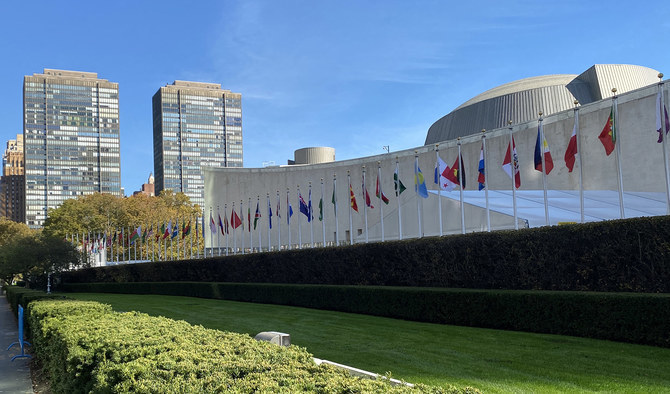
A general view of the United Nations Security Council building in New York city on November 5, 2020. (AFP/File)
Short Url
Updated 10 June 2022
Follow

Pakistan rejects reports FM assured US it wouldn't oppose India's bid for UNSC permanent membership

  • Reports suggesting Pakistan's support for Indian bid emerged after Bhutto-Zardari's meeting with Blinken in US 
  • Islamabad says no discussion took place on the matter during Pakistani FM’s meeting with his US counterpart in May

ISLAMABAD: Pakistan's foreign office on Friday rejected as "baseless" and "absolute fiction" the reports attributed to Foreign Minister Bilawal Bhutto-Zardari regarding Islamabad’s assurance to the United States (US) to not oppose India's bid for the permanent United Nations Security Council (UNSC) membership. 

Bhutto-Zardari visited the US last month to attend a global food security conference at the United Nations (UN) headquarters in New York. He met with US Secretary of State Antony Blinken on May 18 on the sidelines of the conference.  

Reports emerged on social media in the last few days that the Pakistani foreign minister had assured his US counterpart Pakistan would not oppose the Indian bid to the UNSC, in exchange for Washington's support to Pakistan for the Nuclear Supplier Group membership. 

The Pakistani foreign office on Friday rejected these reports and said they were wrongly attributed to Foreign Minister Bhutto-Zardari. 

“The news circulating about any change in Pakistan’s position on the Indian bid for the permanent membership of the UN Security Council is totally baseless and absolute fiction,” Asim Iftikhar Ahmad, a spokesperson for the foreign office, said at a weekly media briefing on Friday. 

“No discussion on this issue took place during the foreign minister’s meeting with Secretary Blinken in New York.” 

He said Pakistan’s position on the UNSC reforms was "clear, consistent, and unambiguous."   

“Together with its other partners, Pakistan opposed any expansion in the UNSC permanent members,” Ahmad said, adding there was no change whatsoever in Pakistan’s policy. 

The spokesperson said Pakistan supported a comprehensive reform of the Security Council, which could make it more democratic, representative, transparent and accountable to the wider membership of the UN. 

“Expansion in the permanent category of the membership does not conform to the principles of the reform,” he added. 

Ahmad said Pakistan believed in the expansion of the non-permanent category of the UNSC membership, with periodic elections and rotation for a more representative and accountable Security Council. 


Pakistan steps up local vaccine manufacturing push with Saudi cooperation Eleven-member Saudi delegation’ to arrive in Pakistan today to give practical shape to local vaccine manufacturing in Pakistan, says health ministry Domestic vaccine manufacturing

Updated 5 sec ago
Follow

Pakistan steps up local vaccine manufacturing push with Saudi cooperation Eleven-member Saudi delegation’ to arrive in Pakistan today to give practical shape to local vaccine manufacturing in Pakistan, says health ministry Domestic vaccine manufacturing

  • Talks with Saudi delegation aim to support domestic production for national immunization needs, ministry says
  • Pakistan currently imports all vaccines, which ramps up foreign exchange and procurement pressures

ISLAMABAD: A high-level Saudi delegation is arriving in Pakistan today, Monday, to give practical shape to local vaccine manufacturing in Pakistan, the health ministry said in a statement amid Islamabad’s push to meet its national immunization needs. 

The eleven-member Saudi delegation’s visit marks a “critical milestone” in strengthening bilateral cooperation between Pakistan and Saudi Arabia in health, pharmaceutical manufacturing and industrial collaboration, the ministry said. 

It added that the development takes place after Pakistan Health Minister Syed Mustafa Kamal held three meetings with his Saudi counterpart over the past seven months in which both sides discussed local vaccine manufacturing, investment opportunities and technical cooperation. Kamal also met Saudi Arabia’s minister of industry to discuss the same. Both sides designated focal persons to ensure effective coordination and follow-up after the meetings. 

“The visit of the high-level Saudi delegation is expected to prove a decisive step toward giving practical shape to the process of local vaccine manufacturing in Pakistan,” Kamal was quoted as saying by the health ministry. 

The Pakistani health minister reaffirmed Islamabad’s commitment to establishing local vaccine production facilities, stating that domestic manufacturing will not only meet Pakistan’s national immunization needs but will also enable surplus production for export. 

This, he said, would contribute to Pakistan’s economic growth and national stability.

“Ensuring the availability of safe, high-quality vaccines for the public remains the government’s top priority, ” the minister said. 

Since Pakistan does not produce vaccines locally, it has to import them from other countries. Producing vaccines will help the South Asian country save valuable foreign exchange and avoid longer procurement delays as it seeks to inoculate its population against various diseases. 

Pakistan, a country of over 240 million people, regularly holds national immunization campaigns against diseases such as polio, measles, rubella and hepatitis.