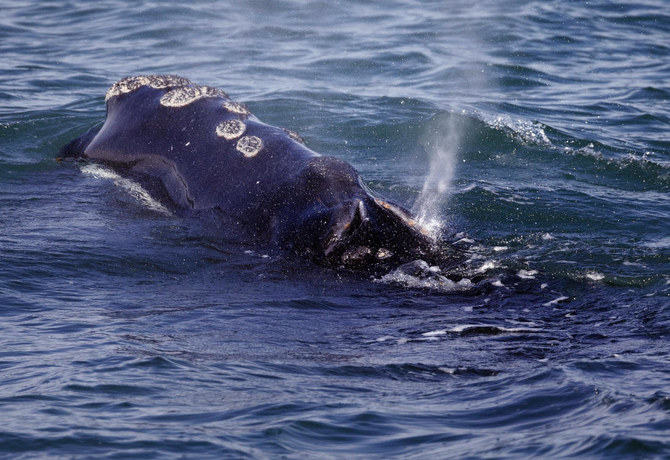
PORTLAND, Maine: Federal authorities spent the past few years analyzing rules for the shipping industry and are now close to releasing fresh guidelines to help protect a vanishing species of whale.
The National Oceanic and Atmospheric Administration has been reviewing the speed regulations it uses to protect North Atlantic right whales, and according to spokesperson Allison Ferreira, the agency will publish new proposed rules within the coming weeks. A public comment process would follow.
Environmentalists have long pushed for stricter shipping rules to protect the whales, which number less than 340 and are vulnerable to collisions with large ships. They’ve fallen in population in recent years due to high mortality and poor reproduction.
“Those are the two primary threats to the species — entanglement in fishing gear and vessel strikes,” said Kristen Monsell, an attorney with the Center for Biological Diversity.
The new rules could expand existing protections for the whales, which are currently protected by a network of “slow zones,” requiring mariners to transit slowly to avoid whale collisions.
Some slow zones are mandatory while others are voluntary. Conservationists have long sought for them all to be mandatory, and for more of them. Some have also urged NOAA to apply the rules to ships under 65 feet (19.8 meters) in length, which is the current cutoff.
More than 50 of the whales were struck by ships between spring 1999 and spring 2018, NOAA records indicate. The collisions aren’t always fatal, but wildlife advocates have cautioned that sub-lethal collisions can result in the whales becoming less likely to reproduce.
Shipping associations have cautioned NOAA over the years to make sure speed rules don’t create unsafe conditions at sea. Ferreira said any changes would “be based on the best available information and completed through public notice and comment.”
The whales were once abundant off the East Coast, but they were decimated during the era of commercial whaling. They have been listed as endangered under the Endangered Species Act for over 50 years.
The whales feed off New England and Canada and migrate to the waters off Georgia and Florida to give birth. They’ve been aided by the protected zones for years, but scientists have said warming ocean temperatures are causing whales to stray more frequently into shipping lanes in search of food.

New restrictions on ships to protect whales coming soon
https://arab.news/jjw56
New restrictions on ships to protect whales coming soon
- The National Oceanic and Atmospheric Administration has been reviewing the speed regulations it uses to protect North Atlantic right whales
- The new rules could expand existing protections for the whales
Why this US cold snap feels bone-shattering when it’s not record-shattering
The brutally frigid weather that has gripped most of America for the past 11 days is not unprecedented. It just feels that way.
The first quarter of the 21st century was unusually warm by historical standards – mostly due to human-induced climate change – and so a prolonged cold spell this winter is unfamiliar to many people, especially younger Americans.
Because bone-shattering cold occurs less frequently, Americans are experiencing it more intensely now than they did in the past, several experts in weather and behavior said. But the longer the current icy blast lasts – sub-freezing temperatures are forecast to stick around in many places — the easier it should become to tolerate.
“We adapt, we get used to things. This is why your first bite of dessert is much more satisfying than your 20th bite,” Hannah Perfecto, who studies consumer behavior at Washington University in St. Louis, wrote in an email. “The same is true for unpleasant experiences: Day 1 of a cold snap is much more a shock to the system than Day 20 is.”
‘Out of practice’ because of recent mild winters
Charlie Steele, a 78-year-old retired federal worker in Saugerties, New York, considers himself a lover of cold weather. In the recent past, he has gone outside in winter wearing a T-shirt and shorts, and has even walked barefoot in the snow. But this January’s deep-freeze is “much, much colder than anything I can remember,” he said.
Steele’s sense of change is backed up data.
There have been four fewer days of subfreezing temperatures in the US per year, on average, between 2001 and 2025 than there were in the previous 25 years, according to data from Climate Central. The data from more than 240 weather stations also found that spells of subfreezing temperatures have become less widespread geographically and haven’t lasted as long — until this year.
In Albany, about 40 miles from Steele, the change has been more pronounced than the national average, with 11 fewer subfreezing days in the last 25 years than the previous quarter century.
“You’re out of practice,” Steele said. “You’re kind of lulled into complacency.”
Coldest week someone under 30 may have felt
Climate change has shifted what people are used to, said several climate scientists, including Daniel Swain of the University of California’s Water Resources Institute.
“It’s quite possible that for anybody under the age of 30, in some spots this may well be the coldest week of their life,” Swain said.
Jennifer Francis, a climate scientist at the Woodwell Climate Research Center in Falmouth, Massachusetts, said, “humans get used to all kinds of things — city noise, stifling heat, lies from politicians, and winter cold. So when a ‘normal’ cold spell does come along, we feel it more acutely.”
We forget how cold it used to be
People forget how extreme cold feels after just two to eight years of milder winters, according to a 2019 study in the journal Proceedings of the National Academy of Sciences. Americans have gone through a much longer stretch than that.
Over the past 30 years, the average daily low in the continental US has dropped below 10 degrees 40 times, according to meteorologist Ryan Maue, former chief scientist for the National Oceanic and Atmospheric Administration. But in the preceding 30 years, that chilly threshold was reached 124 times.
“People have forgotten just how cold it was in the 20th century,” Texas A&M University climate scientist Andrew Dessler said.
Their wake-up call came late last month, when the country’s average daily low dipped below 10 degrees three times in one week.
Regardless of how it feels, extremely cold weather presents dangers. People and vehicles slip on ice, power can go down, leaving people freezing in homes, and storms limit visibility, making commuting to work or even doing basic errands, potentially perilous. More than 110 deaths have been connected to the winter storms and freezing temperatures since January.
Shaking off our cold ‘rustiness’
As this winter’s frigid days stretch on, people adapt. University of San Diego psychiatrist Thomas Rutledge said people shake off what he calls their “weather rustiness.”
Rutledge explained what he meant via email, recalling the period decades ago when he lived in Alaska. “I assumed that everyone was a good driver in winter conditions. How couldn’t they be with so much practice?” he wrote. “But what I annually observed was that there was always a large spike in car accidents in Alaska after first big snowfall hit. Rather than persistent skills, it seemed that the 4-6 months of spring and summer was enough for peoples’ winter driving skills to rust enough to cause accidents.”
That’s Alaska. This cold snap hit southern cities such as Dallas and Miami, where it’s not just the people unaccustomed to the cold. Utilities and other basic infrastructure are also ill-equipped to handle the extreme weather, said Francis of the Woodwell Climate Research Center.
While this ongoing cold snap may feel unusually long to many Americans, it isn’t, according to data from 400 weather stations across the continental US with at least a century of record-keeping, as tracked by the Southeast Regional Climate Center.
Only 33 of these weather stations have recorded enough subzero temperatures since the start of 2026 to be in the top 10 percent of the coldest first 32 days of any year over the past century.
When Steele moved to the Hudson Valley as a toddler in 1949, the average daily low temperature over the previous 10 winters was 14.6 degrees . In the past 10 years, the average daily low was 20.8 degrees .
As a younger man, Steele used to hunt in winter and sit for hours on cold rocks.
“I could never do that now,” he said. “I’m rusty. I’m out of practice.”


