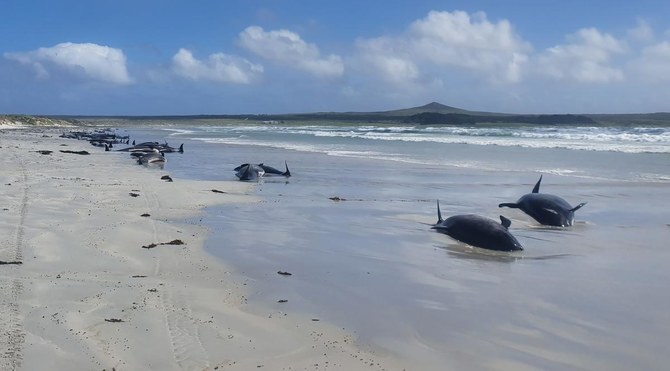
WELLINGTON: About 100 pilot whales and bottlenose dolphins have died in a mass stranding on the remote Chatham Islands, about 800 km (497 miles) off New Zealand’s east coast, officials said on Wednesday.
Most of them were stranded during the weekend but rescue efforts have been hampered by the remote location of the island.
New Zealand’s Department of Conservation (DOC) said in total 97 pilot whales and three dolphins died in the stranding, adding that they were notified of the incident on Sunday.
“Only 26 of the whales were still alive at this point, the majority of them appearing very weak, and were euthanized due to the rough sea conditions and almost certainty of there being great white sharks in the water which are brought in by a stranding like this,” said DOC Biodiversity Ranger Jemma Welch.
Mass strandings are reasonably common on the Chatham Islands with up to 1,000 animals dying in a single stranding in 1918.
Mass whale strandings have occurred throughout recorded modern history, and why it happens is a question that has puzzled marine biologists for years.
In late September, several hundred whales died in shallow waters off the Australian coast in one of the world’s biggest mass whale strandings.

Nearly 100 whales die after mass stranding in New Zealand
https://arab.news/m39wk
Nearly 100 whales die after mass stranding in New Zealand
- Most of them were stranded during the weekend but rescue efforts have been hampered by the remote location of the island
Researchers find 10,000-year-old rock art site in Sinai
- The natural rock shelter’s ceiling features numerous red-pigment drawings of animals and symbols, as well as inscriptions in Arabic and Nabataean
- Some engravings reflect the lifestyles and economic activities of early human communities
CAIRO: Archeologists have discovered a 10,000-year-old site with rock art in Egypt’s Sinai Peninsula, the country’s Ministry of Tourism and Antiquities said.
The previously unknown site on the Umm Irak Plateau features a 100-meter-long rock formation whose diverse carvings trace the evolution of human artistic expression from prehistoric times to the Islamic era.
The Supreme Council of Antiquities “has uncovered one of the most important new archeological sites, of exceptional historical and artistic value,“the ministry said in a statement.
Its chronological diversity makes it “an open-air natural museum,” according to the council’s secretary-general, Hisham El-Leithy.
The natural rock shelter’s ceiling features numerous red-pigment drawings of animals and symbols, as well as inscriptions in Arabic and Nabataean.
Some engravings “reflect the lifestyles and economic activities of early human communities,” the ministry said.
Inside, animal droppings, stone partitions, and hearth remains confirm that the shelter was used as a refuge for a long time.
These “provide further evidence of the succession of civilizations that have inhabited this important part of Egypt over the millennia,” Tourism and Antiquities Minister Sherif Fathi said.
He described the discovery as a “significant addition to the map of Egyptian antiquities.”
The site is located in southern Sinai, where Cairo is undertaking a vast megaproject aimed at attracting mass tourism to the mountain town of Saint Catherine, a UNESCO World Heritage site and home to Bedouin who fear for their ancestral land.


