Saudi Arabia sentences Pakistani to prison for posting video of sloganeering at Prophet's Mosque

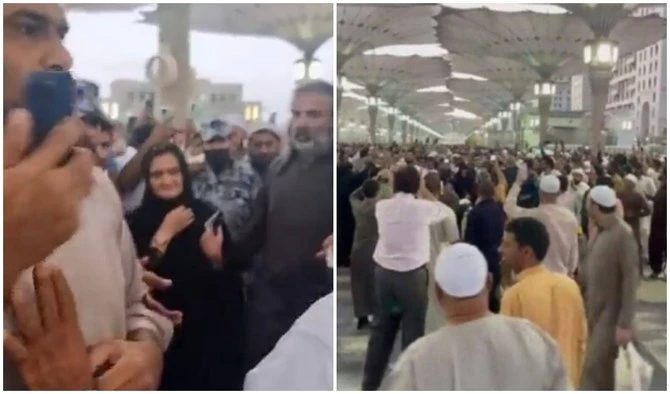
The collage of photo shows people chanting slogans against Pakistani ministers performing Umrah in Madinah, Saudi Arabia, on April 28, 2022. (Screengrabs from social media videos)
Short Url
Updated 10 June 2022
Follow

Saudi Arabia sentences Pakistani to prison for posting video of sloganeering at Prophet's Mosque

  • In April, a group chanted slogans against a Pakistani government delegation visiting the Prophet's Mosque  
  • Pakistani foreign office says Tahir Malik has been sentenced to three years in prison and fined SR10,000  

ISLAMABAD: Saudi Arabia has sentenced a Pakistani man to three years in prison and fined him SR10,000 (Rs0.54 million) for sharing online a video of sloganeering by a group of people at the Prophet's Mosque, the Pakistani foreign office said on Friday.  

Videos shared online in late April showed people chanting slogans against Pakistani Information Minister Marriyum Aurangzeb and Minister for Narcotics Control Shahzain Bugti while they visited the mosque. The politicians were part of a delegation led by Prime Minister Shehbaz Sharif on an official visit to the kingdom. It was widely believed that the protesters were supporters of former Prime Minister Imran Khan, ousted that month in a parliamentary vote of no-confidence.  

Madinah police arrested at least five Pakistani nationals for “abusing and insulting” the visiting delegation, while police in Pakistan registered cases against Khan, and members of his political party for "deliberate and malicious intent to outrage religious sentiment" and "disturbing religious assembly and abetment."   

Pakistan’s foreign office on Friday confirmed that a Pakistani national, Tahir Malik, was sentenced in Saudi Arabia for sharing the video of the incident.  

"We have been informed by our mission in Saudi Arabia, this person Tahir Malik was indicted on account of uploading of the video on social media of the incident that took place in the Masjid-e-Nabvi," FO spokesman Asim Iftikhar Ahmad told reporters at a weekly press briefing on Friday.  

"He was awarded three years’ imprisonment and also a fine of SR10,000."  

Ahmad clarified Malik was not one of the Pakistani citizens apprehended by the Madinah police for chanting slogans, but he was charged "on account of using social media prejudice to the public order against the local laws."  

Last week, the Pakistan Ulema Council also urged Pakistani Hajj pilgrims to abide by the “code of conduct” prescribed by Saudi Arabia and not violate the rules of the kingdom.  

“During the Hajj days, do not try to establish a political arena in Saudi Arabia and especially in Makkah, Madinah, Mina and Arafat and do not be a part of any such effort,” it said in a statement.  

“Pilgrims should pay attention to worship and avoid to become part of any political and sectarian debates and gatherings.”  

UNGA adopts Pakistan-sponsored resolution focusing world attention on Palestine, Kashmir

Updated 9 sec ago
Follow

UNGA adopts Pakistan-sponsored resolution focusing world attention on Palestine, Kashmir

  • The resolution calls on countries to immediately cease foreign military intervention in and occupation of foreign countries and territories
  • Islamabad says the resolution reinforces international attention to the legitimate causes and aspirations of Palestinian, Kashmiri peoples

ISLAMABAD: The United Nations General Assembly (UNGA) has adopted a Pakistan-sponsored resolution on the peoples’ right to self-determination, Pakistan’s UN mission said on Friday, saying it reinforces the world attention to the Palestine and Kashmir issues.

The text, which was adopted by consensus, was recommended last month by the 193-member General Assembly’s Third Committee, which deals with social, humanitarian and cultural issues, according to Pakistani state media.

Co-sponsored by 65 countries, it called on countries to immediately cease foreign military intervention in and occupation of foreign countries and territories as well as acts of “repression, discrimination, and maltreatment.”

The resolution also declared the General Assembly’s firm opposition to acts of foreign military intervention, aggression and occupation, which have resulted in suppression of peoples’ right to self-determination in parts of the world.

“The consensual adoption of the resolution manifests broad international support for the inalienable right of the peoples facing colonialism, alien domination and foreign occupation,” Pakistan’s UN mission said on X. 

“For the people of Indian Illegally Occupied Jammu and Kashmir (IIOJK) and Palestine, the resolution reinforces international attention to their just and legitimate cause and their aspirations for freedom and dignity in accordance with UN Security Council resolutions.”

Pakistan, which does not recognize Israel, supports an independent Palestinian state based on “internationally agreed parameters” and pre-1967 borders, calling for an end to Israeli occupation of the Gaza Strip and the West Bank, including East Jerusalem.

Kashmir, on the other hand, has been divided between Pakistan and India since their independence from British rule in 1947. Both countries claim the Himalayan territory in its entirety but rule it in part and have fought multiple wars over it.

Islamabad has repeatedly urged New Delhi to hold a plebiscite in the disputed territory in line with the United Nations Security Council resolutions.

Ambassador Usman Jadoon, Pakistan’s deputy permanent representative to the UN, this week said the realization of self-determination is not merely a historical aspiration, but an enduring obligation.

“Recent developments in the Middle East demonstrate that lasting peace cannot be achieved through the continued denial and suppression of the legitimate right to self-determination of the Palestinian people,” he said on Thursday.

“Similarly, the UN Security Council has, through several resolutions, recognized the legitimate right of self-determination of the people of Jammu and Kashmir. A just resolution of the Jammu and Kashmir dispute remains central to the establishment of durable peace in South Asia.”