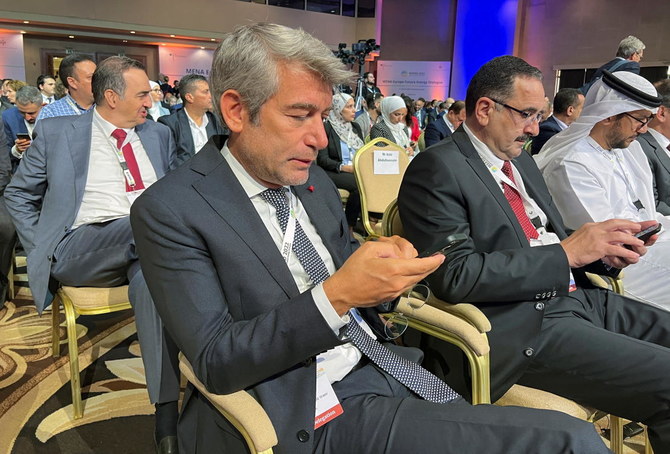
AMMAN: Lebanon’s caretaker energy minister said on Wednesday “politics” was behind the delay of a US-backed deal to supply his country with electricity from Jordan via Syrian territory to ease crippling power shortages.
Walid Fayad told Reuters that the World Bank, which had pledged to finance the project, was “tying it to some kind of political diligence,” alluding to external considerations without getting into specifics.
Speaking on the sidelines of an energy conference in the Jordanian capital, Fayad said the World Bank was also “adding more conditions although they were clear at the start.”
Fayad said the United States had demanded to “see the financing terms from the World Bank” to ensure that the electricity deal “is not sanctionable,” even though Washington had told Beirut in January not to fear sanctions over its regional energy supply plans.
A US State Department source said that the US was requesting details of transactions, including final financing as contracts, to review for sanctions compliance as part of Washington’s OFAC (Office of Foreign Assets Control) process, which administers a number of different sanctions programs. The source said this was part of standard government procedures.
The United States enacted the Caesar Act in 2019 allowing it to freeze assets of anyone dealing with Syria, with the aim of forcing President Bashar Assad to stop his war with opposition forces and agree a political solution.
Lebanon and Jordan signed a deal in Beirut last January to ease chronic Lebanese power outages by transmitting about 400 megawatts (MW) of electricity across Syrian territory.
Fayad said the delay would worsen shortages as Lebanon enters its summer season, with higher energy demand and an influx of tourists.
The Lebanese-Jordanian agreement is part of a wider plan that also aims to pump Egyptian gas to a power station in northern Lebanon via a pipeline that runs through Jordan and Syria.
The agreement with Egypt has yet to be signed.
“There is no delay but an important milestone that we need to get through is the American approval plus the financing from the World Bank,” Egyptian Petroleum Minister Tarek El Molla told Reuters at the conference in Amman.
Lebanon has suffered power outages dating to its 1975-90 civil war, which ravaged the electricity infrastructure and left many families relying on private generators.
A World Bank spokesperson was not immediately available for comment.


![]()

Lebanese caretaker energy minister says ‘politics’ behind delay of US-backed electricity plan
Short Url
https://arab.news/vk4yx
Lebanese caretaker energy minister says ‘politics’ behind delay of US-backed electricity plan
- Walid Fayad told Reuters that the World Bank, which had pledged to finance the project, was "tying it to some kind of political diligence,"
- The United States had demanded to "see the financing terms from the World Bank" to ensure that the electricity deal "is not sanctionable,"


Latest updates


© 2026 SAUDI RESEARCH & PUBLISHING COMPANY, All Rights Reserved And subject to Terms of Use Agreement.