KYIV: Russia struck Ukraine’s capital Kyiv with missiles early on Sunday for the first time in more than a month, while Ukrainian officials said a counter-attack on the main battlefield in the east had retaken half of the city of Sievierodonetsk.
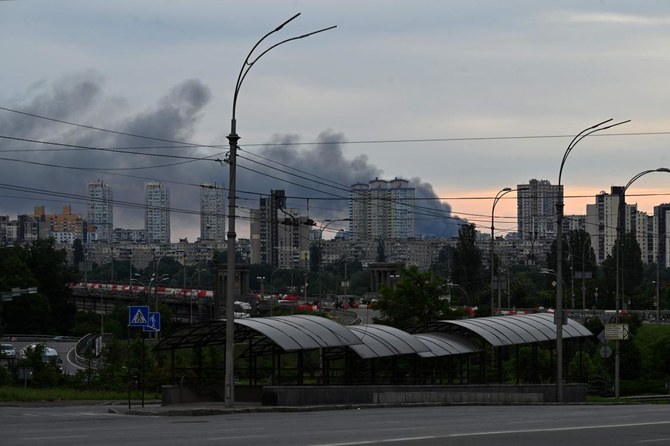
Dark smoke could be seen from many miles away after the attack on two outlying districts of Kyiv. Ukraine said the strike hit a rail car repair works; Moscow said it had destroyed tanks sent by Eastern European countries to Ukraine.
At least one person was hospitalized though there were no immediate reports of deaths. The strike was a sudden reminder of war in a capital where normal life has largely returned since Russian forces were driven from its outskirts in March.
“The Kremlin resorts to new insidious attacks. Today’s missile strikes at Kyiv have only one goal — kill as many as possible,” tweeted Ukrainian presidential adviser Mikhailo Podolyak.
Ukraine said Russia had carried out the strike using long-range air-launched missiles fired from heavy bombers as far away as the Caspian Sea — a weapon far more valuable than the tanks Russia claimed to have hit.
Ukraine’s nuclear power operator said a Russian cruise missile had flown “critically low” over the country’s second largest nuclear power plant.
Sunday’s attack was the first big strike on Kyiv since late April, when a missile killed a journalist. Recent weeks have seen Russia focus its destructive might mainly on front lines in the east and south, although Moscow occasionally strikes elsewhere in what it calls a campaign to degrade Ukraine’s military infrastructure and block Western arms shipments.
Ukraine claims half of Sievierodonetsk
Russia has concentrated its forces in recent weeks on the small eastern industrial city of Sievierodonetsk, pursuing one of the biggest ground battles of the war in a bid to capture one of two eastern provinces it claims on behalf of separatist proxies.
After retreating steadily in the city in recent days, Ukraine mounted a counter-attack there, which it says took the Russians by surprise. After recapturing a swathe of the city, Ukrainian forces were now in control of half of it and continuing to push the Russians back, said Serhiy Gaidai, governor of the Luhansk region that includes Sievierodonetsk.
The claims could not be independently verified. Both sides say they have inflicted huge casualties in Sievierodonetsk, a battle that could determine which side carries the momentum into a protracted war of attrition in coming months.
In another sign Ukraine has held off the Russian advance, Gaidai said evacuations resumed from the Ukrainian-held part of Luhansk province on Sunday, and 98 people had escaped. Russian forces have been trying for weeks to cut off the main road out to encircle Ukrainian troops there, and evacuations were halted last week after a journalist was killed by shelling.
Britain’s defense ministry said on Sunday that Ukrainian counterattacks in Sievierodonetsk over the past 24 hours were likely to blunt any operational momentum Russia had gained. Moscow was deploying poorly equipped separatist fighters in the city to limit the risk to its regular forces, it said.
In neighboring Donetsk province, which Moscow also claims on behalf of its separatist proxies, Russian forces have been advancing in recent days in territory north of the Siverskiy Donets river, in advance of what Ukraine anticipates could be a push on the major city of Sloviansk.
Ukrainian officials said at least eight people were killed and 11 injured in Russian shelling in the province overnight.
In a Sunday address to 35,000 people in Rome, Pope Francis noted that more than 100 days had passed since “the start of the armed aggression against Ukraine,” and called the war “the negation of God’s dream.”
Cracking weapons like nuts
In an interview with Russian state television, President Vladimir Putin said Moscow would hit new targets if the West supplies longer-range missiles to Ukraine. But he also dismissed the impact of advanced rocket systems promised by Washington to Ukraine last week, saying these would not affect the course of fighting.
The United States is already training Ukrainian troops on its HIMARS rocket launchers, which would be able to hit positions far behind Russian lines. Kyiv says such weapons will help it shift the war’s momentum.
Putin, in excerpts of his interview quoted by Russian news agencies ahead of broadcast, said that if the West supplies longer-range missiles, “we will strike at those targets which we have not yet been hitting,” without specifying the targets.
Russian forces had been hitting Ukrainian weapons systems and “cracking them like nuts” he said, dismissing the new US rockets as “meant to make up for the losses of this military equipment” and not likely to change the battlefield balance.
Kyiv rebuked French President Emmanuel Macron on Saturday for saying it was important not to “humiliate” Moscow.
Ukraine has bristled over what it considers pressure from some European allies to relinquish territory to secure a cease-fire.
“Calls to avoid humiliation of Russia can only humiliate France and every other country that would call for it,” Foreign Minister Dmytro Kuleba tweeted in response to Macron’s remarks.


![]()

Russia strikes Kyiv for first time in weeks as battle rages in east
Short Url
https://arab.news/gr3rc
Russia strikes Kyiv for first time in weeks as battle rages in east
- Dark smoke could be seen from many miles away after the attack on two outlying districts of Kyiv
- Moscow said it had destroyed tanks sent by Eastern European countries to Ukraine


Latest updates







© 2026 SAUDI RESEARCH & PUBLISHING COMPANY, All Rights Reserved And subject to Terms of Use Agreement.