BEIRUT: In northern Syria, residents are bracing for a new fight. With the world’s attention focused on the war in Ukraine, Turkey’s leader says he’s planning a major military operation to push back Syrian Kurdish fighters and create a long sought-after buffer zone in the border area.
Tensions are high. Hardly a day passes by without an exchange of fire and shelling between the US-backed Syrian Kurdish fighters, and Turkish forces and Turkey-backed Syrian opposition gunmen.
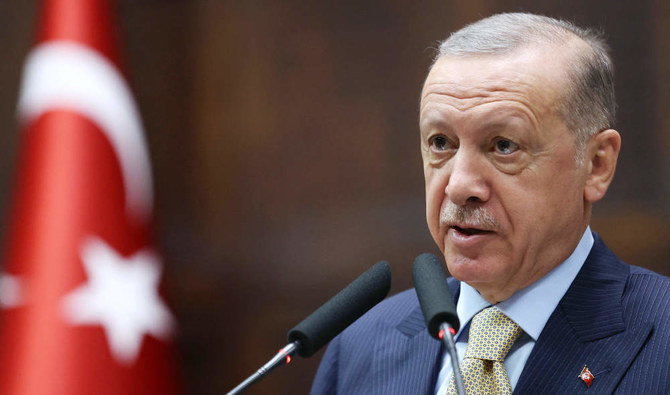
Analysts say Turkish President Recep Tayyip Erdogan is taking advantage of the war in Ukraine to push his own goals in neighboring Syria — even using Turkey’s ability as a NATO member to veto alliance membership by Finland and Sweden as potential leverage.
But a major incursion by Ankara comes with risks and complications, threatening to upset Turkey’s ties with both the US and Russia.
It also risks creating a new wave of displacement in a war-ravaged region where the Daesh group still lurks in the shadows.
Here’s a look at the situation on the ground and some of the key issues:
Erdogan last month outlined plans to resume Turkish efforts to create a 30-km deep buffer zone in Syria, along its southern border through a cross-border incursion against US-allied Syrian Kurdish fighters. Erdogan wanted to create that zone in 2019 but a military operation fell short of achieving it.
“We’ll come down on them suddenly one night. And we must,” Erdogan said, without giving a specific timeline.
Since 2016, Turkey has launched three major operations inside Syria, targeting Syria’s main Kurdish militia — the People’s Protection Units or YPG — which Turkey considers to be a terrorist organization and an extension of the outlawed Kurdistan Workers’ Party, or PKK. The PKK has for decades waged an insurgency within Turkey against the government in Ankara.
The YPG, however, forms the backbone of US-led forces in the fight against Daesh militants and has been a proven top US ally in Syria.
Turkey, through the three previous military operations in Syria, already has control over a large chunk of Syrian territory, including the towns of Afrin, Tel Abyad and Jarablus. Ankara plans to build thousands of housing units in those areas, to ensure what it says will be the “voluntary return” of 1 million out of the 3.7 million Syrian refugees currently in Turkey.
Erdogan said Wednesday that Turkish troops now aim to take new areas, including the towns of Tel Rifaat and Manbij, which sits on a major intersection of roads on Syria’s west-east highway known as the M4. Turkey says the Syrian Kurdish fighters use Tel Rifaat as a base to attack areas held by Turkey-backed Syrian opposition fighters.
There have been also reports that Turkish troops might enter the strategic border town of Kobani, where the US military and Kurdish fighters first united to defeat IS in 2015. The town holds powerful symbolism for Syrian Kurds and their ambitions of self-rule in this part of Syria.
Analysts say Erdogan likely sees a confluence of circumstances, both international and domestic, that make an operation in Syria timely. The Russians are preoccupied with the war in Ukraine, and the Americans need Erdogan to drop his objections to the expansion of NATO to include Finland and Sweden.
“They (Turks) sense an opportunity to try and get concessions from the West,” said Aaron Stein, head of research at the Foreign Policy Research Institute in Philadelphia.
A Syria offensive could also be used to rally Turkish nationalist voters at a time when their economy is in decline, with inflation running at 73.5 percent. Turkey is set to hold presidential and parliamentary elections next year, and previous incursions into Syria to drive out the YPG have bolstered support for Erdogan in past balloting.
So far, there are no signs of mobilization pointing to an imminent invasion, although the Turkish military could be called upon fairly quickly. Syrian Kurdish fighters, however, say they are taking Turkey’s latest threat seriously and have been preparing for a possible attack.
They warn that an incursion would affect their ongoing fight against Daesh and their ability to protect prisons in northern Syria where thousands of extremists, many of them foreign nationals, have been locked up since Daesh was defeated territorially three years ago.
A large-scale military operation carries high risks and is likely to anger both the US and Russia, who also have a military presence in northern Syria.
Turkey and Russia support rival sides in Syria’s 11-year conflict but have been closely coordinating in the country’s north. While Russia has not officially commented, it has in recent days sent fighter jets and helicopter gunships to a base close to the border with Turkey, according to Syrian opposition activists.
As one of Damascus’ closest allies, Russia’s role in Syria has been paramount in turning the tide of the conflict in Syria — which started amid Arab Spring uprisings in 2011 — in favor of Syrian President Bashar Assad. The Syrian opposition fighters were relegated to an enclave in the northwest and Turkey’s sphere of influence.
But with Moscow focused on Ukraine, it’s unlikely Vladimir Putin will stand in Erdogan’s way over what is essentially just a strip of land along Turkey’s southern border.


![]()

Erdogan taking advantage of Ukraine war to push his own goals in Syria
Short Url
https://arab.news/gfp28
Erdogan taking advantage of Ukraine war to push his own goals in Syria
- A major incursion by Ankara comes with risks and complications, threatening to upset Turkey’s ties with both the US and Russia


Latest updates


© 2026 SAUDI RESEARCH & PUBLISHING COMPANY, All Rights Reserved And subject to Terms of Use Agreement.