

Sidra Amin’s career-best century powers Pakistan to 73-run win over Sri Lanka

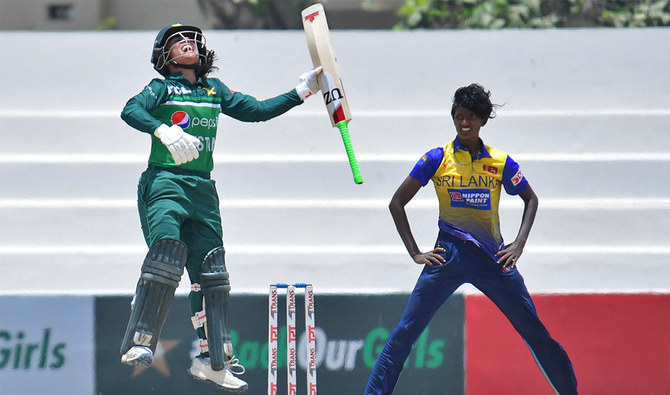
Pakistan's Sidra Amin (L) celebrates after scoring a century as Sri Lanka's Kaveesha Dilhari watches during the second ODI women’s cricket match in Karachi on June 3, 2022. (AFP)
Short Url
Updated 03 June 2022
Follow

Sidra Amin’s career-best century powers Pakistan to 73-run win over Sri Lanka

  • Amin smashes 123 off 150 balls, Fatima Sana takes four wickets
  • Pakistan are leading the three-match series against Sri Lanka 2-0 

ISLAMABAD: Pakistan Women comfortably defeated Sri Lanka by 73 runs in their second One-Day International (ODI) match in Karachi on Friday, courtesy of an impressive century by Sidra Amin and a four-wicket haul by Fatima Sana. 

Pakistan lead the ODI series 2-0, after having whitewashed Sri Lanka in the recently-held T20I series between the two sides. 

The Pakistan side won the toss and opted to bat first in the game. Sri Lanka dropped Amin when she was put down in the slips before scoring a single run. From then on, Amin made sure to make Sri Lanka regret the fumble and smashed a century in the next three hours. 

Pakistan managed to score a record opening century stand in the second ODI, a feat green shirts have never achieved before. Amin was joined by batter Muneeba Ali, who scored 56 off 100 balls. Amin, on the other hand, scored 123 off 150 balls — her second career century — before she was dismissed. 

“Second ODI century for Sidra Ameen,” the International Cricket Council said on Twitter. “What a brilliant innings by the Pakistan opener.” 

The Pakistan Cricket Board (PCB) called it “a special effort” by Amin to bring up the second ODI 100 of her career. 

Pakistan batters Bismah Maroof (36) and Nida Dar (10) remained unbeaten to guide the hosts to a respectable 253/2 at the end of 50 overs. 

Sri Lanka’s Oshadi Ranasinghe and Kavisha Dilhari picked up one wicket each. 

When the visitors came out to bat, Pakistan never allowed them to get comfortable at the crease. Sana and Dar dismissed Sri Lankan openers Hasini Perera and skipper Chamari Athapaththu early on in the innings. 

Sana was the pick of Pakistani bowlers, finishing with 4/26 from her 10 overs. Omaima Sohail took two wickets, while Dar also claimed a scalp. 

At the end of 50 overs, Sri Lanka could only score 180 at a loss of nine wickets. 

The final ODI of the three-match series will be played on Sunday.

Pakistan offers Arabian Sea trade routes to Russia, Central Asia, minister says

Updated 11 sec ago
Follow

Pakistan offers Arabian Sea trade routes to Russia, Central Asia, minister says

  • Islamabad pitches transit corridors linking Eurasia to global shipping lanes
  • Government invites foreign investment in Sukkur–Hyderabad M-6 motorway

ISLAMABAD: Pakistan is offering overland trade routes to Russia and landlocked Central Asian states through its Arabian Sea ports, Communications Minister Abdul Aleem Khan said on Thursday, positioning the country as a strategic transit hub as regional supply chains shift toward alternative corridors.

Pakistan has long sought to leverage its geography to connect landlocked Central Asian economies to warm-water ports, a strategy that has gained importance in recent years as countries explore routes that bypass traditional maritime chokepoints and longer shipping lanes. Islamabad promotes its ports at Karachi and Gwadar as gateways linking South Asia, the Middle East and Eurasia.

Speaking at the 88th session of the UN Economic Commission for Europe (UNECE) Inland Transport Committee in Geneva, Khan said Pakistan’s growing integration into Eurasian connectivity networks marked a new phase in regional trade cooperation.

“Pakistan’s strategic integration into the Belarus, Russia, and Central Asia corridors represents the dawn of a new era in regional connectivity,” he said, adding the country was providing “high-efficiency trade routes for Russia and landlocked Central Asian Republics.”

The minister said six land corridors were now facilitating transit trade, including routes via Türkiye, Azerbaijan and Iran, as well as China-Kazakhstan connectivity and Trans-Afghan links connecting Central Asian states to the Arabian Sea. He added that the Quadrilateral Traffic in Transit Agreement (QTTA) route could also expand northward.

He cited the transit of a Kazakh cargo shipment to the United Arab Emirates via Pakistan in June 2024 as proof of the country’s logistical viability for intercontinental trade.

Khan also pointed to more than 1,800 international TIR road-transit shipments — a UN customs system that allows sealed cargo trucks to cross borders without repeated inspections — as evidence of Pakistan’s operational readiness.

Central to Islamabad’s investment pitch was the proposed Sukkur–Hyderabad (M-6) motorway, a planned highway in southern Pakistan that would complete the country’s main north-south trade corridor linking ports on the Arabian Sea with inland and regional markets. Khan described it as a key missing link in Pakistan’s north-south transport backbone and an opportunity for foreign investors.

He said the project offered “nearly 30 percent guaranteed equity” and would significantly strengthen regional connectivity while generating predictable returns.

Pakistan has increasingly promoted infrastructure built under the China-Pakistan Economic Corridor (CPEC) as the backbone of its connectivity ambitions, arguing that improved road and logistics networks could transform the country into a transit economy rather than solely a destination market.

The government has also allocated a 100-acre terminal at Gwadar Port for Central Asian states and expanded visa-on-arrival access for citizens of 126 countries to facilitate business travel, according to the communications ministry.

Officials say digitalization of transport data and coordination with regional partners including Uzbekistan and Kazakhstan are aimed at making cross-border trade faster and compliant with international conventions.

Khan said the goal was to position Pakistan not merely as a transit territory but as “a proactive hub for global economic activity and a catalyst for a regional trade revolution.”