BAGHDAD: Assassinations, bomb attacks and threats in Iraq and an “environment of fear and intimidation” targeting activists and protesters has put a stranglehold on freedom of expression, the UN mission warned Thursday.
In a report documenting 26 incidents since May 2021 that it said were “aimed at suppressing dissent and criticism carried out by ‘unidentified armed elements’,” the United Nations warned of the deadly threats that activists face.
Among the 26 cases investigated, they include “one targeted killing, three attempted targeted killings, five violent assaults, one house raid, 14 attacks using improvised explosive devices (and) one abduction,” the report read.
It refers to the “persistent impunity with respect to targeted attacks against protesters” as well as against people “seeking accountability for these attacks, and activists and critics espousing views critical of armed elements and affiliated political actors.”
The report, focusing on the period of May 2021 to May 2022 and based on 27 interviews including with judicial officials in the capital Baghdad and southern Iraq, was compiled by the UN’s Office of the High Commissioner for Human Rights (OHCHR) and the UN Assistance Mission for Iraq (UNAMI).
The report notes, however, that “significant progress” has been made in providing compensation to the families of those killed during the bloody anti-government protests that rocked the country for months from late 2019.
More than 500 families have so far received compensation of some $7,000 dollars each, it said.
The demonstrations were sparked by rampant corruption, a lack of job opportunities and poor living conditions.
Nearly 600 people were killed and tens of thousands injured when the authorities cracked down on the protests. Dozens of activists and protesters were targeted in assassinations or attempted killings.
While the violence against protesters was never claimed, many critics accuse powerful pro-Iranian armed factions.
“Information indicates that individuals detained and convicted for these incidents may belong to well-known armed elements operating outside state control,” the UN report said.
The consequence, the UN warns, is that it “propagates an environment of fear and intimidation that continues to severely restrict the enjoyment of the rights to freedom of expression and peaceful assembly.”
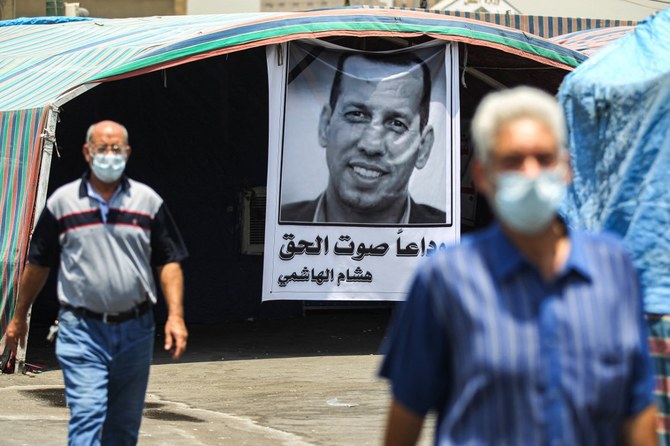
The report also looked at fallout from the fatal July 2020 shooting of security adviser and researcher Hisham Al-Hashemi, and the trial of a policeman for his murder.
After repeated delays, the trial has again been postponed — this time with no new start-date — “due to the ‘inability of bringing the defendant to the court’,” the report added.

Iraqi activists suffering in ‘environment of fear’: UN
Short Url
https://arab.news/p9rqk
Iraqi activists suffering in ‘environment of fear’: UN
- The United Nations warned of the deadly threats that activists face
- The report was compiled by the UN's Office of the High Commissioner for Human Rights and the UN Assistance Mission for Iraq
Activists plan new, bigger flotilla to try to bring aid to Gaza
- Activists previously detained by Israel plan new flotilla
- Israeli officials denounce such missions as stunts
JOHANNESBURG: Activists behind a flotilla intercepted at sea last year by Israel while trying to bring aid to Gaza will try again this year, expecting more than twice as many boats carrying up to 1,000 medics, they said on Thursday.
The Israeli military halted the roughly 40 boats in the Global Sumud Flotilla last October as they attempted to reach blockaded Gaza, arresting Swedish activist Greta Thunberg and more than 450 other participants.
Organizers, who gathered on Wednesday at the foundation of late South African leader Nelson Mandela in Johannesburg, said they hope to bring 100 boats for their next attempt.
“It is a cause ... for those that want to rise and stand for justice and dignity for all,” Mandela’s grandson Mandla Mandela, who was among activists detained last time, told the gathering. “We want to mobilize the ... global community to join forces with us.”
Israeli officials repeatedly denounced last year’s mission, and previous smaller-scale attempts to reach Gaza by sea, as publicity stunts.
Israel, which controls all access to the Gaza Strip, denies withholding supplies for its more than 2 million residents. Palestinians and international aid bodies say supplies reaching the territory are still insufficient, despite a ceasefire reached in October which included guarantees of increased aid.
Following the ceasefire, Israeli forces now control more than 53 percent of the Gaza Strip where they have ordered residents out. Nearly the entire population is crowded into a narrow strip along the coast, mostly living in makeshift tents and damaged buildings.
If the flotilla is blocked again, the activists said it would still be worth it to highlight Gaza’s plight.
“We may not have reached Gaza physically (but) we have reached ... the people in Gaza,” said one of the activists, Susan Abdallah. “They know that we care, that we will not stop at anything until we actually break the siege.”
The Israeli military halted the roughly 40 boats in the Global Sumud Flotilla last October as they attempted to reach blockaded Gaza, arresting Swedish activist Greta Thunberg and more than 450 other participants.
Organizers, who gathered on Wednesday at the foundation of late South African leader Nelson Mandela in Johannesburg, said they hope to bring 100 boats for their next attempt.
“It is a cause ... for those that want to rise and stand for justice and dignity for all,” Mandela’s grandson Mandla Mandela, who was among activists detained last time, told the gathering. “We want to mobilize the ... global community to join forces with us.”
Israeli officials repeatedly denounced last year’s mission, and previous smaller-scale attempts to reach Gaza by sea, as publicity stunts.
Israel, which controls all access to the Gaza Strip, denies withholding supplies for its more than 2 million residents. Palestinians and international aid bodies say supplies reaching the territory are still insufficient, despite a ceasefire reached in October which included guarantees of increased aid.
Following the ceasefire, Israeli forces now control more than 53 percent of the Gaza Strip where they have ordered residents out. Nearly the entire population is crowded into a narrow strip along the coast, mostly living in makeshift tents and damaged buildings.
If the flotilla is blocked again, the activists said it would still be worth it to highlight Gaza’s plight.
“We may not have reached Gaza physically (but) we have reached ... the people in Gaza,” said one of the activists, Susan Abdallah. “They know that we care, that we will not stop at anything until we actually break the siege.”
© 2026 SAUDI RESEARCH & PUBLISHING COMPANY, All Rights Reserved And subject to Terms of Use Agreement.


