

Moody’s downgrades Pakistan’s outlook on uncertainty about ability to secure external finances

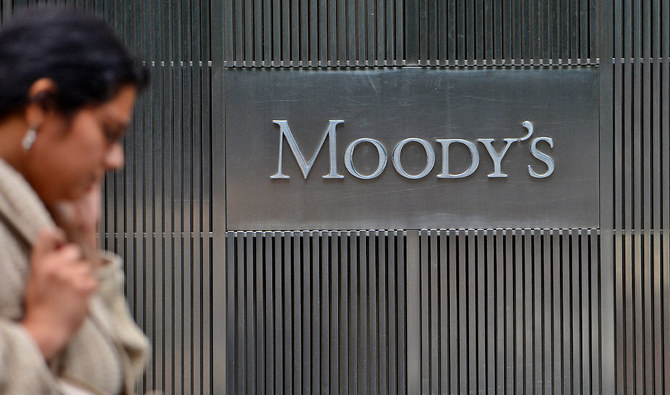
A sign for Moody's rating agency is displayed at the company headquarters in New York, US, on September 18, 2012. (AFP/File)
Short Url
Updated 02 June 2022
Follow

Moody’s downgrades Pakistan’s outlook on uncertainty about ability to secure external finances

  • Last week’s talks between Pakistan and the IMF to resume $6bn loan program ended without breakthrough
  • Decision to change the outlook to negative driven by heightened external vulnerability risk, Moody’s says

ISLAMABAD: International credit agency Moody’s on Thursday downgraded Pakistan’s outlook from stable to negative, citing a “heightened external vulnerability risk” and the inability to secure additional external financing. 

Pakistan has been grappling with an economic crisis spurred by dwindling foreign exchange reserves, a volatile currency and its inability to unlock funding from the IMF and other multilateral donors.  

Last week’s talks between Pakistan and the IMF to resume a $6bn loan program were inconclusive, with the lender setting the condition that Islamabad roll back fuel and power subsidies introduced by the last government that have blown a hole in public finances.

“The decision to change the outlook to negative is driven by Pakistan’s heightened external vulnerability risk and uncertainty around the sovereign’s ability to secure additional external financing to meet its needs,” Moody’s said in a statement.

The credit agency added that surging inflation had increased Pakistan’s external vulnerability risk and put a strain on its already-thin foreign exchange reserves, the current account and local currency.  

“Pakistan’s weak institutions and governance strength adds uncertainty around the future direction of macroeconomic policy,” Moody’s said. “Including whether the country will complete the current IMF Extended Fund Facility (EFF) program and maintain a credible policy path that supports further financing.”

Moody’s said notwithstanding the risks mentioned, the credit agency expected Pakistan to successfully conclude the seventh IMF review and secure funding from the international money lender which would unlock financing from other bilateral and multilateral partners.  

“In this case, Moody’s assesses that Pakistan will be able to close its financing gap for the next couple of years,” it said.  

It added that while the government’s recent decision to hike prices of petroleum products showed it was willing to address the IMF’s concerns, social and political challenges in Pakistan would make it difficult for the government to bring about revenue-raising reforms.  

The rating agency also warned of a “balance-of-payment crisis” if Pakistan was unable to secure external financing later this year.  

“If Pakistan is unable to secure additional financing later this year, foreign exchange reserves will continue to be drawn down from already very low levels, increasing the risk of a balance of payments crisis,” it said.


Pakistan partners with Meta to roll out AI program for teachers’ training

Updated 6 sec ago
Follow

Pakistan partners with Meta to roll out AI program for teachers’ training

  • Around 300 Higher Education Commission members have so far been trained through the program
  • The development comes as the country embraces AI across education, industry and government

ISLAMABAD: Pakistan’s Higher Education Commission (HEC) has launched an artificial intelligence (AI) program in collaboration with American tech giant Meta and Atomcamp ed-tech platform to upgrade skills of university faculty in line with modern technology, state media reported on Friday.

Around 300 HEC members have so far been trained by Atomcamp, which offers services in AI, data science and analytics, enhancing their professional skills and laying the groundwork for the use of modern technology in higher education.

Pakistan has been increasingly embracing AI across education, industry and government, with startups developing solutions for finance, health care and e-commerce, and policymakers planning to integrate AI into public service and digital infrastructure.

“Under this initiative, Atomcamp provided advanced training on AI to faculty members across Pakistan, while HEC provided the necessary support and partnership for this program,” the Associated Press of Pakistan (APP) news agency reported.

“The main objective of this program is to enhance the skills of teaching staff in universities across the country and align the quality of teaching with modern requirements.”

The government plans to introduce more AI and emerging technology programs to bring Pakistani universities at par with global standards, according to the report.

In August last year, Pakistan unveiled its first National Artificial Intelligence Policy to develop AI infrastructure, train one million people in related skills and ensure responsible, ethical use of the technology.

The policy outlines six pillars, including AI innovation, public awareness, secure systems, sectoral transformation, infrastructure and international partnerships, for advancement in the country.