

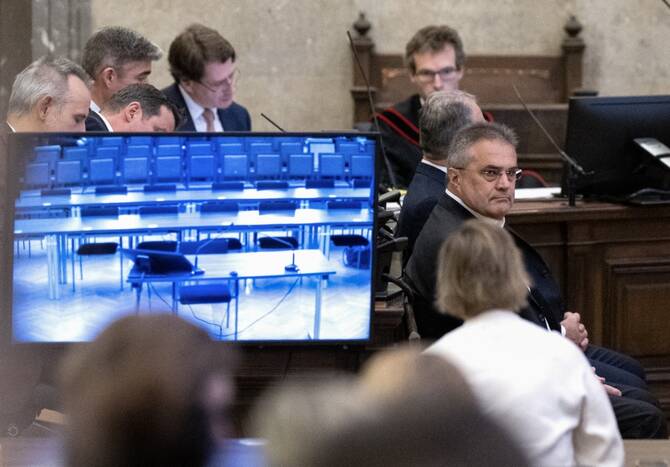

VIENNA: An Austrian court is expected to rule on Wednesday on a former intelligence official charged over spying for Russia, the most high-profile espionage case to have shaken the EU member in recent years.
Austria has been rocked by several cases centered on suspected spying for Moscow, with the current government wanting to harden the legislation to crack down on this.
Former agent Egisto Ott, 63, has pleaded not guilty to a slew of charges that include handing over sensitive devices and selling secret information to Russia.
His trial began in January and stretched over 12 days.
Ott on Tuesday told AFP that he rejected all the accusations — including suspected abuse of office, corruption and espionage to the detriment of Austria — and was “innocent.”
“At no point did I sell or pass on in any way information to Russian intelligence services,” he said, adding he had always acted within the law and on orders from his superiors.
If found guilty, Ott faces up to five years in prison.
Another Austrian agent is standing trial together with Ott on charges of abuse of office, in part by allegedly assisting Ott.
According to the indictment seen by AFP, Ott risked inflicting “serious damage” on Austria’s reputation among friendly intelligence services.
Between 2015 and 2022, Ott is alleged to have acted on the orders of Jan Marsalek, an Austrian executive of collapsed German payment processing firm Wirecard, in return for a total payment of more than 80,000 euros.
Fugitive Marsalek is wanted on fraud charges and is suspected of working for Russia’s intelligence services.
- ‘Assassination manual’ -
To gather information, Ott allegedly used “European databases” and sent “requests for assistance” to Italy and Britain, which resulted in those countries “unknowingly acting in the interest” of Moscow, prosecutors say.
Prosecutors also accuse Ott of handing over several cell phones of top Austrian interior ministry officials.
This gave the Kremlin access to thousands of contacts and put at risk the safety of Ukrainian and Chechen refugees living in Austria.
He is also accused of handing over an encrypted laptop containing “hardware for secure electronic communication not publicly known.”
The laptop, designed by a German company, was handed over to the FSB and sold on to Iran, according to the indictment.
Through his access to databases, Ott is alleged to have been able to leak information on individuals “at risk of reprisals” such as a former Russian spy who had taken refuge in Montenegro.
Investigators also found a document Ott had allegedly written after the 2019 murder of a Georgian man of Chechen origin in Berlin by an agent sent by Moscow.
Prosecutors dubbed it an “instruction manual for future smooth and successful assassinations on EU territory.”
Ott was suspended from his post at Austria’s intelligence services in 2017.
He has already been tried and acquitted of charges of violating official secrecy for allegedly passing information to a far-right politician.
- Nest of spies -
Austria — which long saw itself as a bridge between Moscow and the West and hosts several international organizations — is regularly described as a nest of Russian spies.
Some 220 Russian embassy staff are accredited in Austria, one of Russia’s largest diplomatic missions in Europe.
Espionage remains legal as long as it is not conducted to the detriment of the host country’s interests.
This has strained relations in recent years between the country of some nine million people and foreign intelligence services.
The conservative-led government, which also comprises Social Democrats and liberals, has pledged to crack down on the problem.
It wants to criminalize espionage targeting the EU or international organizations, as well as the recruitment of agents for foreign intelligence services.


