

Pakistan jumps six places on World Economic Forum’s global tourism index

A general view of Naran valley is pictured in Mansehra District of Khyber Pakhtunkhwa province on June 28, 2021. (AFP/File)
Short Url
Updated 21 September 2025
Follow

Pakistan jumps six places on World Economic Forum’s global tourism index

  • The index measures factors and policies for sustainable development of tourism
  • Pakistan ranks 83rd among 117 economies, with record improvement since 2019 

ISLAMABAD: Pakistan has jumped six spots on the International Travel and Tourism Development Index (TTDI), the World Economic Forum (WEF) said in its latest report, with the South Asian nation making a significant improvement in the sector. 

The index measures the set of factors and policies that enable sustainable and resilient development of travel and tourism sector, which in turn contributes to the development of a country. 

The WEF covered 117 economies for its 2021 report, with Pakistan ranking among the lower-middle-income countries improving the most since 2019. 
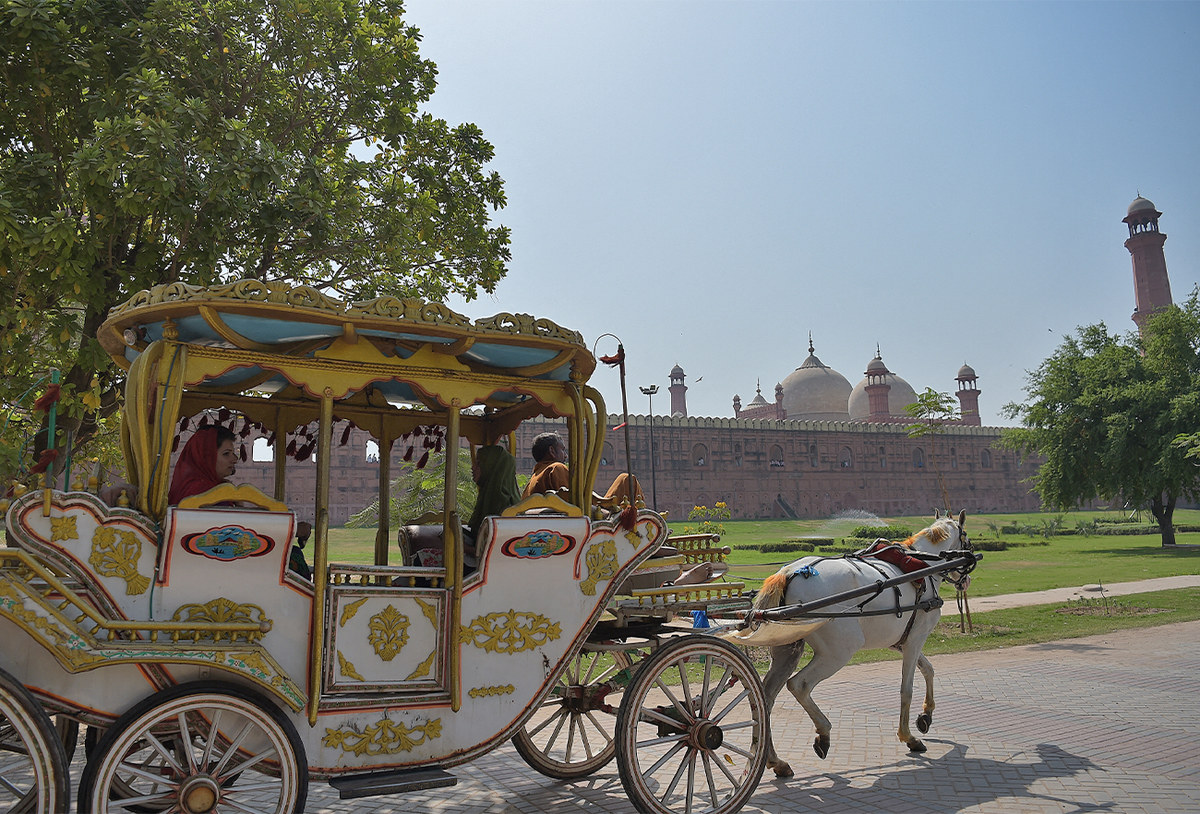


In this photograph taken on October 7, 2017, tourists ride on a horse buggy as they look at the historic Badshahi Mosque in Lahore, Pakistan. (AFP/File)

“As mentioned, Japan is the top performer in both the APAC region and globally, with Australia (7th) and Singapore (9th) ranking in the global top 10,” the WEF report read. 

“However, it is lower-middle-income economies such as Viet Nam (+4.7 percent, 60th to 52nd), Indonesia (+3.4 percent, 44th to 32nd) and Pakistan (+2.9 percent, 89th to 83rd) that have improved their TTDI scores the most since 2019.” 

China, which ranks 12th on the TTDI, has the region’s largest travel and tourism economy, while the Philippines, which depended the most on tourism for its GDP in 2020, ranks 75th, according to the report. India is the top scorer in South Asia on 54th position globally. 

In 2019, tourism accounted for a tenth of global GDP and jobs but the coronavirus pandemic decimated the $9.6 trillion industry, halving its output value and leaving 62 million people jobless. 

The global travel and tourism sector is projected to return to pre-pandemic levels in 2023 and grow at a rate that will outpace global gross domestic product (GDP) growth, the World Travel and Tourism Council (WTTC) said in April. 

The industry is expected to post an annual average growth rate of 5.8 percent from 2022 to 2032 versus the 2.7 percent increase in global GDP, and create 126 million new jobs. 


Pakistan PM calls for faster CPEC implementation, pledges security for Chinese workers

Updated 12 sec ago
Follow

Pakistan PM calls for faster CPEC implementation, pledges security for Chinese workers

  • Shehbaz Sharif pushes expanded cooperation in agriculture, IT and mining under CPEC phase two
  • Chinese envoy reaffirms Beijing’s support for Pakistan’s sovereignty and economic development

ISLAMABAD: Prime Minister Shehbaz Sharif on Friday called for speeding up projects under the China-Pakistan Economic Corridor (CPEC) and pledged stronger security guarantees for Chinese workers and investments, during a meeting with China’s ambassador in Islamabad.

Sharif made the remarks as the two countries strive to launch the second phase of CPEC, a multibillion-dollar infrastructure and energy initiative launched in 2015 as part of China’s Belt and Road Initiative (BRI).

CPEC’s first phase focused largely on power generation and transport infrastructure aimed at easing Pakistan’s chronic energy shortages and improving connectivity. The second phase seeks to expand cooperation into industrial development, with an emphasis on special economic zones and export-oriented growth.

“While highlighting the importance of accelerating ongoing CPEC projects, the Prime Minister stressed on the need to enhance cooperation in agriculture and IT and mining & minerals,” said a statement circulated by the PM Office after the meeting.

“He also underscored Pakistan’s resolve to provide a secure and conducive environment for Chinese personnel, investments, and institutions in Pakistan,” it added.

Chinese nationals and projects in Pakistan have faced security threats in the past, including attacks by militant groups targeting infrastructure sites and convoys. Islamabad has repeatedly vowed to tighten security and has deployed special protection units for Chinese workers.

China is Pakistan’s closest ally in the region and a key economic partner, with CPEC widely regarded by Islamabad as central to long-term economic growth.

During the meeting, the prime minister conveyed greetings to Chinese President Xi Jinping and Premier Li Qiang, particularly on the occasion of the Chinese New Year.

China’s Ambassador to Pakistan, Jiang Zaidong, reiterated Beijing’s support for Pakistan’s sovereignty and socioeconomic development, according to the statement. Both sides also exchanged views on regional and international issues and agreed to maintain close coordination.