

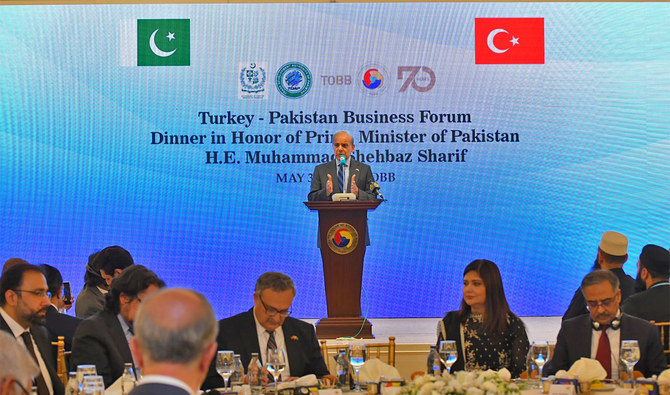
ISLAMABAD: Pakistan’s Prime Minister Shehbaz Sharif on Tuesday arrived in Turkey on a three-day official visit, where he expressed his resolve to take bilateral trade between the two countries to $5 billion annually.
Sharif was warmly received by Turkish Defense Minister Hulusi Akar and senior government and diplomatic staff at the Ankara Esenboga Airport, where a Turkish Army contingent presented a salute to him on his maiden visit to the transcontinental nation since assuming office on April 11.
Shortly after reaching Ankara, the Pakistan premier addressed the Pakistan-Turkey Business Council Forum and assured the attendees he would do everything in his power to achieve the trade target.
“Let us break these barriers, let us remove all hurdles to promote our investment and our trade between the two countries. Whatever [needs] to be done, let’s do it and do it speedily. Time and tide wait for none,” PM Sharif said.
“Let’s resolve today a figure of 5 billion dollars’ trade, two-way. In next three years, if we could take our bilateral trade to 5 billion dollars [annually], I will be a satisfied Pakistani and I will be the happiest person to achieve this target. I guarantee from our side that whatever is needed to achieve this target, I will be there doing everything in my capacity.”
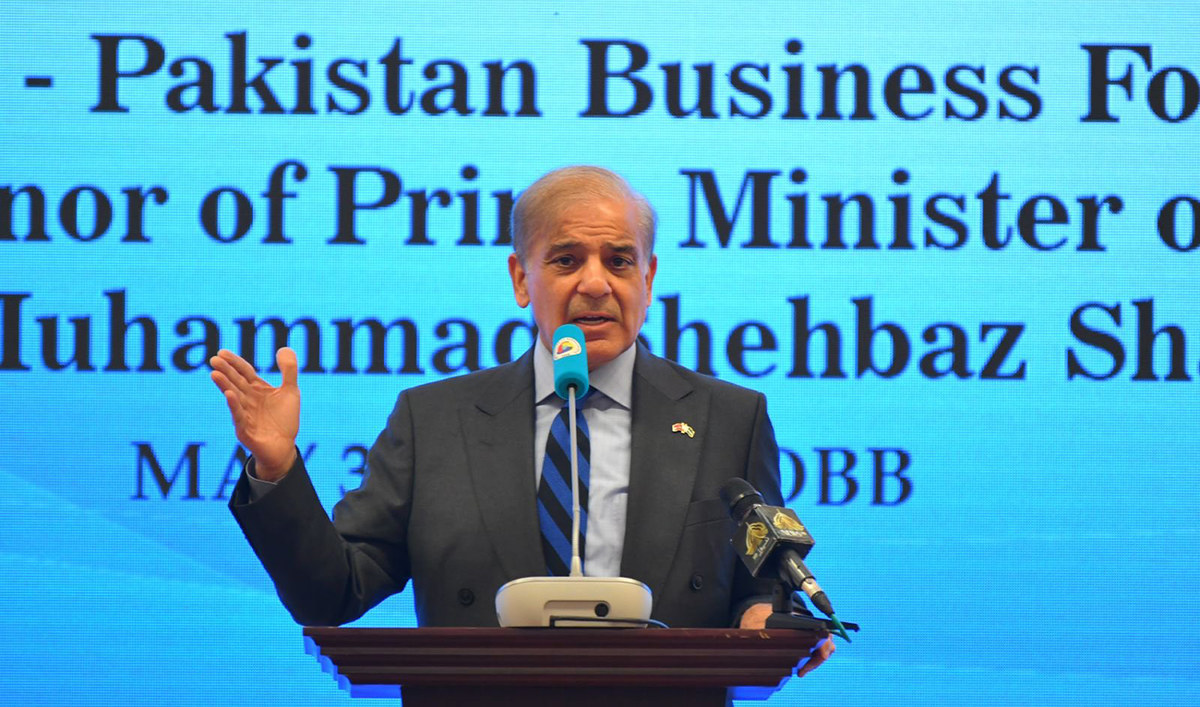
Pakistan premier Shehbaz Sharif addresses the Pakistan-Turkey Business Council Forum in Ankara, Turkey, on May 31, 2022. (PID)
Before leaving for Turkey, Sharif told a Turkish state-run news agency the quantum of bilateral trade between Pakistan and Turkey did not reflect the strength of their relations, pointing out the two countries needed to explore more opportunities for economic collaboration.
“The current level of bilateral trade is still not a true reflection of the excellent state of our relationship. This is also an area where immense opportunities exist for both countries,” Sharif told Anadolu Agency.
“With a population of over 220 million, Pakistan offers its investors a strong and large consumer market with an ever-expanding middle class. Pakistan holds numerous investment opportunities with lucrative returns for investors.”
The prime minister noted that Pakistan and Turkey had always supported “each other on all issues of core national interest.” President Recep Tayyip Erdogan was also the first world leader to call Sharif on April 11 to congratulate him on becoming the new prime minister of Pakistan.
During his visit, PM Sharif will have a tete-a-tete with President Erdogan, which will be followed by the delegation-level talks. Besides discussing the Pakistan-Turkey bilateral relations, the two leaders will also exchange views on regional and international issues. They will also address a joint press stakeout after the meetings, according to the Pakistani foreign office.
As both countries are celebrating the 75th anniversary of the establishment of diplomatic relations, the two leaders will jointly unveil a logo, marking the commencement of the celebrations
The Pakistani prime minister is also accompanied by a high-level political delegation while business leaders from Pakistan and representatives of leading Pakistani companies are also traveling separately to Turkey to participate in business engagements.
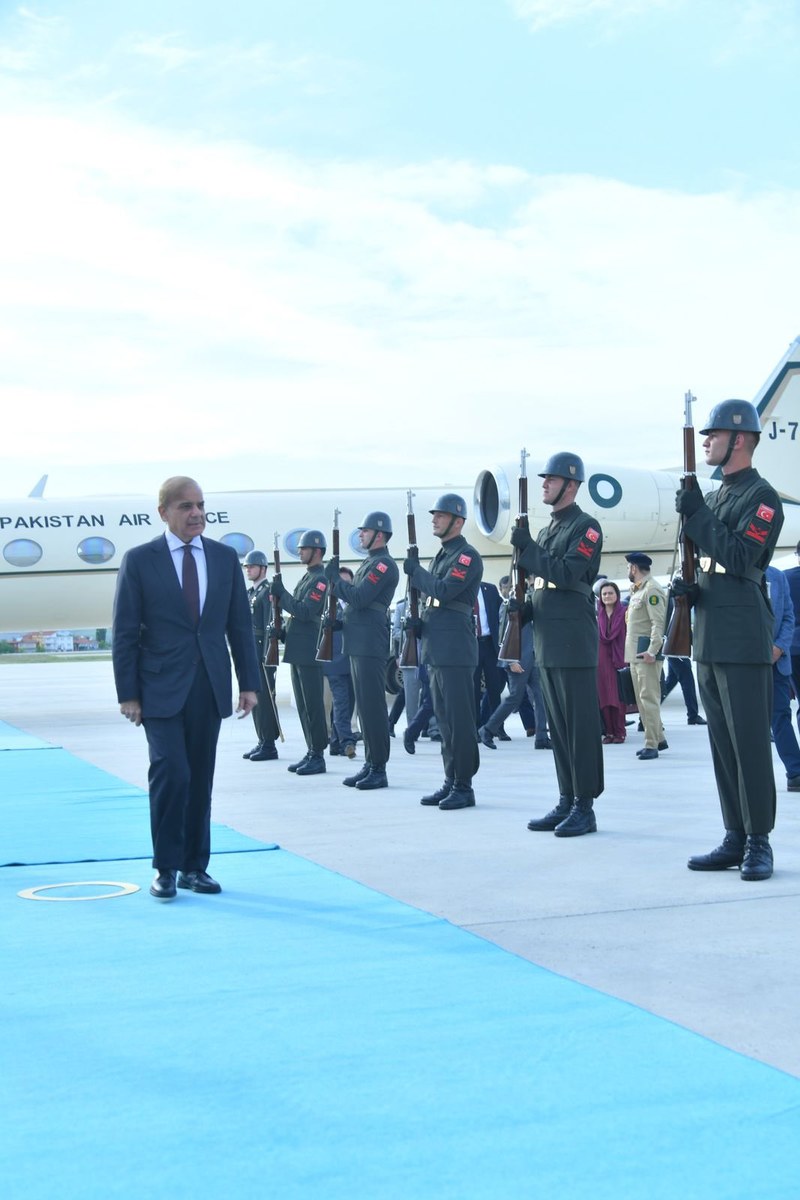
Turkish Army contingent presents a salute to Pakistan Prime Minister Shehbaz Sharif in Ankara, Turkey, on May 31, 2022. (@PakPMO/Twitter)
“The Prime Minister will have extensive interaction with leading Turkish businessmen and potential investors from diverse sectors,” the Pakistani foreign office said, adding that he would be hosted by the president of the Union of Chambers and Commodity Exchanges of Turkey (TOBB).
“The Prime Minister will also attend a Pakistan-Turkey Business Council Forum, hosted in collaboration with DEIK [Turkish Foreign Economic Relations Board],” the foreign office said.
“During these events, the Prime Minister will highlight Pakistan’s vast investment potential and encourage Turkish companies to invest in Pakistan and work to strengthen Pakistan-Turkey trade and economic ties. Prominent businessmen from Pakistan will participate in these events and will also hold B2B meetings on the sidelines.”
Turkish companies have invested more than $1 billion in different sectors in Pakistan, including construction, power, solid waste management, hygiene products, electronics and dairy.
Prominent investors include Al Bayrak, Oz Pak, Zorlu, Arcelik, Siyahkalem, Sutas, Coca-Cola Icecek, and Hayat Kimiya.


