

Most Arabs distrust media coverage on Russia’s invasion of Ukraine: Poll

There was little trust in Western media coverage of the conflict, possibly due to anti-Arab bias in some European and Western news media reports. (Shutterstock)
Short Url
Updated 15 August 2022
Follow

Most Arabs distrust media coverage on Russia’s invasion of Ukraine: Poll

  • Of the 7,835 people surveyed, 33 percent said they did not trust any media coverage of the war

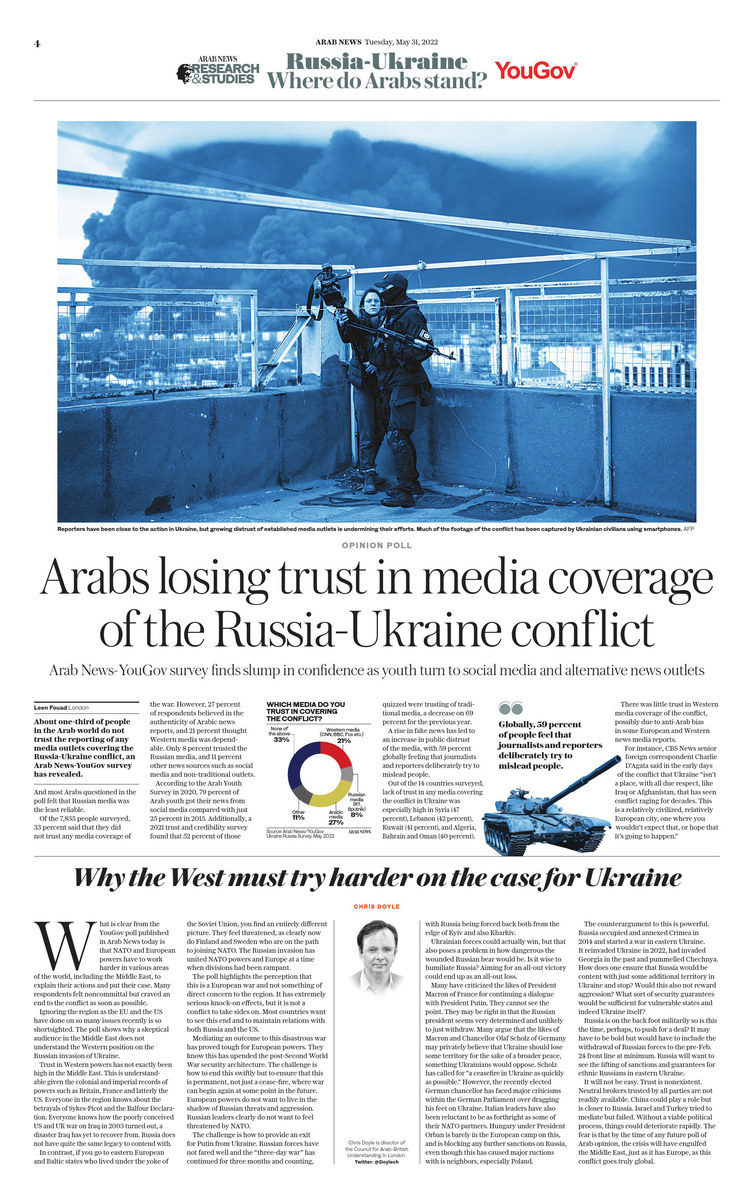
LONDON: Around one-third of people in the Arab world did not trust the reporting of any media outlets covering the Russia-Ukraine conflict, an Arab News-YouGov survey has revealed.

And most Arabs questioned for the poll felt that Russian media was the least reliable.

Of the 7,835 people surveyed, 33 percent said they did not trust any media coverage of the war. However, 27 percent of respondents believed in the authenticity of Arabic news reports, and 21 percent thought Western media was dependable. Only 8 percent trusted the Russian media, and 11 percent other news sources such as social media and non-traditional outlets.

Opinion

This section contains relevant reference points, placed in (Opinion field)

According to the Arab Youth Survey in 2020, 79 percent of Arab youth got their news from social media compared with just 25 percent in 2015. Additionally, a 2021 trust and credibility survey found that 52 percent of those quizzed were trusting of traditional media, a decrease on 69 percent for the previous year.

A rise in fake news has led to an increase in public distrust of the media, with 59 percent globally feeling that journalists and reporters deliberately tried to mislead people.

Out of the 14 countries surveyed, lack of trust in any media covering the conflict in Ukraine was especially high in Syria (47 percent), Lebanon (42 percent), Kuwait (41 percent), and Algeria, Bahrain, and Oman (all 40 percent).

There was little trust in Western media coverage of the conflict, possibly due to anti-Arab bias in some European and Western news media reports.

For instance, CBS News senior foreign correspondent Charlie D’Agata said in the early days of the conflict that Ukraine, “isn’t a place, with all due respect, like Iraq or Afghanistan, that has seen conflict raging for decades. This is a relatively civilized, relatively European city, one where you wouldn’t expect that, or hope that it’s going to happen.”


Paris exhibition marks 200 years of Le Figaro and the enduring power of the press

Updated 17 January 2026
Follow

Paris exhibition marks 200 years of Le Figaro and the enduring power of the press

  • The exhibition celebrated the bicentennial of Le Figaro, offering visitors a rare opportunity to step inside the newspaper’s vast historical archive

PARIS: One of France’s most influential newspapers marked a major milestone this month with a landmark exhibition beneath the soaring glass nave of the Grand Palais, tracing two centuries of journalism, literature and political debate.
Titled 1826–2026: 200 years of freedom, the exhibition celebrated the bicentennial of Le Figaro, offering visitors a rare opportunity to step inside the newspaper’s vast historical archive. Held over three days in mid-January, the free exhibition drew large crowds eager to explore how the title has both chronicled and shaped modern French history.
More than 300 original items were displayed, including historic front pages, photographs, illustrations and handwritten manuscripts. Together, they charted Le Figaro’s evolution from a 19th-century satirical publication into a leading national daily, reflecting eras of revolution, war, cultural change and technological disruption.
The exhibition unfolded across a series of thematic spaces, guiding visitors through defining moments in the paper’s past — from its literary golden age to its role in political debate and its transition into the digital era. Particular attention was paid to the newspaper’s long association with prominent writers and intellectuals, underscoring the close relationship between journalism and cultural life in France.
Beyond the displays, the program extended into live journalism. Public editorial meetings, panel discussions and film screenings invited audiences to engage directly with editors, writers and media figures, turning the exhibition into a forum for debate about the future of the press and freedom of expression.
Hosted at the Grand Palais, the setting itself reinforced the exhibition’s ambition: to place journalism firmly within the country’s cultural heritage. While the exhibition has now concluded, the bicentennial celebrations continue through special publications and broadcasts, reaffirming Le Figaro’s place in France’s public life — and the enduring relevance of a free and questioning press in an age of rapid change.