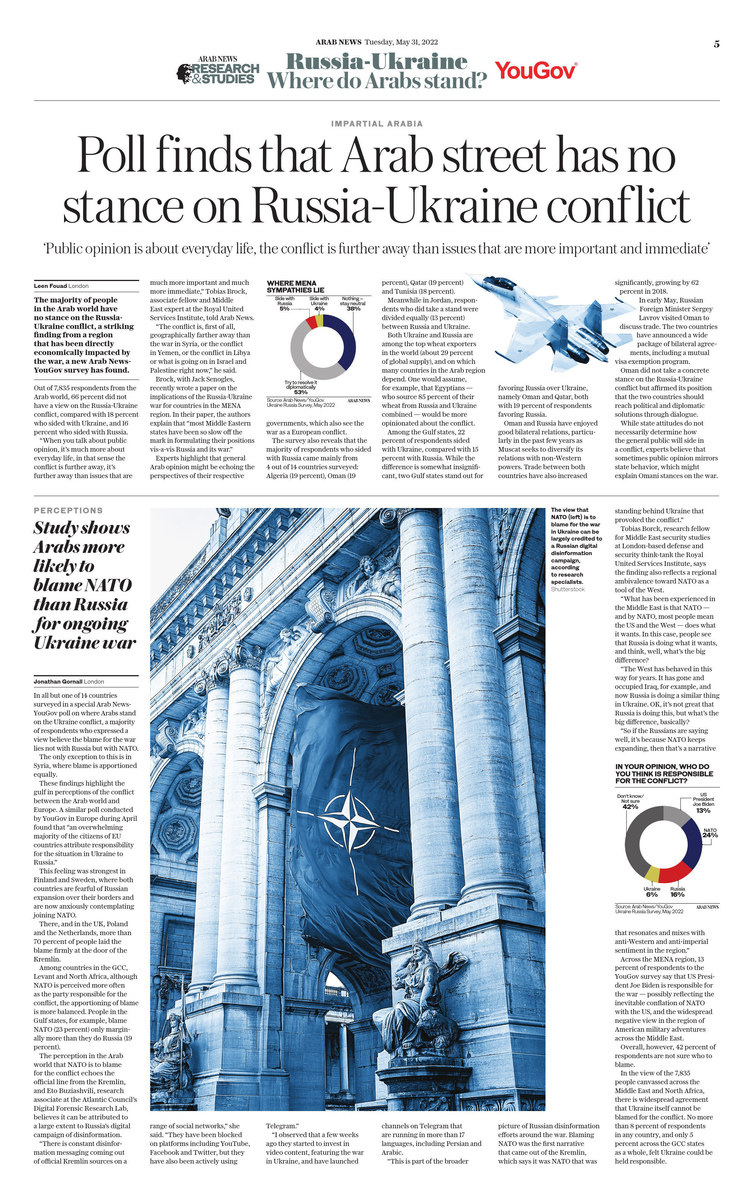

LONDON: In all but one of 14 countries surveyed in a special Arab News-YouGov poll on where Arabs stand on the Ukraine conflict, a majority of respondents who expressed a view believe the blame for the war lies not with Russia but with NATO.
The only exception to this is in Syria, where blame is apportioned equally.
These findings highlight the gulf in perceptions of the conflict between the Arab world and Europe. A similar poll conducted by YouGov in Europe during April found that “an overwhelming majority of the citizens of EU countries attribute responsibility for the situation in Ukraine to Russia.”
This feeling was strongest in Finland and Sweden, where both countries are fearful of Russian expansion over their borders and are now anxiously contemplating joining NATO.
There, and in the UK, Poland and the Netherlands, more than 70 percent of people laid the blame firmly at the door of the Kremlin.
Among countries in the GCC, Levant and North Africa, although NATO is perceived more often as the party responsible for the conflict, the apportioning of blame is more balanced. People in the Gulf states, for example, blame NATO (23 percent) only marginally more than they do Russia (19 percent).
The perception in the Arab world that NATO is to blame for the conflict echoes the official line from the Kremlin, and Eto Buziashvili, research associate at the Atlantic Council’s Digital Forensic Research Lab, believes it can be attributed to a large extent to Russia’s digital campaign of disinformation.
“There is constant disinformation messaging coming out of official Kremlin sources on a range of social networks,” she said. “They have been blocked on platforms including YouTube, Facebook and Twitter, but they have also been actively using Telegram.”
“I observed that a few weeks ago they started to invest in video content, featuring the war in Ukraine, and have launched channels on Telegram that are running in more than 17 languages, including Persian and Arabic.
“This is part of the broader picture of Russian disinformation efforts around the war. Blaming NATO was the first narrative that came out of the Kremlin, which says it was NATO that was standing behind Ukraine that provoked the conflict.”
Tobias Borck, research fellow for Middle East security studies at London-based defense and security think-tank the Royal United Services Institute, says the finding also reflects a regional ambivalence toward NATO as a tool of the West.
“What has been experienced in the Middle East is that NATO — and by NATO, most people mean the US and the West — does what it wants. In this case, people see that Russia is doing what it wants, and think, well, what’s the big difference?
“The West has behaved in this way for years. It has gone and occupied Iraq, for example, and now Russia is doing a similar thing in Ukraine. OK, it’s not great that Russia is doing this, but what’s the big difference, basically?
“So if the Russians are saying well, it’s because NATO keeps expanding, then that’s a narrative that resonates and mixes with anti-Western and anti-imperial sentiment in the region.”
Across MENA, 13 percent of respondents to the YouGov survey say that US President Joe Biden is responsible for the war — possibly reflecting the inevitable conflation of NATO with the US, and the widespread negative view in the region of American military adventures across the Middle East.
Overall, however, 42 percent of respondents aren’t sure who to blame.
In the view of the 7,835 people canvassed across the Middle East and North Africa, there is widespread agreement that Ukraine itself cannot be blamed for the conflict. No more than 8 percent of respondents in any country, and only 5 percent across the GCC states as a whole, felt Ukraine could be held responsible.