Tourism direct contribution to Saudi GDP fell 61 percent in 2020, official data showed

Short Url
Updated 01 June 2022
Follow

Tourism direct contribution to Saudi GDP fell 61 percent in 2020, official data showed

RIYADH: Travel restrictions related to the Covid-19 pandemic saw tourism’s direct contribution to Saudi Arabia's GDP decline by 61 percent from 3.8 percent in 2019 compared to 1.7 percent in 2020, according to the General Authority for Statistics.

The sector's direct contribution to the Kingdom's gross domestic product fell to SR44.4 billion ($11.84 billion) in 2020 from SR114.2 billion in 2019.

The "direct contribution to GDP" indicator refers to the sum of the portion of the gross value added generated by all industries at basic prices in response to domestic tourism consumption plus the amount of net taxes on products and imports included in the value of this spending at purchase prices", according to a methodology note from GASTAT.

The direct gross value added, also known as GVA, generated by tourism activities such as visitor accommodation, food and beverages catering, passenger transport, travel agencies and the like fell to SR27.8 billion in 2020 from SR57.2 billion in 2019.
The GVA generated by other tourism-related activities fell to SR14 billion from SR53.2 billion. 

The value of net taxes also declined to SR2.62 billion from SR3.73 billion in 2019.

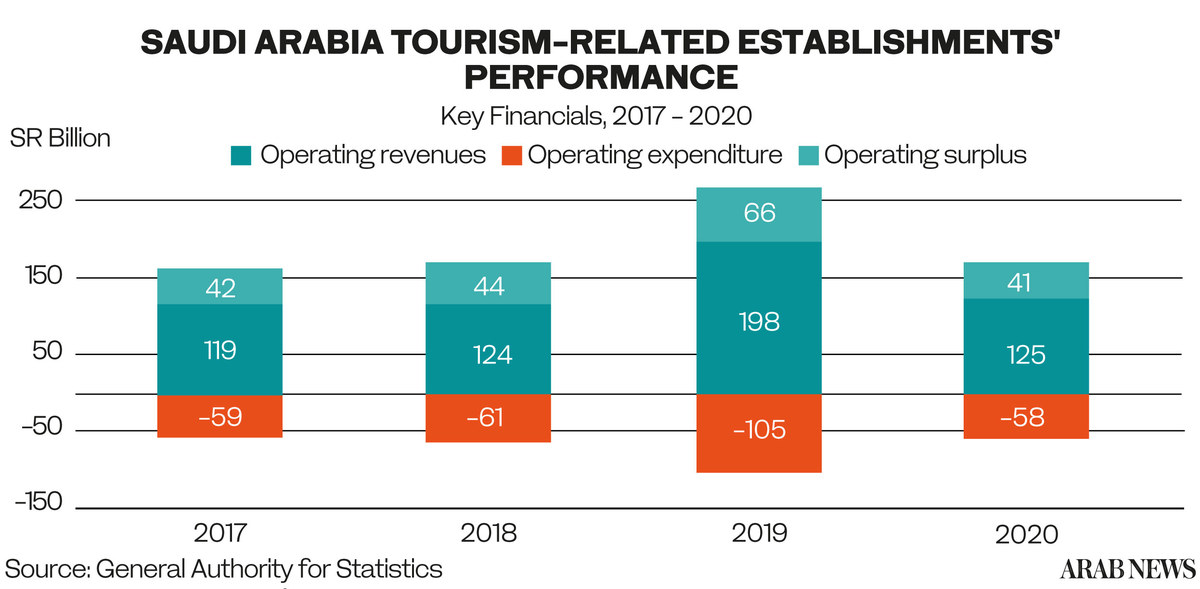
Over the same period, the total operating revenues of tourism-related establishments at a basic price fell 37 percent to SR124.9 billion.

Operating revenues in the services related to passenger air transportation declined almost 60 percent, and those for visitor accommodation fell 51 percent.

The food and beverage catering activities were hit relatively less hard — a decline of 20.4 percent compared to 2019.

It's worth mentioning 2019 saw a surge in total operating revenues of the tourism-related establishments which grew to SR197.9 billion from SR124.1 billion in 2018, according to previous GASTAT reports.


School, hotel outlays keep Saudi POS weekly spending above $3bn: SAMA

Updated 13 sec ago
Follow

School, hotel outlays keep Saudi POS weekly spending above $3bn: SAMA

RIYADH: Spending on education in Saudi Arabia increased by 4.3 percent for the week ending Jan. 10, while hotel outlays saw a 0.9 percent increase, aiding the total weekly spending to stay above $3 billion.

According to the latest data from the Saudi Central Bank, the overall point-of-sale value dropped 16.6 percent to SR14.2 billion ($3.79 billion) with transactions representing a 7.3 percent week-on-week decrease to 236.7 million.

This week saw negative changes across all the remaining sectors.

Spending in the freight transport, postal, and courier services sector saw the biggest decrease at 35.9 percent to SR47.60 million, followed by telecommunications, which posted a 26.2 percent drop to SR188.42 million.

Expenditure on apparel and clothing saw a fall of 19.3 percent to SR1.3 billion, followed by an 18.3 percent decrease in spending on books and stationery. Jewelry outlays saw a 22.3 percent decrease to reach SR422.54 million.

Spending on car rentals in Saudi Arabia fell by 14.2 percent, while airlines saw a 6.3 percent decrease to SR48.04 million.

Expenditure on food and beverages saw a 23.6 percent decrease to SR2.07 billion, claiming the largest share of the POS. Restaurants and cafes retained the second position despite a 7.3 percent dip to SR1.76 billion.

The Kingdom’s key urban centers mirrored the national decline. Riyadh, which accounted for the largest share of total POS spending, saw a 13.6 percent dip to SR4.85 billion, down from SR5.61 billion the previous week.

The number of transactions in the capital settled at 74.78 million, down 6.1 percent week on week.

In Jeddah, transaction values decreased by 9.5 percent to SR2.02 billion, while Dammam reported a 15 percent decrease to SR707.12 million.

POS data, tracked weekly by SAMA, provides an indicator of consumer spending trends and the ongoing growth of digital payments in the Kingdom. 

The data also highlights the expanding reach of POS infrastructure, extending beyond major retail hubs to smaller cities and service sectors, supporting broader digital inclusion initiatives. 

The growth of digital payment technologies aligns with Saudi Arabia’s Vision 2030 objectives, promoting electronic transactions and contributing to the Kingdom’s broader digital economy.