Pakistan government sets up committee to form policy on ‘enforced disappearances’

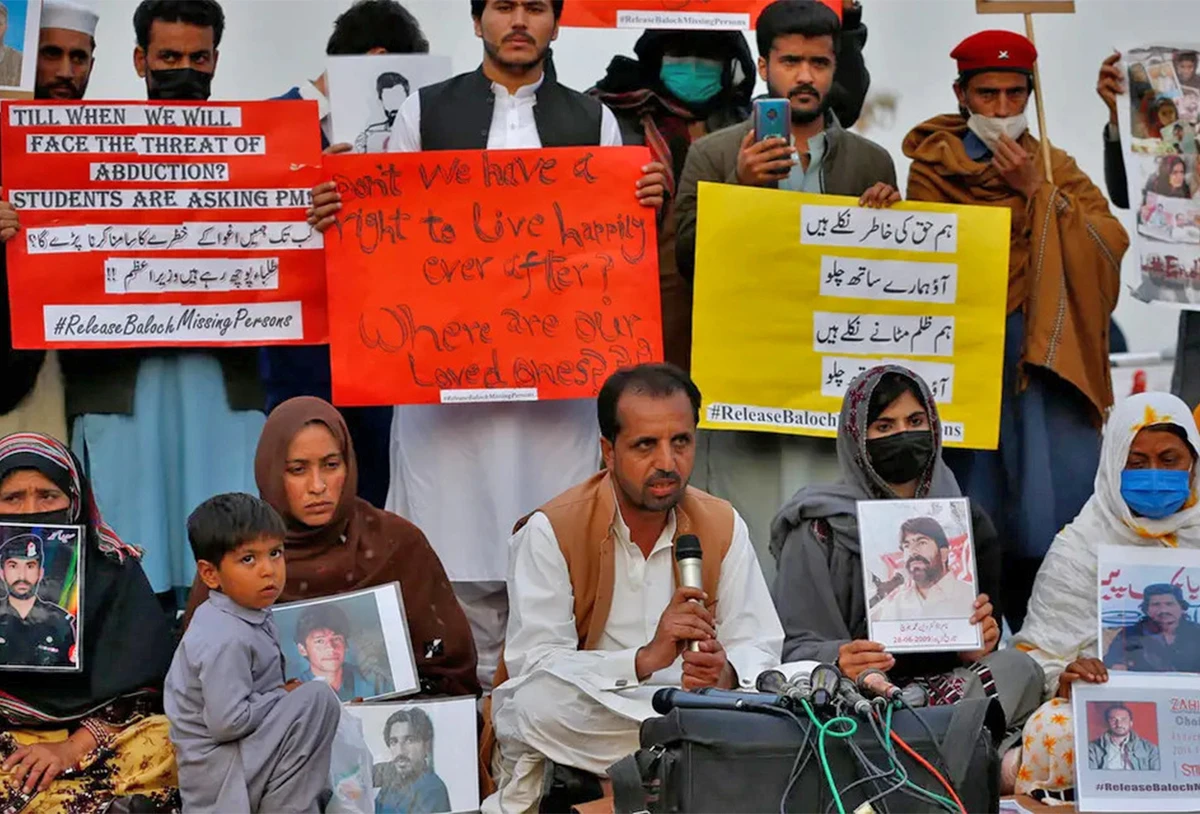
Nasrullah Baloch, center bottom, leader of the Voice of Baluch Missing Persons, speaks while people hold placards and portraits of their missing family members during a press conference in Islamabad on February 20, 2021. (AP/FIle)
Short Url
Updated 30 May 2022
Follow

Pakistan government sets up committee to form policy on ‘enforced disappearances’

  • Islamabad High Court last week said Pakistani rulers, past and present, needed to explain ‘tacit approval’ of enforced disappearances
  • Enforced disappearances once more in spotlight as Islamabad High Court hears case of missing journalist Mudassar Mahmood Naru

ISLAMABAD: The federal government on Monday announced it was setting up a seven-member committee to make policy on the issue of “enforced disappearances,” a day after the Islamabad High Court (IHC) said Pakistani rulers, past and present, needed to explain their alleged “tacit approval” of a policy of missing people. 

Pakistan, where militants have waged war against the state for decades, has long been plagued by enforced disappearances. Families say people are picked up by security forces, disappear often for years, and are sometimes found dead, with no official explanation. The Pakistan military has long denied it is involved in enforced disappearances.

In a rare statement on the matter issued in 2019, the army said it sympathized with families of missing Balochs, while saying that some may have joined militant groups and “not every person missing is attributable to the state.”

On Sunday, the IHC gave a 15-page order saying military ruler General Pervez Musharraf as well as successive prime ministers, including the incumbent PM, needed to submit “affidavits explaining why the court may not order proceedings against them for alleged subversion of the Constitution in the context of undeclared tacit approval of the policy regarding enforced disappearances.”

In response, the interior minister announced on Twitter:

“Formation of committee on missing persons issue, notification issued by Interior Ministry.”

The committee will be chaired by law minister Azam Nazeer Tarar.

Though a common phenomenon in Pakistan since it joined the United States war on terror in 2001, enforced disappearances are once more in the spotlight as the Islamabad High Court hears the case of journalist Mudassar Mahmood Naru, who went missing in 2018 during a family vacation in the northwestern Khyber Pakhtunkhwa province.

“Pervez Musharraf has candidly conceded in his autobiography In the Line of Fire that ‘enforced disappearances’ was an undeclared policy of the state,” Sunday’s IHC order said. “The onus is on each chief executive to rebut the presumption and to explain why they may not be tried for the offense of high treason.”

In 2011, on the orders of the Supreme Court, the Ministry of Interior set up the Commission of
Inquiry on Enforced Disappearances (COIED), with a mandate to trace the location of a ‘disappeared’ person, find out who was responsible (whether state, individual or institution), ensure an FIR was registered and recommend standard operating procedures to law enforcement and intelligence agencies.

According to the COIED’s monthly report for September 2021, it had received 8,122 cases since its inception, of which 2,274 remained unresolved. In September 2021, the Commission disposed of 27 cases, where 24 people had been traced, 13 returned home, six were found in internment centers, five were in jail and three were deemed to not be cases of enforced disappearances.



Traders say Karachi plaza fire caused $54 million losses as search for bodies continues

Updated 6 sec ago
Follow

Traders say Karachi plaza fire caused $54 million losses as search for bodies continues

  • Authorities say at least 67 people died in January 17 blaze at Gul Plaza complex
  • Recovery teams search unstable debris, Sindh government announces compensation

ISLAMABAD/KARACHI: A deadly fire at a major shopping plaza in Pakistan’s largest city of Karachi has caused estimated losses of up to Rs15 billion ($53.6 million), a traders representative said this week, as authorities continue rescue and recovery operations and struggle to identify dozens of victims killed in the blaze.

The fire broke out on Jan. 17 at Gul Plaza, a densely packed commercial building in the heart of Karachi and home to over 1,200 shops, trapping workers and shoppers inside and burning for more than 24 hours before being brought under control. At least 67 people have been confirmed dead, officials say, while recovery teams remain at the site amid fears of further structural collapse.

Tanveer Pasta, president of the Gul Plaza Market Association, said all shops in the plaza were destroyed, estimating total losses at up to Rs15 billion ($53.6 million).

“There were big importers sitting here,” he told Arab News on Thursday. “Just three days before this fire, 31 [shipping] containers were unloaded.”

Earlier this week, the Sindh government had announced compensation of Rs10 million ($35,720) for each person killed in the fire and said affected shopkeepers would also receive financial assistance.

Karachi Mayor Murtaza Wahab said the city administration remained focused on rescue operations and on handing over victims’ remains to their families as quickly as possible. His remarks came after he visited the homes of several victims, according to a statement from his office.

“Rescue personnel of the Karachi Metropolitan Corporation are still engaged in the rescue operation, while the administration is making every effort to hand over [remains] of the victims, loved ones to their families at the earliest,” Wahab was quoted as saying.

Identification has been significantly slowed by the condition of the bodies recovered from the site, Karachi Police Surgeon Dr. Summaiya Syed said.

Most remains were found in fragments, she said, complicating forensic identification and prolonging the process for families waiting for confirmation.

Relatives of more than a dozen missing persons have remained near the destroyed plaza and at hospitals even after providing DNA samples. Some families have criticized what they describe as the slow pace of recovery and identification.

Wahab said the provincial government had committed to supporting affected families and rehabilitating victims.

“The Sindh government would also not sit back until the victims are fully rehabilitated and that all possible support would be provided [to them],” he said.

Authorities have not yet confirmed the cause of the fire. Police have said preliminary indications point to a possible electrical short circuit, though officials stress conclusions will only be drawn after investigations are completed.

Deadly fires are a recurring problem in Karachi, a city of more than 20 million people, where overcrowded markets, aging infrastructure, illegal construction and weak enforcement of safety regulations frequently contribute to disasters. Officials say a blaze of this scale is rare.