NEW DELHI: India on Sunday withdrew a warning not to share photocopies of the national biometric identity card after the announcement caused widespread panic on social media.
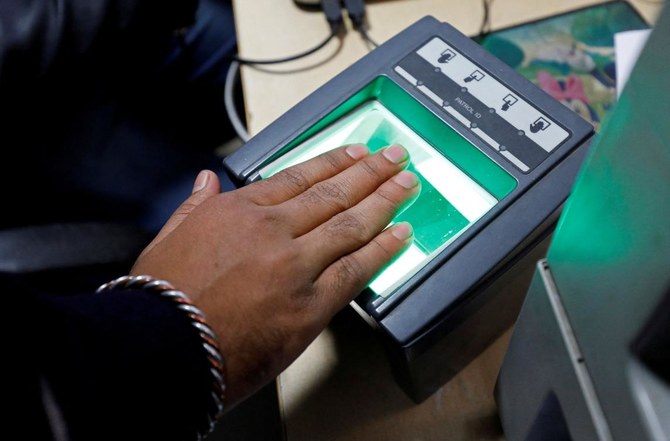
The Aadhaar card, which has a unique number tied to an individual’s fingerprints, face and eye scan, aims to block theft and leakage in India’s welfare schemes. But critics fear it could spawn a surveillance state.
The press information bureau withdrew the warning two days after issuing it, saying the release was published in the context of an attempt to misuse an edited Aadhaar card, and was being withdrawn “in view of the possibility of the misinterpretation.”
The new statement said the Aadhaar ecosystem had adequate features to protect the identity and privacy of users, and that users are only advised to exercise “normal prudence.”
The Friday announcement had advised people not to share photocopies of their Aadhaar with any organization because it could be misused. “Unlicensed private entities like hotels or film halls are not permitted to collect or keep copies of Aadhaar card,” the initial release read.
The warning triggered alarm on social media as screengrabs of the press release and news articles went viral, with the issue among the top 10 trending topics in India on Twitter on Sunday.
“I might have stayed in almost a 100 hotels who kept a copy of my Aadhar! Now this,” said Twitter user @_NairFYI.
The Unique Identification Authority of India says among its frequently asked questions, “It is near impossible to impersonate you if you use Aadhar to prove your identity.”
“People have been freely giving other identity documents. But did they stop using these documents for the fear that somebody would use them to impersonate? No!” it says.
India’s Supreme Court in 2018 upheld the validity of the Aadhaar, but flagged privacy concerns and reined in a government push to make it mandatory for everything from banking to telecom services.


![]()


India withdraws warning on national biometric ID after online panic
Short Url
https://arab.news/959kg
India withdraws warning on national biometric ID after online panic
- Aadhaar card, which has a unique number tied to an individual’s fingerprints, face and eye scan, aims to block theft and leakage in India’s welfare schemes


Japan’s Takaichi moves toward snap election after only 3 months in office
- Move an attempt to capitalize on Sanae Takaichi’s popularity to help governing party regain ground
- But it will delay a vote on a budget that aims at boosting a struggling economy and addressing soaring prices
TOKYO: Japan’s Prime Minister Sanae Takaichi dissolved the lower house of Parliament on Friday, paving the way for a Feb. 8 snap election.
The move is an attempt to capitalize on her popularity to help governing party regain ground after major losses in recent years, but will delay a vote on a budget that aims at boosting a struggling economy and addressing soaring prices.
Elected in October as Japan’s first female leader, Takaichi has been in office only three months, but she has seen strong approval ratings of about 70 percent.
Takaichi is also seeing rising animosity with China since she made pro-Taiwan remarks. And US President Donald Trump wants her to spend more on weapons as Washington and Beijing pursue military superiority in the region.
The dissolution of the 465-member lower house paves the way for a 12-day campaign that officially starts Tuesday.
Takaichi hopes to win majorities
Takaichi’s plan for an early election aims to capitalize on her popularity to expand a governing majority in the lower house, the more powerful of Japan’s two-chamber Parliament.
The scandal-tainted LDP and its coalition have a slim majority in the more powerful lower house after an election loss in 2024. The coalition does not have a majority in the upper house and relies on winning votes from opposition members to pass its agenda.
Opposition leaders criticized Takaichi for delaying passage of a budget needed to fund key economic measures.
“I believe that the only option is for the people, as sovereign citizens, to decide whether Sanae Takaichi should be prime minister,” she told a news conference Monday when announcing plans for the election. “I’m staking my career as prime minister” on it.
A hard-line conservative, Takaichi wants to highlight differences with her centrist predecessor Shigeru Ishiba.
Takaichi stresses that voters need to judge her fiscal spending moves, further military buildup and tougher immigration policies to make Japan “strong and prosperous.”
While an upbeat and decisive image has earned her strong approval ratings, especially among younger people, the LDP is not popular as it recovers from a political funds scandal. Many traditional LDP voters have shifted to emerging far-right populist opposition parties, such as the anti-globalist Sanseito.
China, Trump and corruption scandals
Meanwhile, Japan faces escalating tensions with China after Takaichi made remarks suggesting that Japan could become involved if China takes military action against Taiwan, a self-governing island that Beijing claims as its own. A furious China has increased economic and diplomatic retribution.
Takaichi wants to push further a military buildup and spending increases, while Trump has pressured Japan to spend more on defense.
The move is an attempt to capitalize on her popularity to help governing party regain ground after major losses in recent years, but will delay a vote on a budget that aims at boosting a struggling economy and addressing soaring prices.
Elected in October as Japan’s first female leader, Takaichi has been in office only three months, but she has seen strong approval ratings of about 70 percent.
Takaichi is also seeing rising animosity with China since she made pro-Taiwan remarks. And US President Donald Trump wants her to spend more on weapons as Washington and Beijing pursue military superiority in the region.
The dissolution of the 465-member lower house paves the way for a 12-day campaign that officially starts Tuesday.
Takaichi hopes to win majorities
Takaichi’s plan for an early election aims to capitalize on her popularity to expand a governing majority in the lower house, the more powerful of Japan’s two-chamber Parliament.
The scandal-tainted LDP and its coalition have a slim majority in the more powerful lower house after an election loss in 2024. The coalition does not have a majority in the upper house and relies on winning votes from opposition members to pass its agenda.
Opposition leaders criticized Takaichi for delaying passage of a budget needed to fund key economic measures.
“I believe that the only option is for the people, as sovereign citizens, to decide whether Sanae Takaichi should be prime minister,” she told a news conference Monday when announcing plans for the election. “I’m staking my career as prime minister” on it.
A hard-line conservative, Takaichi wants to highlight differences with her centrist predecessor Shigeru Ishiba.
Takaichi stresses that voters need to judge her fiscal spending moves, further military buildup and tougher immigration policies to make Japan “strong and prosperous.”
While an upbeat and decisive image has earned her strong approval ratings, especially among younger people, the LDP is not popular as it recovers from a political funds scandal. Many traditional LDP voters have shifted to emerging far-right populist opposition parties, such as the anti-globalist Sanseito.
China, Trump and corruption scandals
Meanwhile, Japan faces escalating tensions with China after Takaichi made remarks suggesting that Japan could become involved if China takes military action against Taiwan, a self-governing island that Beijing claims as its own. A furious China has increased economic and diplomatic retribution.
Takaichi wants to push further a military buildup and spending increases, while Trump has pressured Japan to spend more on defense.
Latest updates


© 2026 SAUDI RESEARCH & PUBLISHING COMPANY, All Rights Reserved And subject to Terms of Use Agreement.