SYDNEY: China’s foreign minister signed a deal with Samoa on Saturday to strengthen diplomatic relations, while Australia’s new leader said he had a “comprehensive plan” for the Pacific, as Beijing and Canberra continued rival campaigns to woo the region.
China is building on a security pact it recently signed with Solomon Islands, which has alarmed the United States and its allies such as Australia as they fear a stepped-up military presence by Beijing. Australia’s new center-left government has made the Pacific Islands an early diplomatic priority.
Prime Minister Anthony Albanese, sworn in on Monday, said on Saturday his Labor government’s plan includes a defense training school, support for maritime security, a boost in aid and re-engaging the region on climate change.
“We will be proactive in the region, we want to engage,” he told reporters.
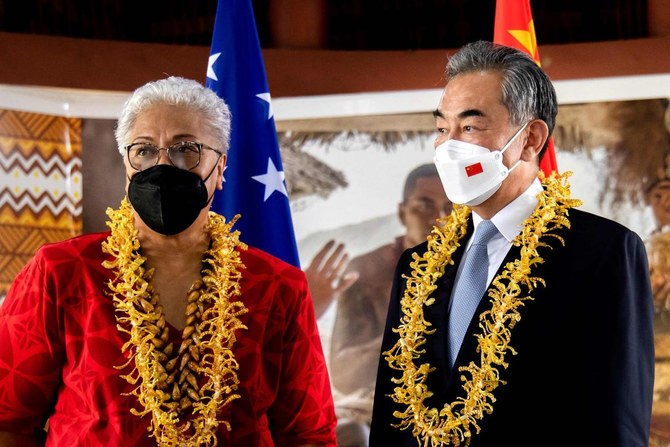
China’s Wang Yi, on a tour of the Pacific seeking a 10-nation deal on security and trade, finished a visit to Samoa, where he met Prime Minister Fiame Naomi Mataafa and signed documents including an “economic and technical cooperation agreement,” Samoa said in a statement.
“Samoa and the People’s Republic of China will continue to pursue greater collaboration that will deliver on joint interests and commitments,” it said.
Also Saturday, Fiji’s Prime Minister Frank Bainimarama said he had a “wonderful meeting” with Australia’s Penny Wong, who had visited days after taking office to show the new government’s attention to the Pacific Islands.
“Fiji is not anyone’s backyard — we are a part of a Pacific family,” Bainimarama wrote on Twitter, posting a picture of himself and Penny Wong shaking hands.
Bainimarama appeared to be taking a veiled swipe at Scott Morrison, the conservative prime minister ousted in an election last weekend, who once referred to the Pacific as Australia’s “backyard”.
Climate change, which Pacific Island nations consider an existential threat, had been a key issue in the election.
Australia’s Wong has said that Canberra will be a partner that does not come with strings attached, while China’s Wang expressed hope that Beijing’s ties with the Solomon Islands could be a regional model.
Wang was headed to Fiji, where he is expected to push for the regional deal in a meeting he is to host on Monday.

China signs deal with Samoa as Australia vows Pacific Islands plan
https://arab.news/y5mzd
China signs deal with Samoa as Australia vows Pacific Islands plan
- China is building on a security pact it recently signed with Solomon Islands
US judge blocks Trump plans to end of deportation protections for South Sudanese migrants
- Kelley issued the order after four migrants from South Sudan along with African Communities Together, a non-profit group, sued
BOSTON: A federal judge on Tuesday blocked plans by US President Donald Trump’s administration to end temporary protections from deportation that had been granted to hundreds of South Sudanese nationals living in the United States.
US District Judge Angel Kelley in Boston granted an emergency request by several South Sudanese nationals and an immigrant rights group to prevent the temporary protected status they had been granted from expiring as planned after January 5.
The ruling is a temporary victory for immigrant advocates and a setback for the Trump administration’s broader effort to curtail the humanitarian program. It is the latest in a series of legal challenges to the administration’s moves to end similar protections for nationals from several other countries, including Syria, Venezuela, Haiti and Nicaragua.
Kelley issued the order after four migrants from South Sudan along with African Communities Together, a non-profit group, sued. The lawsuit alleged that action by the US Department of Homeland Security was unlawful and would expose them to being deported to a country facing a series of humanitarian crises.
Kelley, who was appointed by Democratic former President Joe Biden, issued an administrative stay that temporarily blocks the policy pending further litigation.
She wrote that allowing it to take effect before the courts had time to consider the case’s merits “would result in an immediate impact on the South Sudanese nationals, stripping current beneficiaries of lawful status, which could imminently result in their deportation.”
Homeland Security Department spokesperson Tricia McLaughlin said in a statement that the judge’s ruling ignored Trump’s constitutional and statutory authority and that the temporary protected status extended to South Sudanese nationals “was never intended to be a de facto asylum program.”
Conflict has ravaged South Sudan since it won independence from Sudan in 2011. Fighting has persisted in much of the country since a five-year civil war that killed an estimated 400,000 people ended in 2018. The US State Department advises citizens not to travel there.
The United States began designating South Sudan for temporary protected status, or TPS, in 2011.
That status is available to people whose home countries have experienced natural disasters, armed conflicts or other extraordinary events. It provides eligible migrants with work authorization and temporary protection from deportation.
About 232 South Sudanese nationals have been beneficiaries of TPS and have found refuge in the United States, and another 73 have pending applications, according to the lawsuit.
Homeland Security Secretary Kristi Noem published a notice on November 5 terminating TPS for South Sudan, saying the country no longer met the conditions for the designation.
The lawsuit argues the agency’s action violated the statute governing the TPS program, ignored the dire humanitarian conditions that remain in South Sudan, and was motivated by discrimination against migrants who are not white in violation of the US Constitution’s Fifth Amendment.
“The singular aim of this mass deportation agenda is to remove as many Black and Brown immigrants from this country as quickly and as cruelly as possible,” Diana Konate, deputy executive director of policy and advocacy at African Communities Together, said in a statement.


