SYDNEY, Australia: China will send police officers to the Solomon Islands to help train its police force, the Pacific island nation said on Thursday, after rioting last month sparked by the country’s 2019 switch of diplomatic relations to Beijing from Taiwan.
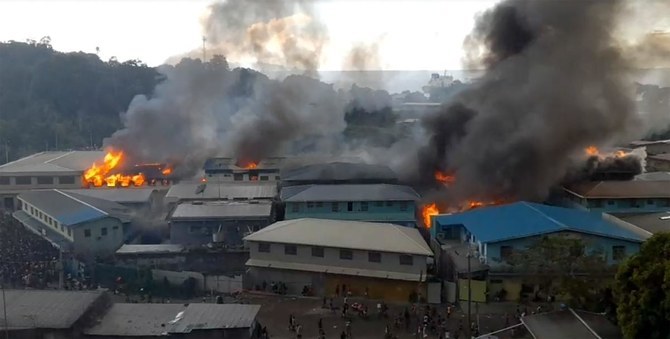
The unrest, in which dozens of buildings were burnt down, arose after the decision by Prime Minister Manasseh Sogavare to launch relations with China fueled a dispute between the national government and the most populous province, Malaita. Other domestic issues also stirred the discontent.
Six Chinese police liaison officers will equip and train the Royal Solomon Islands Police Force, a statement from the Solomon Islands government said.
The Chinese equipment includes shields, helmets, batons and “other non-lethal gears that will further enhance Solomon Islands Police ability in confronting future threats,” the statement said.
Zhao Lijian, a Chinese foreign ministry spokesman, told a regular press conference in Beijing: “China firmly supports the Solomon Islands government in safeguarding its domestic stability, bilateral ties and the rights and interests of Chinese citizens in Solomon Islands.”
Sogavare has blamed “agents of Taiwan” in Malaita province for the protests, in which dozens of buildings were torched in the Chinatown district of Honiara and shops looted, after the premier refused to speak with protesters.
Taiwan has denied any involvement in the unrest.
China claims the democratically governed island of Taiwan as its own territory and has stepped up military and diplomatic pressure to assert its sovereignty claims, fueling anger in Taipei and deep concern in the United States.
To counter China’s expanding interests in the Indo-Pacific region, Australia has ramped up its presence in the Pacific via its membership of the “Quad” group, together with the United States, India and Japan.
“We are aware of China’s expected engagement in the security sector in Honiara. This is a matter for the Solomon Islands government,” a spokesperson for Australia’s foreign affairs department said in an emailed response.
Around 200 police and soldiers from Australia, New Zealand, Fiji and Papua New Guinea arrived in the Solomons capital Honiara within days of the riots, at Sogavare’s request.
Some Australian soldiers who had been deployed in Honiara began returning home on Thursday.
Australia has a bilateral security agreement with the Solomon Islands. Australian police were previously deployed there in 2003 under a regional peacekeeping mission and stayed for a decade.


![]()

Solomon Islands taps China police advisers after riots
Short Url
https://arab.news/zwf88
Solomon Islands taps China police advisers after riots
- Six Chinese police liaison officers will equip and train the Pacific nation's police force
- PM Sogavare blamed “agents of Taiwan” of stoking the protests, in which dozens of buildings were burnt down
Latest updates



© 2026 SAUDI RESEARCH & PUBLISHING COMPANY, All Rights Reserved And subject to Terms of Use Agreement.