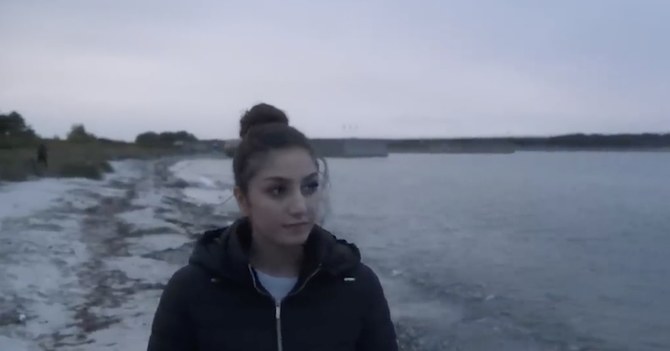

LONDON: UK newspaper The Guardian released a documentary film on Friday that tells the story of Aya Abu-Daher, a 19-year-old Syrian refugee in Denmark whose residence permit was revoked, leaving her facing deportation.
“Sending Aya Back,” directed by Michael Graversen, follows Abu-Daher’s journey to Denmark and the events that unfolded after she received her deportation notice from the Danish government.
The film is divided into nine chapters detailing some of the most notable moments in Abu-Daher’s life, including her high-school graduation, some of her TV interviews, and her appeal against the decision to revoke her residence permit.
Abu-Daher arrived in Denmark in 2015 with her family after fleeing Syria’s Civil War. She enrolled in school and became fluent in Danish. She worked in restaurants every summer to earn enough money to support herself financially.
Abu-Daher’s appeal process was, eventually, successful and her residency was extended for an additional two years on the grounds that her public profile would put her at risk of reprisal from Syrian President Bashar Assad’s regime.
However, Abu-Daher believes that her asylum was granted mainly as a result of the widespread media coverage her case received.
In Denmark’s last election, in 2019, the victorious Social Democrats, headed by Mette Frederiksen, adopted a restrictive line on immigration. Since then, 189 Syrians have had their residence permits revoked after Copenhagen decided to re-examine the cases of around 500 people from Damascus.
Following the decision to revoke residence permits for Syrian refugees, Denmark faced heavy criticism from the international community for its tough stance. The country now has one of the most restrictive immigration policies in Europe.
Russia’s invasion of Ukraine three months ago exposed Europe’s double standards when it comes to refugees. The vast majority of European countries welcomed Ukrainian refugees with open arms — or, at least, open borders — in stark contrast to the prevailing attitudes of European governments towards migrants from outside of Europe.
According to the United Nations High Commissioner for Refugees, Poland has taken in more than 3.3 million refugees from Ukraine since late February, with more than 900,000 refugees going to Romania, around 600,000 to Hungary, 460,000 to Moldova and 420,000 to Slovakia.
Migrants and refugees from elsewhere trying to enter Europe, however, are still struggling to access essential services, often face discrimination and abuse, and, for many, attempts to seek sanctuary in Europe prove fatal. More than 23,000 migrants have died or disappeared since 2014 trying to reach Europe by sea, according to the International Organization for Migration.
Media outlets in the West have also faced criticism for double standards in their coverage of Ukrainian refugees.
During an interview on the BBC, the former Ukrainian deputy chief prosecutor David Sakvarelidze said the war was “very emotional for me, because I see European people with blue eyes and blond hair being killed.”
On Al-Jazeera English, presenter Peter Dobbie made various inappropriate comments describing Ukrainians fleeing the war as “prosperous, middle-class people” who “are not obviously refugees trying to get away from areas in the Middle East that are still in a big state of war.”