

Pakistani FM meets Saudi counterpart, GCC general secretary on WEF sidelines

Pakistani Foreign Minister Bilawal Bhutto Zardari (L) meets his Saudi counterpart Prince Faisal bin Farhan Al Saud on the sidelines of the World Economic Forum in Davos, May 25, 2022. (APP)
Short Url
Updated 25 May 2022
Follow

Pakistani FM meets Saudi counterpart, GCC general secretary on WEF sidelines

  • WEF returned to Davos on Monday this week with multiple threats to the global economy topping the agenda
  • World leaders flagged risk of worldwide recession, conflict in Ukraine, global oil supply crunch and climate change

ISLAMABAD: Pakistani Foreign Minister Bilawal Bhutto Zardari on Wednesday held separate meetings with his Saudi counterpart as well as the secretary-general of the Gulf Cooperation Council on the sidelines of the World Economic Forum (WEF) in Davos.

The World Economic Forum returned to Davos on Monday this week with multiple threats to the global economy topping the worries of the world’s well-heeled, with leaders flagging the risk of a worldwide recession, the conflict in Ukraine, a global oil supply crunch, and climate change.

“Bhutto Zardari met with His Highness Prince Faisal bin Farhan Al Saud, Foreign Minister of the Kingdom of Saudi Arabia on the sidelines of the World Economic Forum (WEF) in Davos, today,” the foreign office said in a statement.

“The Foreign Minister paid tribute to the Custodian of the Two Holy Mosques His Majesty King Salman bin Abdulaziz and His Royal Highness Crown Prince Mohammad bin Salman for achieving new heights of progress and development of the Kingdom under their visionary leadership.”
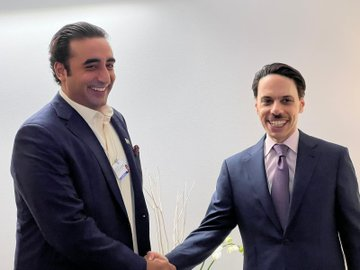


Pakistani Foreign Minister Bilawal Bhutto Zardari (L) meets his Saudi counterpart Prince Faisal bin Farhan Al Saud on the sidelines of the World Economic Forum in Davos, May 25, 2022. (APP)

 The two ministers expressed satisfaction over their “excellent bilateral partnership” and resolved to strengthen it. They also discussed regional and global issues.

The foreign minister also separately met Dr. Nayef Falah M. Al-Hajjraf, the secretary-general of the Gulf Cooperation Council (GCC), on the sidelines of the WEF.

“The Foreign Minister and the Secretary-General reviewed the status of Pakistan’s cooperation with GCC and its member states,” the foreign office said.

“The Foreign Minister and the Secretary-General agreed to explore further avenues for enhancing bilateral trade and economic ties between Pakistan and the GCC as well as to strengthen institutional linkages, in line with the Joint Action Plan for Strategic Dialogue,” the statement said. “On Pakistan-GCC Free Trade Agreement (FTA), the two sides expressed determination to conclude the negotiations at the earliest possible.”


Pakistan’s Senate passes bill to regulate virtual assets, protect investors

Updated 5 sec ago
Follow

Pakistan’s Senate passes bill to regulate virtual assets, protect investors

  • PVARA chairman terms the approval of bill a ‘defining moment’ for Pakistan’s digital economy
  • Senator says Pakistan will soon be trading major crypto coins such as Bitcoin, Ethereum, XRP

ISLAMABAD: The Senate, the upper house of Pakistan parliament, has passed the Virtual Assets Bill 2026 that paves the way for regulation and supervision of the digital assets sector to protect investors, the Pakistan Virtual Assets Regulatory Authority (PVARA) said on Friday. 

Pakistan has in recent months stepped up efforts to draft rules for regulating the fast-expanding market for digital coins and tokens, requiring virtual asset service providers to secure government approval. Islamabad’s move to embrace digital currency marks a significant policy shift as it had banned cryptocurrency in 2018, citing financial risks.

PVARA will oversee the registration and licensing of virtual asset exchanges, custodians and other service providers, according to the bill. It will set conduct of business requirements, enforce customer protection safeguards and implement measures to combat money-laundering and financial crime.

“The passage of this bill through the Senate represents a defining moment for Pakistan’s digital economy,” PVARA quoted its Chairman Bilal bin Saqib as saying. “We are transforming years of unregulated activity into a transparent, secure, and investor-friendly ecosystem that positions Pakistan as a credible jurisdiction for virtual assets.”

The legislation introduces regulatory provisions, including mandatory licensing for virtual asset service providers, market surveillance mechanisms, anti-money laundering and counter-terrorism financing compliance, and coordination with Pakistani financial regulators, including the State Bank of Pakistan and the Securities and Exchange Commission of Pakistan.

The bill establishes a formal legal framework empowering PVARA to oversee virtual asset service providers and seeks to enhance market transparency by aligning the country’s digital asset regime with international standards. It will now be sent to the National Assembly, lower house of parliament, for approval before being submitted to President Asif Ali Zardari for its enactment into law.

Pakistan ranks among the world’s largest cryptocurrency markets by adoption, with millions of citizens actively engaged in virtual assets. PVARA said the Virtual Assets Bill 2026 provides a legal foundation to channel this organic growth into a regulated framework.

On Wednesday, Dr. Afnanullah Khan, a Pakistani senator from the ruling party, said major crypto coins such as Bitcoin, Ethereum and XRP will soon be traded in Pakistan through crypto exchanges.

Last week, Pakistan launched a crypto testing framework called the “regulatory sandbox” to regulate digital assets, allowing firms to trial new products and services under official supervision. The initiative creates a controlled environment where companies can test crypto-related services under the oversight of PVARA before full-scale approval.

In January, Pakistan signed a memorandum of understanding with a company affiliated with World Liberty Financial, a crypto-based finance platform launched in September 2024 and linked to US President Donald Trump’s family, to explore the use of a dollar-linked Stablecoin for cross-border payments. Stablecoins are cryptocurrencies pegged to a fiat currency to maintain a stable value.