

Pakistani FM meets Saudi counterpart, GCC general secretary on WEF sidelines

Pakistani Foreign Minister Bilawal Bhutto Zardari (L) meets his Saudi counterpart Prince Faisal bin Farhan Al Saud on the sidelines of the World Economic Forum in Davos, May 25, 2022. (APP)
Short Url
Updated 25 May 2022
Follow

Pakistani FM meets Saudi counterpart, GCC general secretary on WEF sidelines

  • WEF returned to Davos on Monday this week with multiple threats to the global economy topping the agenda
  • World leaders flagged risk of worldwide recession, conflict in Ukraine, global oil supply crunch and climate change

ISLAMABAD: Pakistani Foreign Minister Bilawal Bhutto Zardari on Wednesday held separate meetings with his Saudi counterpart as well as the secretary-general of the Gulf Cooperation Council on the sidelines of the World Economic Forum (WEF) in Davos.

The World Economic Forum returned to Davos on Monday this week with multiple threats to the global economy topping the worries of the world’s well-heeled, with leaders flagging the risk of a worldwide recession, the conflict in Ukraine, a global oil supply crunch, and climate change.

“Bhutto Zardari met with His Highness Prince Faisal bin Farhan Al Saud, Foreign Minister of the Kingdom of Saudi Arabia on the sidelines of the World Economic Forum (WEF) in Davos, today,” the foreign office said in a statement.

“The Foreign Minister paid tribute to the Custodian of the Two Holy Mosques His Majesty King Salman bin Abdulaziz and His Royal Highness Crown Prince Mohammad bin Salman for achieving new heights of progress and development of the Kingdom under their visionary leadership.”
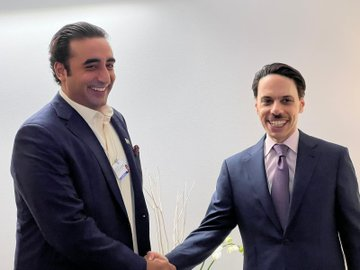


Pakistani Foreign Minister Bilawal Bhutto Zardari (L) meets his Saudi counterpart Prince Faisal bin Farhan Al Saud on the sidelines of the World Economic Forum in Davos, May 25, 2022. (APP)

 The two ministers expressed satisfaction over their “excellent bilateral partnership” and resolved to strengthen it. They also discussed regional and global issues.

The foreign minister also separately met Dr. Nayef Falah M. Al-Hajjraf, the secretary-general of the Gulf Cooperation Council (GCC), on the sidelines of the WEF.

“The Foreign Minister and the Secretary-General reviewed the status of Pakistan’s cooperation with GCC and its member states,” the foreign office said.

“The Foreign Minister and the Secretary-General agreed to explore further avenues for enhancing bilateral trade and economic ties between Pakistan and the GCC as well as to strengthen institutional linkages, in line with the Joint Action Plan for Strategic Dialogue,” the statement said. “On Pakistan-GCC Free Trade Agreement (FTA), the two sides expressed determination to conclude the negotiations at the earliest possible.”


After mosque bombing, Islamabad intensifies patrols, surveillance during Ramadan prayers, iftar

Updated 7 sec ago
Follow

After mosque bombing, Islamabad intensifies patrols, surveillance during Ramadan prayers, iftar

  • Police chief orders enhanced screening at capital city’s entry and exit points after Feb. 6 blast
  • Safe City cameras to monitor Islamabad round the clock as special pre-iftar traffic plan enforced

ISLAMABAD: Police in the federal capital have been instructed to step up patrols, surveillance and checkpoint inspections during Ramadan prayers and iftar hours, an official statement said on Wednesday, as the city’s police chief chaired a security meeting following a deadly mosque bombing earlier this month.

Inspector General of Police Syed Ali Nasir Rizvi directed senior officers to ensure “foolproof security” across the city, with special focus on mosques during peak congregational times.

The meeting comes after a suicide bombing at a mosque on the outskirts of Islamabad on Feb. 6 that killed at least 32 people. The blast targeted the Qasr-e-Khadijatul Kubra mosque and imambargah during Friday prayers and was claimed by Daesh that said one of its militants detonated an explosive vest inside the congregation.

“All officers must ensure their presence in the field and properly brief personnel about their duties,” Rizvi said, according to a statement issued by the police.

“Strict security arrangements should be ensured at mosques, imambargahs and Ramadan bazaars,” he continued. “Special patrols should be conducted during Fajr, iftar and Taraweeh hours.”

The police chief said Safe City cameras would be used for round-the-clock effective monitoring across the capital.

In addition to security measures, he reviewed traffic arrangements and directed strict implementation of a special traffic plan during pre-iftar rush hours, calling for additional deployment on major roads and at commercial centers.

Islamabad, which has generally seen fewer large-scale militant attacks than some other parts of Pakistan, has faced sporadic security incidents in the past, prompting authorities to tighten monitoring during religious gatherings and other high-risk events.
