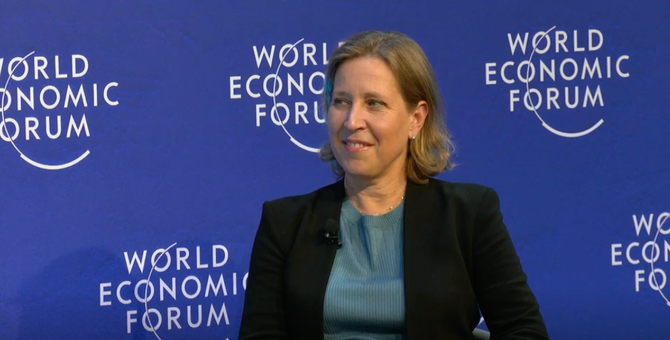
DAVOS: “During downturns is when we get better at what we do,” Susan Wojcicki, CEO of YouTube, told the audience at the World Economic Forum in Davos earlier today.
Seventy-five percent of Fortune 500 CEOs expect the next recession to begin by the end of 2023, according to a Fortune 500 survey. Wojcicki, who was Google’s 16th employee, has lived through two recessions during her time at the company.
And although there are “concerning macros trends” such as the war in Ukraine and inflation in the US, she said with regard to Google’s and YouTube’s business: “We have always tried to take a long-term point of view and we see tremendous growth across the board.”
The war in Ukraine marks a significant moment for YouTube, which is still operating in Russia, unlike other social media platforms. “As soon as the war broke out, we realized this was an incredibly important time for us to get it right with regard to our responsibility, and we made a number of really, really tough decisions,” Wojcicki said.
The reason for YouTube continuing to operate in Russia, said Wojcicki, is the platform’s ability — and responsibility — to “deliver independent news into Russia,” so that the average Russian citizen has the same free access to information as anybody else anywhere else in the world.
Although Russia has not suspended YouTube, it has its own version of the video-sharing platform, RUTUBE. Wojcicki is not concerned about RUTUBE specifically, but she said that “video is a very competitive emerging market right now and I expect us to continue to see more players,” especially out of Asia.
TikTok’s growth story, for instance, is worth mentioning. “We definitely are seeing really strong competition coming out of China, particularly with TikTok,” Wojcicki said.
TikTok’s rise to popularity was largely fueled by its short-form content format, which enticed both viewers and creators. Although YouTube now features longer videos, it was a short-form video platform in its early days when the only other form of video was traditional TV. In fact, the first-ever video uploaded to YouTube was only 18 seconds long.
Today, YouTube is investing more and more in short-form content with the launch of YouTube Shorts. “I expect to see a lot of competition there,” said Wojcicki of short-form video platforms, adding that such content “is probably the fastest part of the market right now.”
The conversation would not have been complete without talking about misinformation. YouTube has made worthy investments and improvements in battling misinformation through new policies and frameworks. According to a study by the company, the amount of violative content that is not caught by YouTube is down to 10-12 videos per 100,000 views.
“That number has come down significantly and our plan is to continue to work on it and make sure that we continue to reduce that,” Wojcicki said.


![]()

WEF 2022: YouTube CEO discusses Russia, recession and misinformation
Short Url
https://arab.news/bp4jq
WEF 2022: YouTube CEO discusses Russia, recession and misinformation
- ‘During downturns is when we get better at what we do,’ Susan Wojcicki tells Davos audience
- Although Russia has not suspended YouTube, it has its own version of the video-sharing platform, RUTUBE


Latest updates


© 2026 SAUDI RESEARCH & PUBLISHING COMPANY, All Rights Reserved And subject to Terms of Use Agreement.