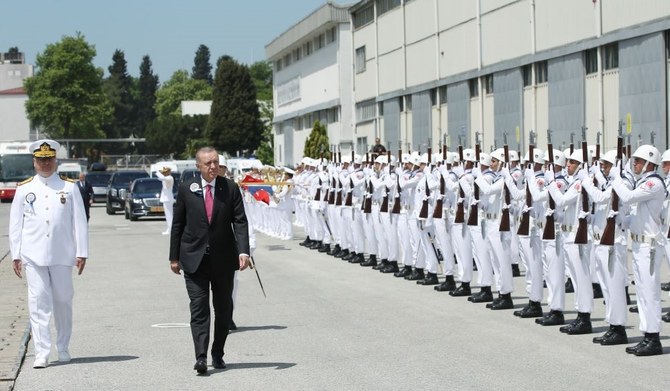

ANKARA: Turkish President Recep Tayyip Erdogan announced on Monday evening an impending military operation into northern Syria to establish a 30 km-deep safe zone along the southern border.
Turkey’s operation is expected to focus on areas where the country is targeted the most by cross-border attacks. But Erdogan did not go into further detail.
Turkish forces have launched three major incursions into northern Syria since 2016 and took control of areas along the border against threats from Daesh and the Syrian Kurdish People’s Protection Units, or YPG, listed as a terror group by Turkey.
The withdrawal of the Syrian Kurdish forces up to 30 km into Syria was part of the Russia-Turkey deal in Sochi.
The announcement comes at a time in which Turkey is vehemently objecting to the NATO membership bids of Sweden and Finland, citing the two Scandinavian countries’ support for the terror groups and their arms embargoes following Turkey’s previous Syria operation in 2019.
Although the two countries deny any support given to the terror groups on their soil, Ankara asked Sweden and Finland for the extradition of 33 members of the Kurdistan Workers’ Party, or PKK, and an end to the ongoing military export bans to Turkey.
Turkey considers the YPG as the Syrian offshoot of the PKK.
The timing of the announcement, therefore, stirred debate about whether it would be part of a grand bargain between Turkey and the Western alliance to decrease its support for the Syrian Kurdish militants in exchange for Ankara lessening its pressure on the enlargement goals of the organization.
Noah Ringler, an expert from Georgetown University, thinks the northwestern Syrian city of Tal Rifaat is the most likely target of the operation, while Kobane or Manbij is the next most likely option.
“I believe Erdogan still seeks a broader deal with US President Joe Biden on NATO enlargement and the purchase of American-made F-16s and would not like to confront US forces further east near Al-Malikiyah,” he told Arab News.
An operation in Tal Rifaat, situated halfway between Aleppo and the Turkish border, has been on the agenda for years as the YPG seized control in the region. The city houses Kurds who fled Afrin when Turkey carried out an operation there in 2018 to root the YPG out.
Ankara, however, perceives a threat coming from the Tal Rifaat area, which is believed to be used by Kurdish forces to conduct cross-border attacks on Turkey.
There have been several fire exchanges between Turkish forces and Syrian Kurdish militants for a couple of months.
As Tal Rifaat is home to many refugees living in Kilis and Azaz and has limited Russian and Iranian presence, Ringler said that Russia is likely willing to let Turkey attack within certain areas with some pre-conditions, like ensuring the lack of Turkish sanctions on Russian goods and services.
“Russia may also ask Turkey to put pressure on the PYD (Kurdish Democratic Union Party) to return them to the table with Syrian President Bashar Assad, as talks have stalled,” he added.
Experts also note that any such operation could take advantage of Russia’s preoccupation with the invasion of Ukraine and US commitments to defend Taiwan against China.
According to Ringler, Turkey’s drone strikes on the YPG in northeastern Syria have always been satisficing, as elections in Turkey draw near.
“Erdogan considers taking new steps as vital to distract the attention from domestic issues and divide the opposition over Kurdish and Syrian issues,” he said.
The details of the operation and the decision to launch it will however be discussed during Turkey’s National Security Council meeting on Thursday.
Whether the operation has or will have the green light from Russia and US is still unclear.
“Turkish Armed Forces have the capacity to attack all of the above areas, but for political reasons it is likely the best for Erdogan to do sequential operations, threatening additional action closer to next year’s elections and in order to gain concessions from the US, Iran, Russia and the YPG,” said Ringler.
He added: “I think Assad’s forces will fight back like in February 2020, and the extent of Russian air support will be a key indicator of the extent to which Turkey is coordinating with Russia. Assad’s forces are unlikely to give up positions without trying to impose costs on Turkish-backed Syrian armed groups and the Turkish Armed Forces for their presence in Syria.”
According to Ringler, US Congressional elections will also play a role in negotiations with the US, as presidential powers do not allow Biden to lift some of the existing sanctions and Congress remains committed to arms sanctions on Turkey related to its S-400 Russian missile defense purchase and Operation Peace Spring into Syria.
Currently hosting about 3.7 million refugees from Syria whose presence in the country has increasingly become a hot topic among several opposition parties pledging their immediate repatriation, Ankara has been discussing their resettlement to briquette houses in safe areas along the border.
The Turkish government is also worried that public anger over the refugees’ widespread presence will dominate the upcoming election round and influence electoral preferences.
The latest official figures revealed that 400-500 people are returning each week to the safe zones on the Turkey-Syria border. Since 2016, around half a million Syrians have returned to those zones, which are controlled by Ankara-backed groups.
“The regions they returned to are Jarablus, A’zaz, Marea, Al-Bab, Ras Al-Ayn, and Tal Abyad. These are all safe regions in Syria that we have created,” Turkey’s Interior Minister Suleyman Soylu recently said.
However, the Syrian government considers the presence of safe zones as a kind of “colonialism” and “ethnic cleansing.” Syria’s Ministry of Foreign Affairs recently urged the international community to stop Ankara from proceeding with its plans for building houses and local infrastructure in safe zones to send 1 million refugees back to their country.
Caroline Rose, a senior analyst at the New Lines Institute, thinks that the recently announced Turkish military operation in northern Syria is certainly a tactic Ankara has employed to test Russia in Syria amid its intervention in Ukraine.
“It is also a message Turkey is wishing to send following its opposition to Swedish and Finnish membership in NATO due to grievances related to the PKK, as well as to take advantage of Russian distraction in Ukraine to alter the status quo in Syria and deepen its footprint in the northeast,” she told Arab News.
Rose, however, does not think the US will offer any public or private green light for this operation, nor will Russia publicly support it.
The Syrian Democratic Forces, in a statement on Tuesday, accused Turkey of “destabilizing the region.”
Navvar Saban, a military analyst at the Omran Center for Strategic Studies in Istanbul, believes there is always an opportunity for Turkey to launch a tactic operation targeting a specific area.
“The most reasonable targets would be Tal Rifaat and Manbij. I don’t expect any operation on the eastern side of Syria. Turkey should concentrate its efforts and forces on controlling the strategic points on the M4 highway in Idlib that became a de facto frontier between Turkish-controlled pockets and Kurdish forces,” he told Arab News.
Erdogan’s announcement also came a day before diplomatic delegations from Sweden and Finland landed in Ankara on Tuesday to discuss their NATO membership bid, where Turkey is expected to present some files on PKK activities during their meeting with the Turkish Presidential Spokesperson Ibrahim Kalin and Deputy Foreign Minister Sedat Onal on Wednesday.