

Pakistani chief justice featured on Time ‘100 Most Influential’ list

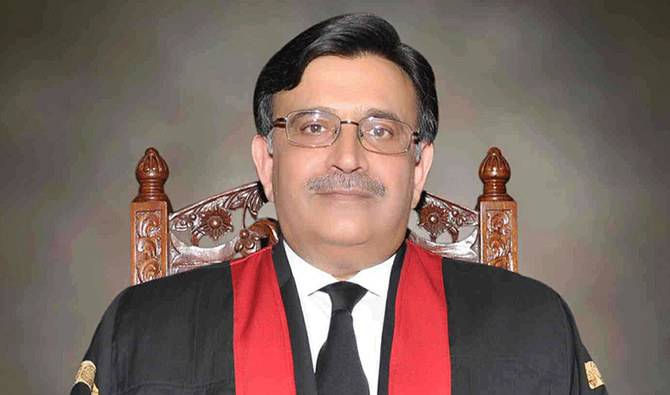
The undated photo shows Chief justice of Pakistan Umar Ata Bandial. (Photo courtesy: Lahore High Court)
Short Url
Updated 23 May 2022
Follow

Pakistani chief justice featured on Time ‘100 Most Influential’ list

  • Time write-up describes Bandial as “polite and understated,” an “antidote” to rising temperatures in country of 220 million
  • Says the Columbia- and Cambridge-­educated jurist bears heavy mantle of delivering justice and being seen to do so

ISLAMABAD: Chief justice of Pakistan Umar Ata Bandial has been listed in Time magazine’s annual 100 most influential people in the world issue for 2022. 

The list features Apple CEO Tim Cook, American talk show host and TV producer Oprah Winfrey, Ukrainian President Volodymyr Zelensky and Russian President Vladimir Putin.

The Time write-up described Bandial as “polite and understated” and an “antidote” to rising temperatures in the country of 220 million. 

“Widely respected for his personal integrity, the Columbia- and Cambridge-­educated jurist bears the heavy mantle of not just delivering justice but also being seen to do so,” Bandial’s description read. “How far he succeeds in this task may well determine the trajectory of Pakistan, and its region, for years to come.”

The write-up recalls how in early April this year the Supreme Court of Pakistan, led by Bandial, overturned now former Prime Minister Imran Khan’s move to dissolve Parliament, declaring it “unconstitutional:” 

“As other institutions lock horns in a battle for advantage ahead of impending elections, the court looms large as the final arbiter.”

Bandial is the 28th chief justice of Pakistan and assumed office in February 2022.

He has been a justice of the Supreme Court of Pakistan since June 2014. Prior to his appointment to the Supreme Court, he served as a justice of the Lahore High Court from June 1, 2012 to June 16, 2014.

Bandial will serve as the chief justice until his retirement on September 16, 2023.


Pakistan engages Saudi Arabia, China in bid to ease surging Middle East tensions 

Updated 10 March 2026
Follow

Pakistan engages Saudi Arabia, China in bid to ease surging Middle East tensions 

  • Pakistan’s foreign minister stresses need for de-escalation in conversations with Chinese, Saudi counterparts
  • Tensions in the Middle East continue to remain high as conflict between US, Israel and Iran intensifies

ISLAMABAD: Pakistan’s Deputy Prime Minister Ishaq Dar spoke to the foreign ministers of Saudi Arabia and China on Tuesday, stressing the importance of diplomatic engagement to de-escalate tensions in the Middle East as the Iran war intensifies. 

Pakistan has constantly engaged regional countries in efforts to broker a ceasefire in the Middle East, after the US and Isreal launched coordinated strikes against Iran on Feb. 28. 

Iran launched fresh attacks on Gulf countries on Tuesday morning, where it has targeted US military bases in recent weeks. In addition to firing missiles and drones at Israel and American bases in the region, Iran has also been targeting energy infrastructure which, combined with its stranglehold on the Strait of Hormuz, has sent oil prices soaring worldwide. 

Dar spoke to Saudi Foreign Minister Prince Faisal bin Farhan to discuss developments in the Middle East and ongoing deliberations at the UN Security Council, Pakistan’s foreign office said in a statement. 

“DPM/FM shared Pakistan’s perspective, underscoring the importance of continued coordination and diplomatic engagement to support de-escalation and promote peace and stability across the region and beyond,” the statement said. 

Dar, who also serves as Pakistan’s foreign minister, spoke to Chinese foreign minister Wang Yi over the telephone separately. The two discussed the evolving regional situation and broader global developments.

Dar underscored the need to ease tensions in the Middle East and the wider region during the conversation, the foreign office said. 

Yi appreciated Pakistan’s constructive efforts aimed at promoting de-escalation and stability in the region, it added. 

“The two leaders stressed the importance of de-escalation and emphasized the need to pursue dialogue and diplomacy in accordance with the principles of the UN Charter,” the foreign office’s statement said. 

The conflict in the Middle East has hit Pakistan hard as well, forcing Islamabad to hike petrol and diesel prices by Rs55 per liter last Friday. 

Pakistan’s government has also announced a set of austerity measures, which include closing schools and cutting down on government expenditures, as it evaluates petrol stocks and looks for alternative supply routes.