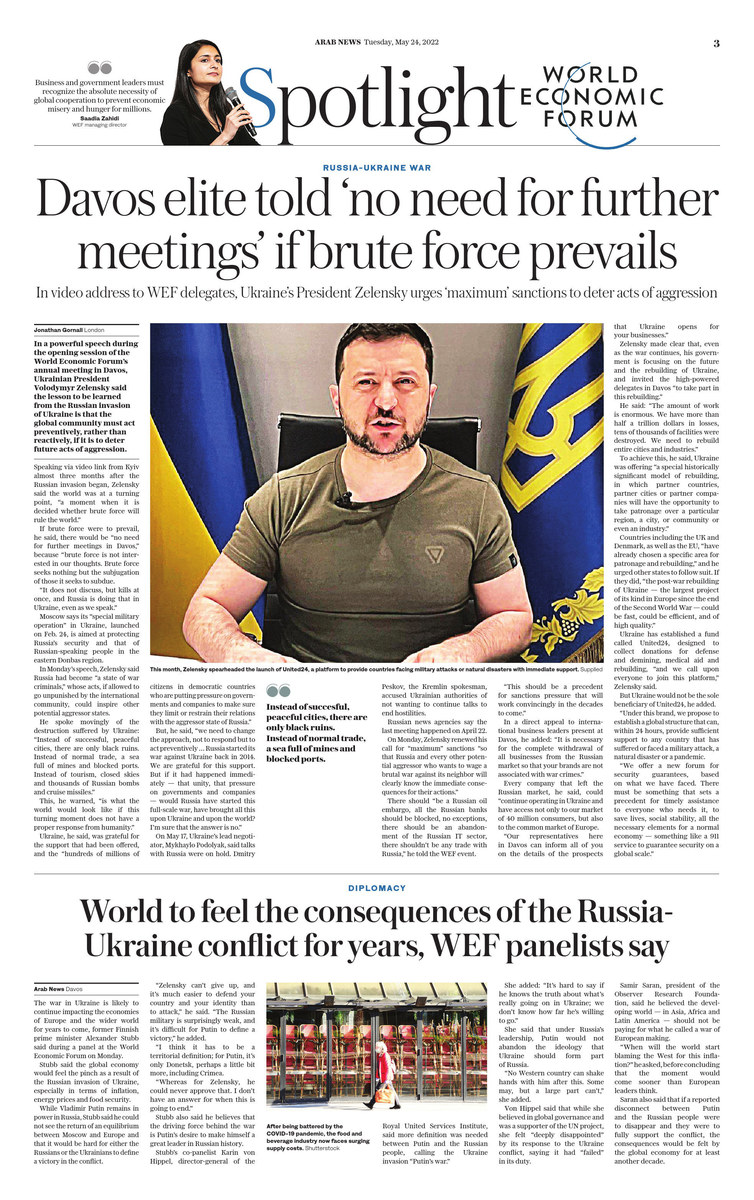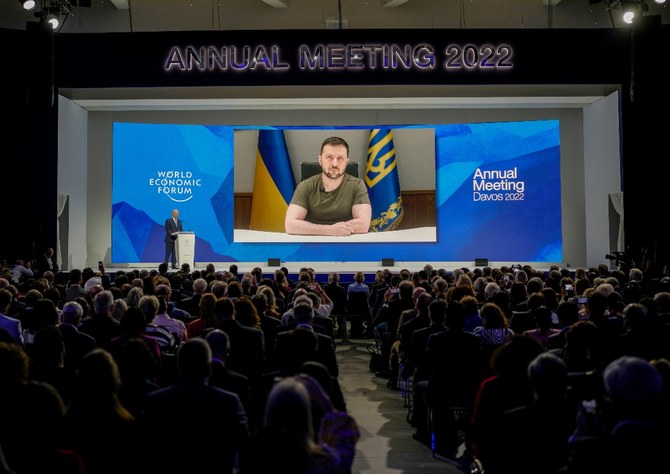

LONDON: In a powerful speech during the opening session of the World Economic Forum’s annual meeting in Davos, Ukrainian President Volodymyr Zelensky said that the lesson to be learned from the Russian invasion of Ukraine is that the global community must act preventively, rather than reactively, if it is to deter future acts of international aggression.
Speaking via video link from Kyiv almost three months after the Russian invasion began, Zelensky said that the world was at a turning point, “a moment when it is decided whether brute force will rule the world.”
If brute force were to prevail, he said, there would be “no need for further meetings in Davos,” because “brute force is not interested in our thoughts. Brute force seeks nothing but the subjugation of those it seeks to subdue.
“It does not discuss, but kills at once, and Russia is doing that in Ukraine, even as we speak.”
Moscow says its “special military operation” in Ukraine, launched on Feb. 24, is aimed at protecting Russia’s security and that of Russian-speaking people in the eastern Donbas region.
In Monday’s speech, bookended by standing ovations from Davos summit participants, Zelensky said that Russia had become “a state of war criminals,” whose acts, if allowed to go unpunished by the international community, were in danger of inspiring other potential aggressor states in future.
He spoke movingly of the chaos and destruction suffered by Ukraine: “Instead of successful, peaceful cities, there are only black ruins. Instead of normal trade, a sea full of mines and blocked ports. Instead of tourism, closed skies and thousands of Russian bombs and cruise missiles.”
This, he warned, “is what the world would look like if this turning moment does not have a proper response from humanity.”
Ukraine, he said, was grateful for the support that had been offered by so many of the world’s countries, and the “hundreds of millions of citizens in democratic countries who are putting pressure on governments and companies to make sure they limit or restrain their relations with the aggressor state of Russia.”
But, he said, “we need to change the approach, not to respond but to act preventively … Russia started its war against Ukraine back in 2014. We are grateful for this support. But if it had happened immediately — that unity, that pressure on governments and companies — would Russia have started this full-scale war, have brought all this upon Ukraine and upon the world? I’m sure that the answer is no.”
He added that the Russian war on Ukraine showed that “support to a country under attack is more valuable the sooner it is provided. Weapons, funding, political support and sanctions against Russia — if we would have received 100 percent of our needs at once, back in February, the result would have been tens of thousands of lives saved.”
On May 17, Ukraine’s lead negotiator, Mykhaylo Podolyak, said that talks with Russia were on hold. Dmitry Peskov, the Kremlin spokesman, has accused Ukrainian authorities of not wanting to continue talks to end hostilities.
Russian news agencies say the last meeting happened on April 22.
On Monday, Zelensky renewed his call for sanctions of Russia to be stepped up to “maximum, so that Russia and every other potential aggressor who wants to wage a brutal war against its neighbor will clearly know the immediate consequences for their actions.”
There should “be a Russian oil embargo, all the Russian banks should be blocked, no exceptions, there should be an abandonment of the Russian IT sector, there shouldn’t be any trade with Russia,” he told the WEF event.
“This should be a precedent for sanctions pressure that will work convincingly in the decades to come.”
In a direct appeal to the many international business leaders present at Davos, he added: “It necessary for the complete withdrawal of all businesses from the Russian market so that your brands are not associated with war crimes. This matters … when global markets are becoming destabilized.”
Every company that left the Russian market, he said, could “continue operating in Ukraine and have access not only to our market of 40 million consumers, but also to the common market of Europe.
“Our representatives here in Davos can inform all of you on the details of the prospects that Ukraine opens for your businesses.”
Zelensky made clear that, even as the war continues, his government is focusing on the future and the rebuilding of Ukraine, and he invited the high-powered delegates in Davos “to take part in this rebuilding.”
He said: “The amount of work is enormous. We have more than half a trillion dollars in losses, tens of thousands of facilities were destroyed. We need to rebuild entire cities and industries.”
To achieve this, he said, Ukraine was offering “a special historically significant model of rebuilding, in which partner countries, partner cities or partner companies will have the opportunity to take patronage over a particular region, a city, or community or even an industry.”
Countries including the UK and Denmark, as well as the EU, “have already chosen a specific area for patronage and rebuilding,” and he urged other states to follow suit. If they did, “the post-war rebuilding of Ukraine — the largest project of its kind in Europe since the end of the Second World War — could be fast, could be efficient, and of high quality.”
Ukraine has established a fund called United 24, designed to collect donations for defense and demining, medical aid and rebuilding, “and we call upon everyone to join this platform,” Zelensky said.
“For each and every donor we will have a specific proposal of how to help and where to allocate funds.”
But Ukraine would not be the sole beneficiary of United 24, he added.
“Under this brand, we propose to establish a global structure that can, within 24 hours, provide sufficient support to any country that has suffered or faced a military attack, a natural disaster or a pandemic.
“We offer a new forum for security guarantees, based on what we have faced. There must be something that sets a precedent for timely assistance to everyone who needs it, to save lives, social stability, all the necessary elements for a normal economy — something like a 911 service to guarantee security on a global scale.”