


JEDDAH: Denying that the European Union discriminates between refugees Michael Koehler, the deputy director general of the European Civil Protection and Humanitarian Aid Operations (ECHO), has claimed that Syrians were welcomed in the same way as Ukrainians and that the crimes of the Bashar Assad regime will not be forgotten.
In a wide-ranging interview with Arab News, Koehler also reiterated Europe’s commitment to supporting Palestinian humanitarian needs, stating that any cut in EU aid relates solely to financial transfers for development assistance, not humanitarian aid.
Koehler denied that Europe’s treatment of Ukrainians fleeing their country because of the war with Russia and those from the Middle East has revealed racism, double standards and hypocrisy. “The only difference that I see is that refugees from Ukraine have, on the basis of a decision of the European ministers of interior, immediately been granted work permits,” he told the host of Arab News’ “Frankly Speaking” interview show, Katie Jensen. “But apart from that, the treatment is not different from refugees from other parts of the world.”
“Frankly Speaking” features in-depth discussions with leading policymakers and business leaders, diving deep into the biggest news-making headlines across the Middle East and around the world. During his appearance on the show, Koehler spoke on a number of issues, including what the future holds for displaced Ukrainians and whether the EU plans to pull funding from Middle East crisis zones to make up for the humanitarian aid gap.
Koehler said one needs to look back at the arrival of the Syrians and Iraqis in 2015 and 2016 when slightly more comparable numbers of refugees were pouring into Europe. “The million Syrians that poured into (Germany) were very much welcomed,” he said. “It is not quite fair in a way to compare the welcome that now Ukrainians are receiving two months into the crisis, with the situation of other refugees that have been in Europe for four years, five years, six years or seven years, and where certain problems have arisen.”
“We are absolutely not yet there in the Ukraine crisis, but it’s a very general phenomenon. Structurally, this is a very well-known phenomenon,” he said, pointing to instances where the initial warm welcome given to refugees by the host population gave way to problems that “led sometimes to populist reactions.”
Still, Koehler expressed regret at comments such as those made by Bulgarian Prime Minister Kiril Petkov (“These are not the refugees we are used to, these people are Europeans, intelligent, educated people”), and the implication that countries have the right to choose refugees based on race, religion or politics.
“No, absolutely not. Absolutely not,” he said. “It is, however, of course, normal that if you are a direct neighbor of a country that is in the situation Ukraine finds itself in, then of course there is perhaps a slightly bigger emotion. There’s a slightly bigger readiness of private persons to help, but we’ve seen the same thing in other scenarios.”
Alluding to the insensitive remarks of European politicians, Koehler said: “We shouldn’t take the statements of this or that individual politician as the kind of policy line of European member states and of the EU. Politicians can voice their personal opinions, but this doesn’t mean that the legal order that settles the way refugees are welcomed, the support they receive and so forth, that this would be changed.”
Koehler disagreed with the notion that with the Ukrainian humanitarian crisis holding the spotlight, the atrocities committed by the Assad regime in Syria, where 6.2 million people remain internally displaced, have been forgotten. “No, they have not been forgotten,” he responded. “In fact, I shared via Twitter part of the ministerial meeting on Syria in the region that we are hosting here at Brussels for the sixth time. This is the annual meeting of the international community.
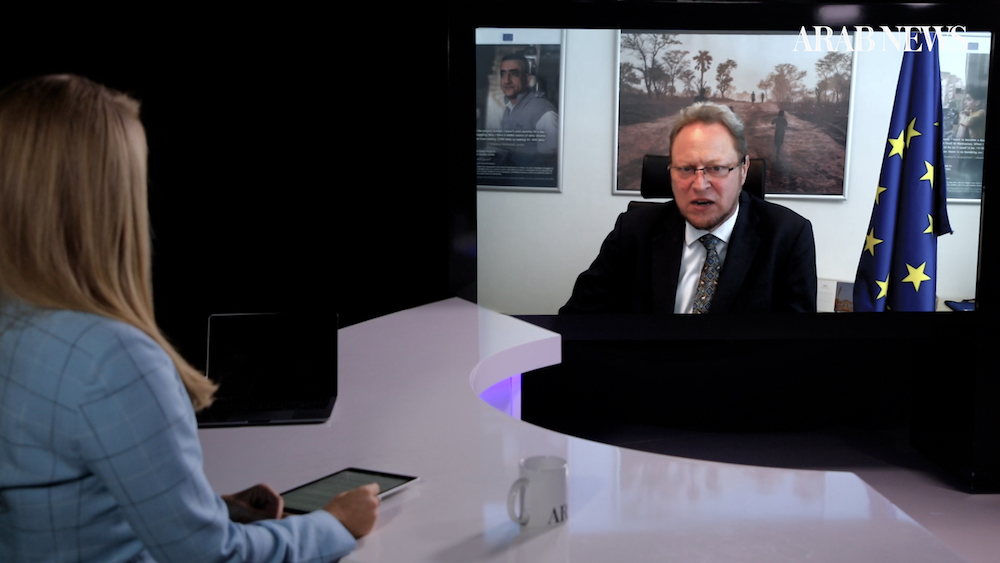
“The international community has put together a record pledge: €6.4 billion for 2022-2023, which is half a billion more than the equivalent pledge of last year. So, what this tells us is that there is no fatigue in the international community when it comes to assisting Syrians. The donors are there, there is no donor fatigue and the international organizations are mobilized.”
But what about all the complaints of humanitarian agencies that they are running out of money? Koehler says he does not deny there is a problem of “donor insufficiency.”
“If you look at the amount of money that’s mobilized every year for humanitarian aid, you see an increase of money. This is totally outpaced by the needs, because every year we have more crises. The existing crises unfortunately don’t go away and the number of people that are suffering keeps increasing.”
Asked how the humanitarian funding gap could be filled, Koehler said the solution is a mixture of elements, starting with more donors, especially those in the EU. “Look at the clubs of rich countries. There are 38 members of OECD or the G20,” he said. “Not all of these countries have already started to deliver humanitarian aid. Some do, but not very consistently. There may be a year where they may put a lot of money on the table, and in other years they are a bit more (tight-fisted) with their resources.”
Among the many ways the Middle East is exposed to the vagaries of the Ukraine war, Russia has hinted at vetoing the renewing of the mandate that allows the UN to use the Bab Al-Hawa crossing in northern Syria when it expires on July 9. This means that EU aid might have to go through Damascus and thus be under the control of the Assad regime. “If Bab Al-Hawa was closed, there would be a huge supply problem and we have seen what it means already in the northeast of Syria,” Koehler said.
“However, we are also very much in favor of cross-line cooperation, so we have no problem with bringing aid from Damascus to the northeast, for example, or the northwest. Unfortunately, this is happening only on a small scale, which has to do with political but also logistical problems.”
According to Koehler, there is a new system by which aid is always delivered through specialized partners, never through governments, “so delivering aid, for example in the part of Syria that is controlled by the authorities in Damascus, does not mean to give money to the Assad government.
“It is implemented through specialized owned organizations, NGOs, UN agencies and so forth. For that we have monitoring, we have audits, we have independent audits by third parties,” he said. “We have our offices on the ground. ECHO has an office in Damascus that can monitor what’s going on, and as soon as there is some kind of suspicion of diversion of aid, we stop. We stop, we enquire and we only resume aid once we are sufficiently, let’s say, reassured about the way the aid is implemented.”
Koehler said ECHO was using the same modus operandi in Afghanistan. “As I said earlier, we never work through governments. So, we work with the local NGOs. We work with the Red Crescent, we work, for example, with UNICEF and other organizations and we make sure that this money comes to the benefit directly of the population concerned,” he said.
However, he acknowledged that with more restrictions announced by the Taliban, many of them targeted at women, “we are frankly disappointed with the way things are developing in Afghanistan.”
Last April the EU pledged €525 million of humanitarian aid to Afghanistan, and according to Koehler, as a consequence of the developments in Afghanistan since the Taliban takeover of the country last year, the international community, in particular the EU, have stepped up humanitarian funding.
“The Taliban came up with a number of assurances, concerning, for example, girls’ education and women’s rights. However, we now see that many of these assurances have proved questionable or even formally revoked. and this of course creates major problems.”
Moving on to another humanitarian hotspot, Koehler played down fears that humanitarian aid funding will stop despite a UN warning this month that more than five and a half million Palestinian refugees may no longer have access to basic services such as food, education and health care due to a drop in contributions from member states, the EU in particular.
“We support UNRWA and we continue our assistance,” he said, referring to the UN agency that supports the relief and human development of Palestinian refugees.
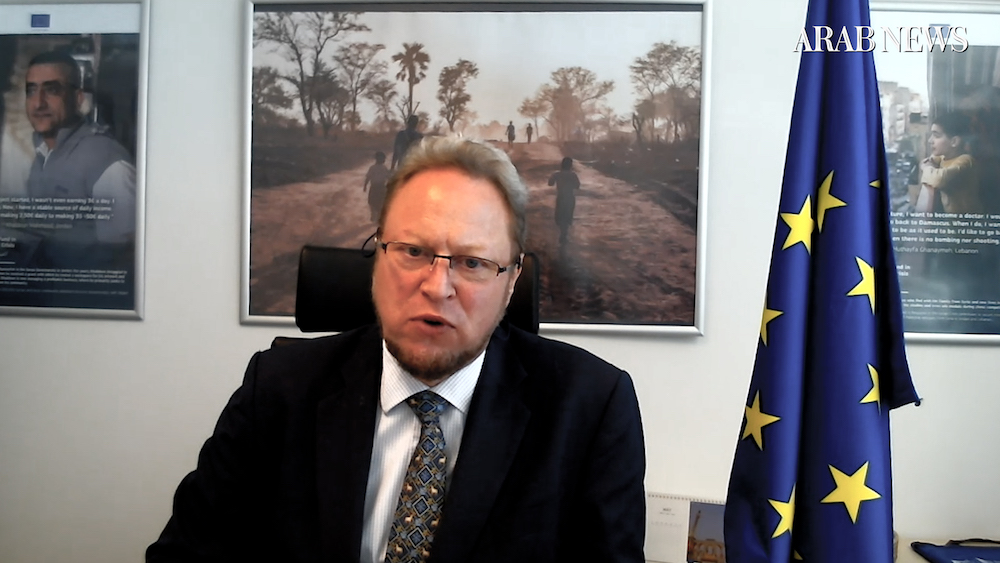
With regard to the EU’s contribution, he said this is “not a cut in funding. This is about negotiating the conditions for the 2021-2022 installments.”
He added: “What has stopped for a short while is not humanitarian aid but direct financial transfers that EU development assistance is making available for the benefit of the Palestinian National Authority. And this is not a stop for good, but this is about agreeing to a certain number of conditions, under which this money would be made available.”
But amid concerns over possible closure of UNRWA, what is the EU’s position on the right of return? “The EU has a principled position in this regard and we stand still behind the two-state solution. We want a negotiated solution between the parties,” Koehler said. “We see the occupation of Palestine as something that has to be brought to an end, in accordance with relevant UN resolutions on the basis of bilateral negotiations that we are ready to incentivize and support as much as possible.”
Koehler concluded by saying that aid agencies and donors must unite and “speak with one voice” for effective humanitarian relief efforts in crisis zones. “Wherever the international community, the donors from the US to the UK, to the EU, to Sweden, to Germany, to the Kingdom of Saudi Arabia, wherever the donors speak with one voice, this one voice has an effect,” he said, citing the example of the failed attempt in 2020 by the Iran-backed Houthi militia to impose a 2 percent tax on humanitarian aid deliveries in Yemen.
“The international community said ‘no way.’ Also, the World Food Programme said ‘no way.’ We said, ‘If that is what you want to do, we will simply discontinue our operations in the territory that you have control over.’”




