

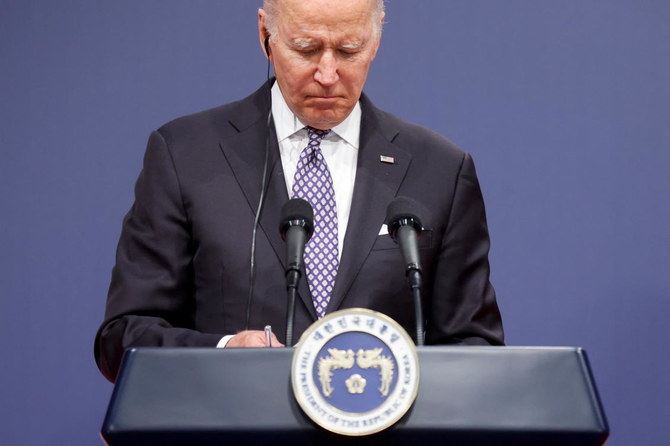
Joe Biden signs $40 billion for Ukraine assistance during Asia trip

President Joe Biden signed the measure under unusual circumstances: a US official brought a copy of the bill on a commercial flight so the president could sign it. (Reuters)
Short Url
Updated 21 May 2022
Follow

Joe Biden signs $40 billion for Ukraine assistance during Asia trip

  • The legislation was passed by Congress with bipartisan support
  • The new legislation will provide $20 billion in military assistance

SEOUL: President Joe Biden on Saturday signed legislation to support Ukraine with another $40 billion in US assistance as the Russian invasion approaches its fourth month.
The legislation, which was passed by Congress with bipartisan support, deepens the US commitment to Ukraine at a time of uncertainty about the war’s future. Ukraine has successfully defended Kyiv, and Russia has refocused its offensive on the country’s east, but American officials warn of the potential for a prolonged conflict.
The funding is intended to support Ukraine through September, and it dwarfs an earlier emergency measure that provided $13.6 billion.
The new legislation will provide $20 billion in military assistance, ensuring a steady stream of advanced weapons that have been used to blunt Russia’s advances. There’s also $8 billion in general economic support, $5 billion to address global food shortages that could result from the collapse of Ukrainian agriculture and more than $1 billion to help refugees.
Biden signed the measure under unusual circumstances. Because he’s in the middle of a trip to Asia, a US official brought a copy of the bill on a commercial flight so the president could sign it, according to a White House official.
The logistics reflect a sense of urgency around continuing US support for Ukraine, but also the overlapping international challenges facing Biden. Even as he tries to reorient American foreign policy to confront China, he’s continuing to direct resources to the largest conflict in Europe since World War II.

Rewilding Arabia
Return of the leopard is at the heart of plans to conserve and regenerate Saudi Arabia’s landscapes and wildlife

Enter


keywords


UK Police arrest 86 people at prison protest for Palestine Action hunger striker

Updated 25 January 2026
Follow

UK Police arrest 86 people at prison protest for Palestine Action hunger striker

  • Demonstration outside Wormwood Scrubs held in support of Umer Khalid
  • Khalid 1 of 5 people charged in connection with break-in at RAF base last year

LONDON: A protest outside a prison in the UK in support of a man detained for supporting the banned group Palestine Action has led to the arrest of 86 people.

London’s Metropolitan Police said a group of demonstrators breached the grounds of Wormwood Scrubs prison in the capital, refused to leave when ordered to do so, and threatened officers. They were arrested on suspicion of aggravated trespass.

The group, several of whom attempted to gain access to the prison itself, were protesting in support of Umer Khalid, who is currently on hunger strike at the facility.

Khalid is one of five people charged in relation to a break-in by Palestine Action members at an RAF base at Brize Norton last year, in which two military aircraft were damaged.

Khalid, who denies the charges, is one of several people who are on or who have taken part in hunger strikes in recent months, all of whom have been held on similar charges for over a year without their cases being brought to trial.

A spokesperson for the UK’s Ministry of Justice said: “The escalation of the protest at HMP Wormwood Scrubs is completely unacceptable. While we support the right to peacefully protest, reports of trespassing and threats being made to staff and police officers are deeply concerning.

“At no point was prison security compromised. However, where individuals’ actions cause risk or actual harm to hardworking staff, this will not be taken lightly and those responsible can expect to face consequences.

“Prisoners are being managed in line with longstanding policy. This includes regular checks by medical professionals, heart monitoring and blood tests, and support to help them eat and drink again. If deemed appropriate by healthcare teams, prisoners will be taken to hospital.”