

Dual impact from oil and non-oil sectors ‘to propel Saudi GDP growth by 10 percent’

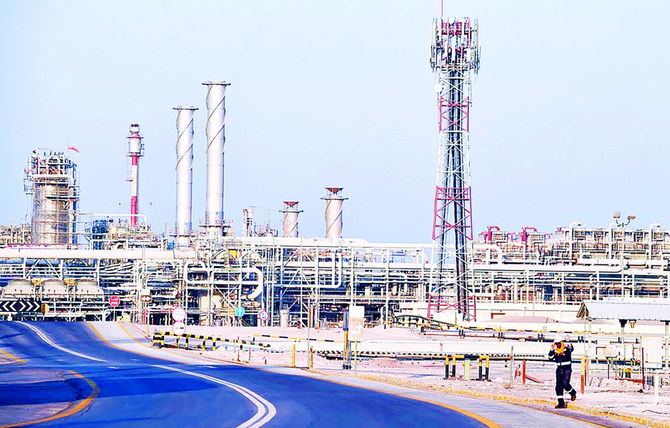
According to the World Bank, energy prices are expected to rise more than 50 percent in 2022, before easing in 2023 and 2024. (AFP/File)
Short Url
Updated 25 May 2022
Follow

Dual impact from oil and non-oil sectors ‘to propel Saudi GDP growth by 10 percent’

  • Capital Economics says it will be the highest annual growth rate in over a decade, if this happens

RIYADH: Saudi Arabia’s gross domestic product is expected to grow by 10 percent this year, driven by increased activities in the oil and non-oil sectors, according to a recent note from Capital Economics.

The London-based independent research firm said it will be the highest annual growth rate in over a decade, if this happens.

Capital Economics expects the Kingdom to achieve the projected 10-percent growth due to a  significant increase in oil output combined with an expected loosening of fiscal policy that is set to encourage growth in the non-oil sector.

This projection follows the flash estimate for the first quarter GDP released earlier this month which showed the economy grew 2.2 percent since the last quarter of 2021, and 9.6 percent year-on-year — the highest growth rate in 11 years.

In regards to performance on a quarter-on-quarter basis, the growth is attributed to a 2.9 percent rise in oil GDP due to increased output on the back of the OPEC+ deal and a 2.5 percent growth in non-oil activities.

The increase in energy prices, which has been the largest since the 1973 oil crisis, together with the war in Ukraine — which altered the global patterns on trade, production and consumption — have contributed to this record GDP growth.

SPEEDREAD

The projection by London-based Capital Economicsfollows the flash estimate for the first quarter GDP released earlier this month which showed the economy grew 2.2 percent since the last quarter of 2021, and 9.6 percent year-on-year — the highest growth rate in 11 years.

Though Saudi Arabia still hasn’t met its OPEC+ quota, it is one of the few members raising produc- tion significantly. With other member countries struggling to meet their quotas and an expected decline in Russian output, Capital Economics predicts the Kingdom will increase oil production faster than anticipated under the current OPEC+ agreement.

According to the World Bank, energy prices are expected to rise more than 50 percent in 2022, before easing in 2023 and 2024.

As oil prices remain elevated, policymakers are expected to relax fiscal policy to stimulate non-oil activities, with a reduction in the value-added tax a possibility, the note from Capital Economics pointed out.

The Kingdom’s non-oil sector has also expanded at the fastest rate in over four years, according to the Saudi Arabia PMI survey.

This has been due to new business and activity that boosted sharply as client demand recovered after COVID-19.

The increase in business also came in line with Vision 2030, a reform plan that aims to diversify the country’s economic resources.

The 10 percent figure projected by Capital Economics is much higher than recent projections from the IMF, which predicted the Saudi economy to grow by 7.6 percent in 2022, as mentioned in its World Economic Outlook released in April 2022.

Rewilding Arabia
Return of the leopard is at the heart of plans to conserve and regenerate Saudi Arabia’s landscapes and wildlife

Enter


keywords


Saudi non-oil exports jump 21% as trade balance improves: GASTAT 

Updated 5 sec ago
Follow

Saudi non-oil exports jump 21% as trade balance improves: GASTAT 

RIYADH: Saudi Arabia’s non-oil exports, including re-exports, rose 20.7 percent year on year in November to SR32.69 billion ($8.72 billion), official data showed. 

According to preliminary figures released by the General Authority for Statistics, national non-oil exports, excluding re-exports, increased by 4.7 percent in November compared with the same month in 2024. 

The strong performance highlights progress under the Kingdom’s Vision 2030 strategy, which aims to diversify the economy and reduce its long-standing dependence on crude oil revenues. 

In its latest report, GASTAT stated: “The ratio of non-oil exports, including re-exports, to imports increased in November 2025, reaching 42.2 percent, compared with 34.9 percent in November 2024. This increase was driven by a 20.7 percent rise in non-oil exports, alongside a 0.2 percent decline in imports over the same period.”  

It added: “The value of re-exported goods increased by 53.1 percent during the same period, driven by an 81.9 percent increase in ‘machinery, electrical equipment and parts’, which accounted for 51.5 percent of total re-exports.”  

Machinery, electrical equipment and parts also led the non-oil export basket, making up 24.2 percent of outbound shipments and recording an 81.5 percent annual increase. This was followed by products of the chemical industries, which represented 20.3 percent of total non-oil exports and rose 0.5 percent year on year. 

The data adds to signs of resilience in Saudi Arabia’s non-oil economy, with S&P Global’s Purchasing Managers’ Index at 57.4 in December, well above the 50 threshold that separates expansion from contraction. 

Top non-oil destinations 

The UAE was the leading destination for Saudi non-oil exports in November, with shipments valued at SR10.48 billion. 

India ranked second at SR3.01 billion, followed by China at SR2.32 billion, Singapore at SR1.76 billion and Bahrain at SR900.7 million. 

Exports to Egypt totaled SR815.5 million during the month, while Turkiye and Jordan received goods worth SR799.1 million and SR773.3 million, respectively. 

GASTAT said ports and airports played a central role in facilitating non-oil shipments in November. 

By sea, Jeddah Islamic Seaport handled the largest volume of non-oil exports at SR3.57 billion, followed by King Fahad Industrial Seaport in Jubail at SR3.51 billion. 

Ras Al-Khair Seaport was the exit point for non-oil goods valued at SR2.66 billion, while Jubail Seaport and King Abdulaziz Seaport in Dammam handled outbound shipments worth SR2.32 billion and SR2.14 billion, respectively. 

By air, King Abdulaziz International Airport handled goods worth SR5.60 billion, while King Khalid International Airport in Riyadh processed exports valued at SR3.53 billion. 

Exports and imports 

Saudi Arabia’s total merchandise exports reached SR99.73 billion in November, representing a 10 percent increase compared with the same month in 2024. 

“Merchandise exports in November 2025 increased by 10.0 percent compared to November 2024, and oil exports increased by 5.4 percent. The percentage of oil exports in total exports declined from 70.1 percent in November 2024 to 67.2 percent in November 2025,” GASTAT added.  

China remained the Kingdom’s largest export destination, accounting for 13.5 percent of total exports, followed by the UAE at 11.7 percent and Japan at 9.9 percent. India, South Korea, the US, Egypt, Singapore, Bahrain and Poland were also among the top 10 destinations, which together accounted for 71.4 percent of total exports. 

Imports declined by 0.2 percent year on year in November to SR77.38 billion, while the merchandise trade surplus surged by 70.2 percent, the report showed. 

China was the Kingdom’s largest source of imports, accounting for 26.7 percent of inbound shipments, followed by the US at 10.2 percent and the UAE at 6.2 percent.  

“Germany, Japan, India, Italy, France, Switzerland, and Egypt were also among the top ten import sources, with total imports from these ten countries representing 68.6 percent of Saudi Arabia’s overall imports,” added GASTAT.  

King Abdulaziz Port in Dammam was the leading entry point for goods, handling 22.8 percent of imports in November. Jeddah Islamic Port followed with 22.6 percent, ahead of King Khalid International Airport in Riyadh at 17 percent and King Abdulaziz International Airport in Jeddah at 11.9 percent.