Biden cheers Finland, Sweden NATO plans as Turkey balks

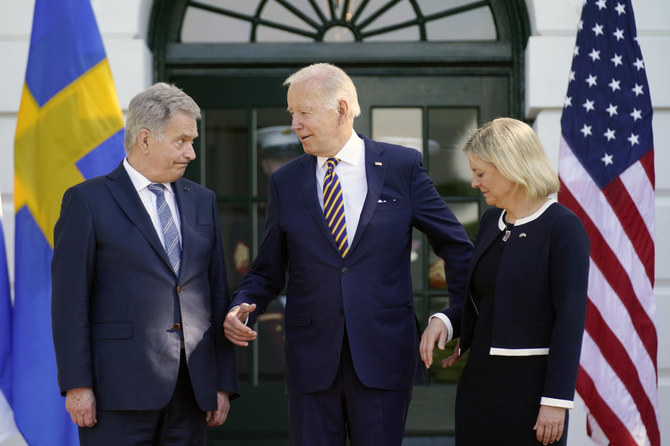
President Joe Biden greets Prime Minister Magdalena Andersson of Sweden and President Sauli Niinisto of Finland as they arrive at the White House in Washington on Thursday. (AP)
Short Url
Updated 19 May 2022
Follow

Biden cheers Finland, Sweden NATO plans as Turkey balks

  • "Finland and Sweden make NATO stronger," Biden said
  • Turkey has expressed strong opposition to the Nordic countries' ascension

WASHINGTON: President Joe Biden met with the leaders of Finland and Sweden at the White House on Thursday to offer robust US support for their applications to join NATO.
Meanwhile Turkey threatened to block the Nordic nations from becoming members of the alliance.
Biden, who has rallied the West to stand up to Russia after its invasion of Ukraine, joined Swedish Prime Minister Magdalena Andersson and Finnish President Sauli Niinistö in a sunny White House Rose Garden bedecked with their countries’ flags in a show of unity and support.
“Finland and Sweden make NATO stronger,” Biden said. “They’re strong, strong democracies, and a strong, united NATO is the foundation of America’s security.”
Biden said his administration was submitting paperwork to the US Congress for speedy approval once NATO members gave the two countries a green light.
“They meet every NATO requirement and then some,” the president said. “Having two new NATO members in the high north will enhance the security of our alliance and deepen our security cooperation across the board.”
Turkey has expressed strong opposition to the Nordic countries’ ascension, pressing Sweden to halt support for Kurdish militants it considers part of a terrorist group and both to lift their bans on some arms sales to Turkey.
All 30 NATO members need to approve any new entrant. Turkish President Tayyip Erdogan said in a video posted on Twitter on Thursday that Turkey had told allies it will reject Sweden and Finland’s membership.
The Finnish president said at the White House that his country was open to discussing all Turkey’s concerns, and pledged to “commit to Turkey’s security just as Turkey will commit to our security” as a NATO ally.
“We take terrorism seriously,” Niinistö said.
Sweden and Finland have for decades stood outside the Cold War era military alliance designed to deter threats from the Soviet Union, but Russia’s invasion of Ukraine has heightened security concerns.
The situation in Ukraine “reminds us of the darkest days of European history,” Andersson said. “During dark times it is great to be among close friends.”
Conversations between Sweden, Finland and Turkey have taken place to address Ankara’s concerns, with the United States involved in the effort. US national security adviser Jake Sullivan told reporters on Wednesday that US officials were confident Turkey’s concerns can be addressed, and Biden told reporters “I think we’re going to be okay” on the issue.
Biden’s unabashed support put a firm, deliberate US stamp of approval on Finland and Sweden’s applications. He squeezed in the meeting just before departing to Asia and gave both leaders speaking time in the Rose Garden, underscoring that support.
Biden’s remarks also sent a signal to Russian President Vladimir Putin. On Monday Putin said there was no threat to Russia if Sweden and Finland joined NATO but cautioned that Moscow would respond if the alliance bolstered military infrastructure in the new Nordic members.
Biden said on Thursday that new members joining NATO is not a threat to any nation. “It never has been,” he said.


Immigration raids in Minnesota fuel grassroots Somali activism

Updated 5 sec ago
Follow

Immigration raids in Minnesota fuel grassroots Somali activism

  • “You would never fathom that people would just pluck you off the streets ... and say, ‘Prove to me that you’re a citizen,’” Mohamed said
  • Trump, who ‌has described Somalis as “garbage” who should be thrown out of the country, has said the operations are necessary to combat crime

MINNEAPOLIS: When immigration agents began aggressive operations in Minneapolis last month, Kowsar Mohamed started knocking on doors, fielding late-night calls and mobilizing other Somali Americans into an ad-hoc response team.
Many feared they were being singled out, a worry that revived memories of the state surveillance and arbitrary authority they thought they had left behind when they resettled in the United States.
More than 100 volunteers now patrol south Minneapolis, distribute “Know Your Rights” guides and escort frightened elders — part of a sweeping grassroots effort to counter what many describe as constitutionally suspect raids that are destabilizing Minnesota’s roughly 80,000-strong Somali community, one of the country’s largest refugee populations.
“You would never fathom that people would just pluck you off the streets ... and say, ‘Prove to me that you’re a citizen,’” Mohamed said, referring to reports of aggressive tactics by the agents. “It’s not that we never thought it was impossible. We just believed the Constitution was going to protect us from this level of interrogation.”

TRUMP’S 3,000-AGENT PUSH SPARKS VOTER-INTIMIDATION FEARS
The deployment of 3,000 federal agents — ordered by Republican President Donald Trump — has intensified accusations from Democrats and local leaders that he is targeting ‌a politically influential community ‌ahead of the 2026 midterm elections, deepening fears that the operations amount to intimidation aimed at suppressing ‌Somali ⁠voter turnout.
Trump, who ‌has described Somalis as “garbage” who should be thrown out of the country, has said the operations are necessary to combat crime, though many of those arrested have no criminal charges or convictions. He has also cited a fraud scandal around the theft of federal funds for social-welfare programs in Minnesota to justify sending agents into the state, many of them from US Immigration and Customs Enforcement.
Democrats and community leaders accuse the agents of harassing peaceful protesters, racial profiling and searching houses without warrants. Minneapolis has been on edge since the fatal shooting of 37-year-old Renee Good by an immigration agent on January 7.
“A lot of community members escaped war and this administration is triggering another war zone,” said Abdulahi Farah, co-chair of the Somali American Leadership Table, an advocacy group formed in response ⁠to hate crimes and political attacks on Somalis. He said Trump’s history of racist rhetoric against Black and other immigrants of color has emboldened far-right activists and had a destabilizing effect on ‌small businesses and citizens’ general sense of safety.
Department of Homeland Security spokesperson Tricia McLaughlin said in ‍a statement to Reuters that immigrants who are served administrative warrants or ‍I-205 removal orders “have had full due process and a final order of removal from an immigration judge.”

PUSHING BACK AGAINST IMMIGRATION RAIDS
In Cedar-Riverside, a ‍normally bustling Somali neighborhood lined with restaurants, boutique shops and convenience stores, business owners say activity is noticeably quieter since immigration agents arrived there last month.
“It’s been really slow,” said Rashid Jama, a grocery store manager in the neighborhood, also known as the West Bank. “A lot of our suppliers are Latino and they’re scared to come to work.”
The efforts of Mohamed, a third-year doctoral student at the University of Minnesota, are part of a broader wave of grassroots initiatives to push back by filming arrests, planning peaceful protests and accelerating voter outreach.
Some Somali Americans fear the raids are a bid to suppress voter turnout before midterm elections in November, according to over a dozen grassroots organizers, local officials and residents interviewed by ⁠Reuters.
“It’s signaling that if we get rid of them, if we scare them, they’re not going to come out to vote in the 2026 midterm election. We know that’s the target,” said Farah, whose group is partnering with other grassroots organizations to train people on priorities like opposing ICE raids as well as broader issues like affordability.
Mosques and neighboring community centers are now turning into political education hubs in Minnesota, local leaders said.
Civil rights advocates and scholars say the Minneapolis immigration operations echo past crackdowns in Black and Latino neighborhoods, fueling fears of political scapegoating, said political science professor Christina Greer at Fordham University.
Somali American voters have largely supported Democrats since refugees began resettling in the US in the 1990s, before becoming more politically active in the 2000s. US Representative Ilhan Omar is the community’s most high-profile member and a frequent target of racist attacks from Trump.
Asked about that and tactics of agents decried by residents, White House spokeswoman Abigail Jackson said in a statement to Reuters that immigrants “who fail to contribute to our economy, rip off Americans and refuse to assimilate into our society should not be here.”
Minnesota Republican Party Chairman Alex Plechash denied the raids were politically driven, calling the charge “categorically false” but said complaints about aggressive tactics ‌warrant review.
Some Somali community leaders say mobilizing voters will be a priority in the months ahead.
“The power we have is to vote,” said Abdullahi Kahiye, 37, who said he became a naturalized US citizen in 2024. “ICE and whoever is trying to terrorize the Somali community will not succeed.”