

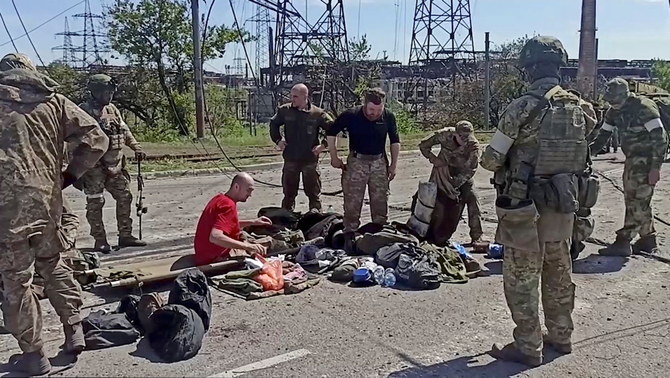

KYIV/MARIUPOL, Ukraine: Russia said on Wednesday nearly 700 more Ukrainian fighters had surrendered in Mariupol but Kyiv was silent about their fate, while a pro-Russian separatist leader said commanders were still holed up in tunnels beneath the Azovstal steelworks.
More than a day after Kyiv announced it had ordered its garrison in Mariupol to stand down, the ultimate outcome of Europe’s bloodiest battle for decades remained unresolved. Ukrainian officials halted all public discussion of the fate of fighters who had made their last stand there.
“The state is making utmost efforts to carry out the rescue of our servicemen. Let’s wait. Currently, the most important thing is to save the lives of our heroes,” military spokesman Oleksandr Motuzaynik told a news conference. “Any information to the public could endanger that process.”
Russia said 694 more fighters had surrendered overnight, bringing the total number of people who had laid down arms to 959. The leader of pro-Russian separatists in control of the area, Denis Pushilin, was quoted by a local news agency DNA as saying the main commanders were still inside the plant.
Ukrainian officials had confirmed the surrender of more than 250 fighters on Tuesday but they did not say how many more were inside or what might become of them.
“Unfortunately, the subject is very sensitive and there is a very fragile set of talks going on today, therefore I cannot say anything more,” said Mariupol Mayor Vadym Boichenko. He said President Volodymyr Zelensky, the Red Cross and the United Nations were involved in talks but gave no details.
Negotiations over Mariupol’s surrender came as Finland and Sweden formally applied to join NATO, bringing about the very expansion that Russian President Vladimir Putin has long cited as one of his main reasons for launching the “special military operation” in February.
The final surrender would bring a close to a near three-month siege of the port city of more than 400,000 people, where Ukraine says tens of thousands of civilians died under Russian bombardment.
Ukrainian officials have spoken of arranging a prisoner swap for Mariupol defenders. Moscow says no such deal was made for the fighters, many from a unit with far-right origins which it calls Nazi.
Russia says more than 50 wounded fighters have been brought for treatment to a hospital, and others have been taken to a prison, both in towns held by pro-Russian separatists.
Russia’s defense ministry posted videos of what it said were Ukrainian fighters receiving hospital treatment after surrendering at Azovstal.
One man shown lying on bed said he had access to food and doctors, while a second said he had been bandaged and had no complaints about his treatment. It was not possible to establish if the men were speaking freely.
The Kremlin says Putin has personally guaranteed the humane treatment of those who surrender. Other Russian politicians have called for them to be kept captive and even for their execution.
Finland and Sweden apply to NATO
The Swedish and Finnish ambassadors handed over their NATO membership application letters in a ceremony at the alliance’s headquarters in Brussels.
“This is a historic moment which we must seize,” NATO Secretary-General Jens Stoltenberg said.
US President Joe Biden said Washington would work with Finland and Sweden to stay vigilant against any threats while their membership was being considered.
Turkey has said in recent days it will block the Nordic members’ accession unless they do more to crack down on Kurdish militants on their territory. Stoltenberg said he thought the issue could be overcome and Washington has also said it expects it to be resolved.
Finland, which shares a 1,300-km (810-mile) border with Russia, and Sweden were both militarily non-aligned throughout the Cold War.
Although Russia had threatened retaliation against the plans, Putin said on Monday their NATO membership would not be an issue unless the alliance sent more troops or weapons there.
Despite war and sanctions, Russia has remained the main source of energy for Europe.
The EU’s executive European Commission announced a 210 billion euro plan for Europe to end its reliance on Russian oil, gas and coal by 2027, including plans to more than double EU renewable energy capacity by 2030.
In a further sign of Moscow’s isolation, Google became the latest big Western company to pull out of Russia, saying its Russian unit had filed for bankruptcy and was forced to shut operations after its bank accounts were seized.
Victory
The steelworks surrender in Mariupol would let Putin claim a rare victory in a campaign which has otherwise faltered. Recent weeks have seen Russian forces abandon the area around Ukraine’s second largest city Kharkiv after being driven from the north and the environs of the capital Kyiv at the end of March.
Nevertheless, Moscow has continued to press on with its main offensive, trying to capture more territory in the Donbas region of southeastern Ukraine which it claims on behalf of separatists it has supported since 2014.
Mariupol, the main port for the Donbas, is the biggest city Russia has captured so far, and gives Moscow full control of the Sea of Azov and an unbroken swathe of territory across Ukraine’s east and south. The siege was Europe’s deadliest battle at least since wars in Chechnya and the Balkans of the 1990s.
The city’s near total destruction demonstrated Russia’s tactic of raining down fire on population centers.
Human Rights Watch said it had documented further cases of apparent war crimes by Russian troops in the Kyiv and Chernihiv regions from late February through March, including summary executions, torture and other grave abuses.
Kremlin spokesman Dmitry Peskov and Russia’s defense ministry did not respond to requests for comment on the report. Moscow denies targeting civilians and says, without evidence, that signs of atrocities were staged to discredit its troops.


