Germany to boost military drills with Sweden, Finland amid NATO bid

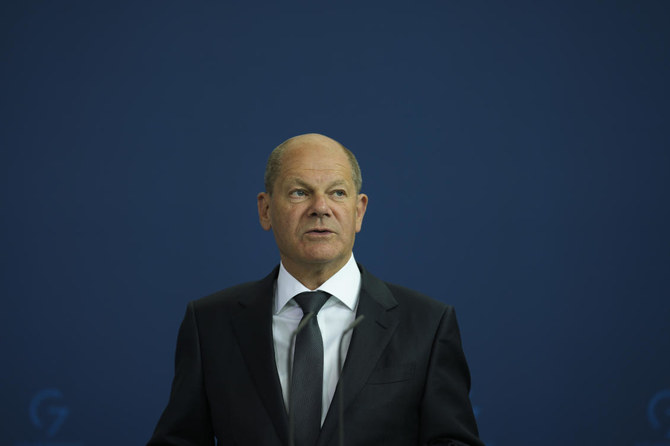
German Chancellor Olaf Scholz attends a news conference with the incumbent Prime Minister of Liechtenstein Daniel Risch after a meeting at the chancellery in Berlin Tuesday. (AP)
Short Url
Updated 17 May 2022
Follow

Germany to boost military drills with Sweden, Finland amid NATO bid

  • "We will intensify our military cooperation, especially in the Baltic Sea region and through joint exercises," Scholz said
  • Swedish Prime Minister Magdalena Andersson confirmed on Monday her country would apply to join NATO, a day after Finland

BERLIN: Germany will ramp up its military collaboration with Sweden and Finland as the two countries seek NATO membership in the wake of Russia’s invasion of Ukraine, Chancellor Olaf Scholz said Tuesday.
“We will intensify our military cooperation, especially in the Baltic Sea region and through joint exercises,” Scholz said amid concern for the two candidates’ security during the transition period to NATO accession.
“It is already clear that our countries are bound together by an obligation to provide each other with all possible assistance and support for mutual protection” as members of the United Nations and the European Union, Scholz added.
“Both countries can always rely on our support, especially in this very special situation,” he said.
With Moscow pressing its assault in eastern border regions of Ukraine nearly three months into its invasion, Helsinki and Stockholm are poised to give up decades of military non-alignment over fears they could be next.
Swedish Prime Minister Magdalena Andersson confirmed on Monday her country would apply to join NATO, a day after Finland — which shares a 1,300-kilometer (800-mile) border with Russia — said the same.
Russian President Vladimir Putin, whose war has sparked global outrage, said the move poses “no direct threat for us... but the expansion of military infrastructure to these territories will certainly provoke our response.”
NATO secretary general Jens Stoltenberg told a meeting of the alliance in Berlin on Sunday that it would “look into ways to provide security assurances including by increasing NATO presence in the region” during the transition period.
“Finland and Sweden are concerned about the interim period... we will try to speed up that process,” he said.


Germany’s leader calls on US and Europe to ‘repair trans-Atlantic trust’

Updated 4 sec ago
Follow

Germany’s leader calls on US and Europe to ‘repair trans-Atlantic trust’

  • German Chancellor said Europe and US should conclude that 'we are stronger together'
  • Merz acknowledges rift in trans-Atlantic relations over the past year as he opens Munich Security Conference
MUNICH: German Chancellor Friedrich Merz called on Friday for the United States and Europe to “repair and revive trans-Atlantic trust together,” arguing that even the US isn’t powerful enough to go it alone in an increasingly tough world.
Merz called for a “new trans-Atlantic partnership,” acknowledging that “a divide, a deep rift” has opened up across the Atlantic as he opened the Munich Security Conference, an annual gathering of top global security figures including many European leaders and US Secretary of State Marco Rubio.
At last year’s conference, held a few weeks into US President Donald Trump’s second term, Vice President JD Vance stunned European leaders by lecturing them about the state of democracy and freedom of speech on the continent — a moment that set the tone for the last year.
A series of statements and moves from the Trump administration targeting allies followed, including Trump’s threat last month to impose new tariffs on several European countries in a bid to secure US control of Greenland, a semiautonomous territory of NATO ally Denmark. The president later dropped that threat.

‘Stronger together’

“The culture war of the MAGA movement in the US is not ours,” Merz said. “The freedom of the word ends here when this word is turned against human dignity and the constitution. And we don’t believe in tariffs and protectionism, but in free trade.”
He added that Europe would stand by climate agreements and the World Health Organization “because we are convinced that we will only solve global tasks together.”
But Merz said Europe and the US should conclude that “we are stronger together” in today’s world. He argued that the post-World War II world order “as imperfect as it was at its best times, no longer exists” today.
“In the era of great-power rivalry, even the United States will not be powerful enough to go it alone,” he said. “Dear friends, being a part of NATO is not only Europe’s competitive advantage. It’s also the United States’ competitive advantage, so let’s repair and revive trans-Atlantic trust together.”
The Europeans, Merz said, are doing their part.

A ‘shift in mindset’ in Europe

Since last year’s Munich conference, NATO allies have agreed under pressure from Trump to a large increase in their defense spending target.
NATO Secretary-General Mark Rutte said there has been a “shift in mindset,” with “Europe really stepping up, Europe taking more of a leadership role within NATO, Europe also taking more care of its own defense.”
With Rubio heading the US delegation this year, European leaders can hope for a less contentious approach more focused on traditional global security concerns.
Speaking as he introduced Merz, conference chairman Wolfgang Ischinger asked: “does the Trump administration truly believe that it needs allies and partners and if so ... is Washington actually prepared to treat allies as partners?”
Before departing for Germany on Thursday, Rubio had some reassuring words as he described Europe as important for Americans.
“We’re very tightly linked together with Europe,” he told reporters. “Most people in this country can trace both, either their cultural or their personal heritage, back to Europe. So, we just have to talk about that.”
But Rubio made clear it wouldn’t be business as it used to be, saying: “We live in a new era in geopolitics, and it’s going to require all of us to reexamine what that looks like.”
Mike Waltz, the US ambassador to the United Nations, told the conference that the US had been sustaining the financial burden of multilateralism for too long and Europeans need to do more.
“There is a cost to the status quo and the status quo was not sustainable any more,” Waltz said.
Merz said that Europe’s “excessive dependency” on the US was its own fault, but it is leaving that behind. “We won’t do this by writing off NATO — we will do it by building a strong, self-supporting European pillar in the alliance, in our own interest,” he said.
He acknowledged that Europe and the US will likely have to bridge more disagreements in the future than in the past, but “if we do this with new strength, respect and self-respect, that is to the advantage of both sides.”
Rubio arrived in Munich on Friday. He met Merz and Chinese Foreign Minister Wang Yi separately on the sidelines of the conference, and also had a meeting scheduled with Danish Prime Minister Mette Frederiksen and Greenlandic Prime Minister Jens-Frederik Nielsen. He is due to address the conference on Saturday morning.