Beijing locks down more people in China’s zero COVID-19 fight

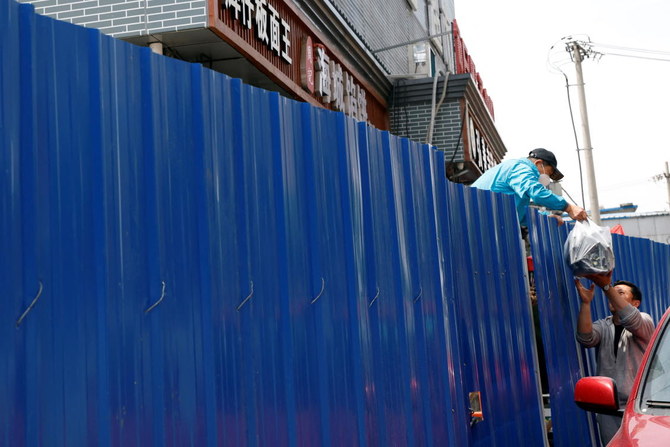
A worker in protective suit receives supply through the fence of a barricaded residential area under lockdown in Beijing, China on May 17, 2022. (Reuters)
Short Url
Updated 17 May 2022
Follow

Beijing locks down more people in China’s zero COVID-19 fight

  • In Beijing, the number of cases has held steady but new clusters have popped up in different parts of the city

BEIJING: Authorities in Beijing restricted more residents to their homes on Tuesday in a now 3-week-long effort to control a small but persistent COVID-19 outbreak in the Chinese capital.
Seven adjoining areas in the city’s Fengtai district were designated lockdown zones for at least one week, with people ordered to stay at home in an area covering about 4 by 5 kilometers. The area is near a wholesale food market that was closed indefinitely on Saturday following the discovery of a cluster there.
The added restrictions come as Shanghai, China’s largest city, slowly starts to ease a citywide lockdown that has trapped most of its population for more than six weeks. The twin outbreaks in Beijing and Shanghai, the country’s most prominent cities, have focused attention on whether China can sustain its strict “zero-COVID” approach, as many other countries adapt to the fast-spreading omicron variant and ease restrictions.
China recorded 1,100 new cases on Monday, the National Health Commission said Tuesday. Of those, about 800 were in Shanghai and 52 were in Beijing. The daily number of new cases in Shanghai has declined steadily for more than two weeks, but authorities have been moved slowly to relax restrictions, frustrating residents.
In Beijing, the number of cases has held steady but new clusters have popped up in different parts of the city. City spokesperson Xu Hejian said that Beijing’s top priority is to screen people related to the cluster at the wholesale food market and isolate those who test positive. A second wholesale food market in Fengtai district was shut down Tuesday.
Most of Beijing is not locked down, but the streets are much quieter than usual with many shops closed and people working from home.


Budget impasse shuts down US Department of Homeland Security

Updated 4 sec ago
Follow

Budget impasse shuts down US Department of Homeland Security

  • Thousands of government workers, from airport security agents to disaster relief officials, will either be furloughed or forced to work without pay
WASHINGTON: The Department of Homeland Security entered a partial shutdown Saturday as US lawmakers fight over funding the agency overseeing much of President Donald Trump’s immigration crackdown.
Thousands of government workers, from airport security agents to disaster relief officials, will either be furloughed or forced to work without pay until funding is agreed upon by Congress.
At the center of the budget dispute is the department’s Immigration and Customs Enforcement (ICE), whose agents killed two US citizens amid sweeping raids and mass protests in Minneapolis.
Democrats oppose any new funding for DHS until major changes are implemented over how ICE conducts its operations.
In particular, they have demanded curtailed patrols, a ban on ICE agents wearing face masks during operations and the requirement that they obtain a judicial warrant to enter private property.
“Donald Trump and Republicans have decided that they have zero interest in getting ICE under control,” House Minority Leader Hakeem Jeffries said Friday.
“Dramatic changes are needed,” Jeffries told a news conference. “Absent that, Republicans have decided to shut down parts of the federal government.”
White House Press Secretary Karoline Leavitt put the blame on the opposition, telling Fox News that “Democrats are barreling our government toward another shutdown for political and partisan reasons.”
But while DHS faces a shutdown, ICE itself will remain operational, under funds approved in last year’s government spending bill.
Senator John Fetterman pushed against his fellow Democrats, saying: “This shutdown literally has zero impact on ICE.”
The primary impact would land on other agencies, including the Federal Emergency Management Agency (FEMA), which oversees emergency response to natural disasters.
The Transportation Security Administration, which runs airport safety, warned on X that a prolonged shutdown could result in longer wait times and canceled flights.
Negotiations stalled
The shutdown would be the third of Trump’s second term, including a record 43-day government closure last October and November.
The government just reopened from a smaller, four-day partial shutdown earlier this month, also over DHS funding.
Even if all 53 Republican senators vote to fund DHS, Senate rules require support from 60 of the body’s 100 members to advance the budget bill, meaning several Democrats would need to get on board.
In response to the Democrats’ demands, the White House said it was ready to negotiate over immigration enforcement policy.
Senate Majority Leader John Thune called it “an extremely serious offer,” but warned Democrats are “never going to get their full wish list.”
Some concessions were made during the previous shutdown amid Democratic pressure and national outcry after federal agents shot and killed Renee Good, a mother of three, and Alex Pretti, a nurse who worked with military veterans, in Minneapolis last month.
Homeland Security Secretary Kristi Noem said federal agents in the city would wear body cameras “effective immediately” in a move that would be later “expanded nationwide.”
The Senate went into recess for a week starting Thursday, but senators could be called back to Washington in case of a rapid leap in negotiations.
For the moment, however, talks between the White House and Democrats appear to be at a standstill.