

Iraq’s prized rice crop threatened by drought

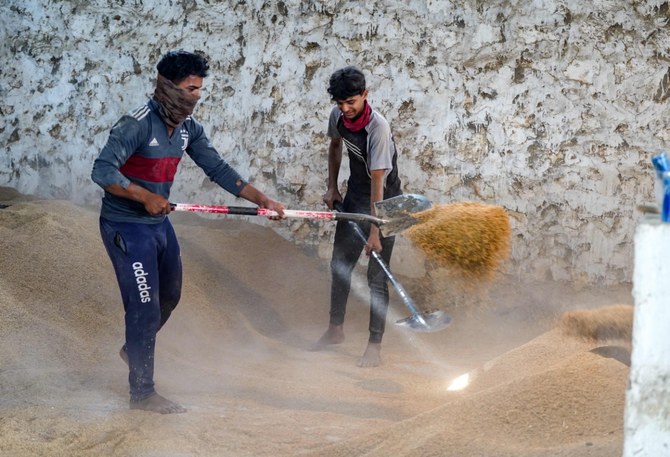
Men work in a rice mill in Iraq’s central province, on May 1. Drought is threatening the Iraqi tradition of growing amber rice, the aromatic basis of rich lamb and other dishes, and an important sector in a struggling economy. AFP
Short Url
Updated 15 May 2022
Follow

Iraq’s prized rice crop threatened by drought

AL-ABASSIYA, IRAQ: Drought is threatening the Iraqi tradition of growing amber rice, the aromatic basis of rich lamb and other dishes, and a key element in a struggling economy.

The long-grained variety of rice takes its name from its distinctive scent, which is similar to that of amber resin. It is used in Iraqi meals including sumptuous lamb qouzi, mansaf and stuffed vegetables.

But after three years of drought and declining rainfall, Iraq's amber rice production will be only symbolic in 2022, forcing consumers to seek out imported varieties and leaving farmers pondering their future.

“We live off this land,” Abu Rassul says, standing near a small canal that in normal times irrigates his two hectares (five acres) near Al-Abassiya village in the central province of Najaf.

“Since I was a child I have planted amber rice,” says the farmer in his 70s, his face wrinkled and unshaven, dressed in a dazzling white dishdasha robe. “Water enables us to plant every year.”

Except for this one.

Water shortage

Normally, rice fields planted in mid-May should stay submerged all summer until October — but that is a luxury Iraq can no longer allow.

The country’s available water reserves “are well below our critical level of 18 billion cubic meters,” Shaker Fayez Kadhim, Najaf’s water resources manager, told AFP.

Rice drains between 10 and 12 billion cubic meters during its cultivation period of about five months, so it is “difficult to grow rice in Najaf or other provinces because of the high level of water it needs,” Kadhim said.

Previously, more than 70 percent of the amber crop was grown in Diwaniyah and neighboring Najaf provinces.

In early May, officials limited total rice crop areas to 1,000 hectares (2,471 acres), in Najaf and Diwaniyah only, according to the Agriculture Ministry.

The normal quota is 35 times that.

Water shortages have also led to reduced quotas for wheat farmers.

The country’s annual rice production had been 300,000 tons, according to Mohammed Chasseb, a senior official in the ministry’s planning department.

Climate change

Iraq is known in Arabic as the “country of the two rivers” — the Tigris and the Euphrates. But despite those two legendary water sources, the supply of water has been declining for years and the country is classified as one of five most vulnerable to climate change effects and desertification.

The consequences are dire: Depleted rivers, more intense sandstorms, declining crop yields — all of which add to the multiple challenges the country faces after decades of war and insurgency.

The Tigris and Euphrates, and their tributaries, originate in Turkey and Syria as well as Iran, which dams them upstream. This reduces the flow as they enter Iraq.

Call for action

Kadhim says the Euphrates has dropped to about one-third of its normal level. He wants “political action” to get more water flowing.

Ahmed Hassoun, 51, president of the Najaf farmers’ association, fears the worst.

“There is a risk of seeing rice cultivation disappear for lack of water," he said, blaming authorities.

“We know Iraq will have a shortage of rain in the coming years,” said Hassoun, an agricultural engineer. Despite that, nothing has been done to “modernize the irrigation system,” he complains.


New Murabba seeks contractors for Mukaab Towers fit-outs: MEED

Updated 28 January 2026
Follow

New Murabba seeks contractors for Mukaab Towers fit-outs: MEED

RIYADH: Saudi Arabia’s New Murabba Development Co., a wholly owned subsidiary of the Public Investment Fund, has issued a request for information to gauge the market for modular and offsite fit-out solutions for its flagship Mukaab development, MEED reported on Wednesday.

The RFI was released on Jan. 26, with submissions due by Feb. 11. NMDC has also scheduled a market engagement meeting during the first week of February to discuss potential solutions with prospective contractors.

Sources close to the project told MEED that NMDC is “seeking experienced suppliers and contractors to advise on the feasibility, constraints, and execution strategy for using non-load-bearing modular systems for the four corner towers framing the Mukaab structure.” The feedback gathered from these discussions will be incorporated into later design and procurement decisions.

The four towers — two residential (North and South) and two mixed-use (East and West) — are integral to the Mukaab’s architectural layout. Each tower is expected to rise approximately 375 meters and span over 80 stories. Key modular elements under consideration include bathroom pods, kitchen pods, dressing room modules, panelized steel partition systems, and other offsite-manufactured fit-out solutions.

Early works on the Mukaab were completed last year, with NMDC preparing to award the estimated $1 billion contract for the main raft works. This was highlighted in a presentation by NMDC’s chief project delivery officer on Sept. 9, 2025, during the Future Projects Forum in Riyadh.

Earlier this month, US-based Parsons Corp. was awarded a contract by NMDC to provide design and construction technical support. Parsons will act as the lead design consultant for infrastructure, delivering services covering public buildings, infrastructure, landscaping, and the public realm at New Murabba. The firm will also support the development of the project’s downtown experience, which spans 14 million sq. meters of residential, workplace, and entertainment space.

The Parsons contract follows NMDC’s October 2025 agreements with three other US-based engineering firms for design work across the development. New York-headquartered Kohn Pedersen Fox was appointed to lead early design for the first residential community, while Aecom and Jacobs were selected as lead design consultants for the Mukaab district.

In August 2025, NMDC signed a memorandum of understanding with Falcons Creative Group, another US-based firm, to develop the creative vision and immersive experiences for the Mukaab project. Meanwhile, Beijing-based China Harbour Engineering Co. completed the excavation works for the Mukaab, and UAE-headquartered HSSG Foundation Contracting executed the foundation works.