

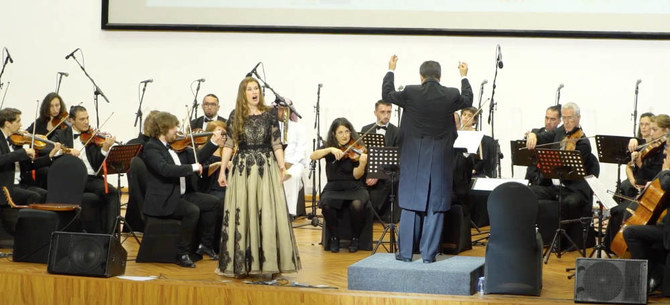
Western opera and Saudi tunes in harmony at Voices for Peace concert in celebration of Europe Day

The concert in Jeddah was the second performance of Voices for Peace, following a show in Riyadh the night before. (Supplied)
Short Url
Updated 16 May 2022
Follow

Western opera and Saudi tunes in harmony at Voices for Peace concert in celebration of Europe Day

  • The show featured Saudi opera singer Sawsan Al-Bahati and her French counterpart, Aurelie Loilier, and the conductor was Algerian maestro Amine Kouider
  • ‘I’m overexcited and very happy for this event that allowed us a nice cultural exchange between both countries … Unity is the message for music,” said Al-Bahati

JEDDAH: The musical cultures of Saudi Arabia and Europe were in perfect harmony in Jeddah during Voices for Peace, a special gala operatic concert in celebration of Europe Day.

The show, which took place at Battarjee Medical College on Thursday night, featured Saudi opera singer Sawsan Al-Bahati and her French counterpart, Aurelie Loilier. They were accompanied by two orchestras conducted by Algerian maestro Amine Kouider.

It was organized by the Consulate General of France in Jeddah and the audience included Mostafa Mihraje, the French Consul General, and Makarem Battarjee, the president of Saudi German Hospitals Group.

Highlighting France’s role in Europe Day, an EU celebration of peace and unity in Europe that is held on May 9 each year, Mihraje explained that his country was one of the six founding members of the union, alongside Belgium, German, Italy, Luxembourg and the Netherlands.

HIGHLIGHT

The show featured Saudi opera singer Sawsan Al-Bahati and her French counterpart, Aurelie Loilier. They were accompanied by two orchestras conducted by Algerian maestro Amine Kouider.

“This, of course, gives us a special responsibility in this regard, especially given that starting today, for six months, France is heading the European Union,” he told Arab News.

“Of course this is something we are proud of and that gives us a great responsibility in this regard, in light of the crises that Europe is going through — Russia’s attack on Ukraine in particular.

“We are very happy today because we gave an example that cultures build bridges between two countries. And as you saw today, the French musical group and the Saudi musical group sang and played music in a special, organized and harmonious way. And we are very proud of this.”

Loilier said that the chance to sing alongside Saudi counterpart Al-Bahiti was a very meaningful experience.

“Of course, it’s a very important moment and it’s unique and it was a great pleasure for me to be there,” said the soprano. “It’s quite new to sing like this … and I hope we will come back and sing again with Sawsan, in France maybe. I hope she will come to France to sing with me as a next step.

“It’s a way to share emotions and to feel the friendship between everyone.”

Al-Bahiti said that this was the first time she had performed a duet with a professional, international opera singer.

“I’m overexcited and very happy for this event that allowed us a nice cultural exchange between both countries,” she said, adding that the message she wants to send out as an artist is one of unity.

“This event has made it happen and it’s only the beginning. Unity is the message for music. Music is the language of the world; we talk by music through our heart, so this is exactly what we want to achieve.”

The concert in Jeddah was the second performance of Voices for Peace, following a show in Riyadh the night before.

Amjaad Aiman, a member of a Saudi choir that took part in the concerts, said she had a great time practicing and performing.

“We represented the Arabic side, alongside the French orchestra,” she said. “The preparations and choral singing were so much fun and were a beautiful experience for me.

“We’ve been rehearsing since Monday and first sang at the Cultural Palace in Riyadh on Wednesday, and now in Jeddah at Battarjee Medical College.”


Rebuilding lives: Saudi initiative gives fresh hope to amputees

Updated 08 December 2025
Follow

Rebuilding lives: Saudi initiative gives fresh hope to amputees

  • Baitureh Health Association has provided life-changing support to more than 1,000 people
  • Prosthetic limbs can cost up to $76,000

MAKKAH: The Baitureh Health Association for the Care of Amputees has quickly become one of Saudi Arabia’s most impactful humanitarian initiatives, transforming support for people with lost limbs.

Established in 2020, the association deals with people’s physical, psychological and social needs and fills a long-standing gap in the national health system.

CEO Badr bin Alyan told Arab News that the initiative was created in response to a growing need, driven by amputations linked to accidents, blood disorders, occupational injuries and other causes.

Its operations were “based on service integration rather than fragmentation, enabling beneficiaries to return to their lives with confidence, ability and independence,” he said.

This holistic process covers everything from initial evaluations to psychological and physical rehabilitation, family support, prosthetic fitting and ongoing maintenance.

Its psychological support programs include group sessions led by certified mentors who have undergone similar experiences, as well as field visits to support patients before and after amputation.

More than 1,000 people across the Kingdom have so far benefitted from the association’s work, about 10 percent of them children, whom Alyan said were “the most sensitive and the most in need of intensive psychological and family support.”

Its specialist programs for children — My First Step and Therapeutic Entertainment — help young people adapt to prosthetics, overcome trauma and build confidence in a safe and supportive setting.

The association has completed more than 300 prosthetic fittings, including silicone cosmetic limbs, mechanical, hydraulic, electronic and 3D-printed models. 

Alyan said the type of prosthetic selected depended on a number of factors, such as age, lifestyle, type of amputation, activity level and psychological readiness.

Children also have to undergo frequent adjustments to their new limbs to account for their growth.

Each prosthetic cost between SR20,000 ($5,300) and SR285,000, Alyan said.

The association funds its work through sponsorships, community contributions and strategic partnerships.

Despite its success, Alyan said there were still challenges to be faced, including the lack of a consolidated base for the provision of psychological support and therapy services and prosthetics development and maintenance.

There was also a shortage of local experts, he said.

In response, the association set up a rehabilitation center, which Alyan said would help to localize prosthetics manufacturing, reduce costs and accelerate fitting processes and create opportunities for local experts to develop their knowledge and experience.

But providing prosthetics was only part of the association’s work, he said.

“Rebuilding a human life is the deeper goal.”