Italian president offers condolences to UAE over death of Sheikh Khalifa

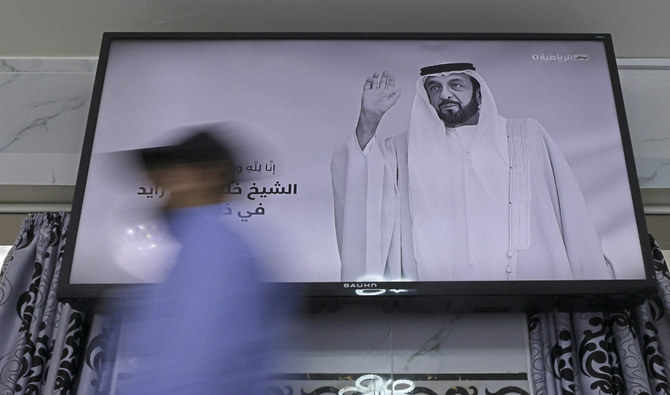
A local channel displays the portrait of late UAE's President Sheikh Khalifa bin Zayed Al-Nahyan, during a state mourning in Abu Dhabi on May 13, 2022. (AFP)
Short Url
Updated 13 May 2022
Follow

Italian president offers condolences to UAE over death of Sheikh Khalifa

  • Mattarella praises former leader’s “tenacity and farsightedness” in message to Sheikh Mohammed bin Rashid Al-Maktoum
  • European Commission President Ursula von der Leyen, European Council President Charles Michel convey their sympathies

ROME: Italian President Sergio Mattarella offered his condolences to the UAE on Friday upon the death of its former president, Sheikh Khalifa bin Zayed Al-Nahyan, remembering him for his “tenacity and farsightedness.”

In a message to Sheikh Mohammed bin Rashid Al-Maktoum, ruler of Dubai and the acting president of the UAE, Mattarella said he “learned with sadness the news of the passing of His Highness Khalifa Bin Zayed Al-Nahyan,” who, he added, had led his country on “an important path” of growth and development.

“Please accept, Your Highness, the expressions of the most sincere condolences of the Italian Republic and my own personal condolences, which I beg you to extend to the Royal Family and to the whole people the UAE,” Mattarella added.

Mattarella was joined in his condolences by leaders from across Europe and from the EU.

President of the European Commission Ursula von der Leyen said: “I offer my condolences to the people of the UAE on the passing of Sheikh Khalifa. The sheikh devoted his life to his country, working for the welfare and future of the Emirates.

“With him, the UAE became prosperous, tolerant and open to the world. His legacy will live on,” she added.

European Council President Charles Michel added in a message: “The EU honours Sheikh Khalifa’s legacy and leadership, under which the UAE became a frontrunner of sustainable development and economic diversification.”


EU to propose permanent ban on Russian oil after Hungary election, document shows

Updated 6 sec ago
Follow

EU to propose permanent ban on Russian oil after Hungary election, document shows

  • Two EU officials said the timing was designed to prevent the oil ban becoming a major factor in Hungary’s election campaign
  • Hungary and Slovakia, still reliant on Russian oil imports, are strongly opposed to any ban

BRUSSELS: The European Commission will submit a legal proposal to permanently ban Russian oil imports on April 15, three days after Hungary’s parliamentary election, according to EU officials and a document seen by Reuters.
Two EU officials told Reuters the timing was designed to prevent the oil ban becoming a major factor in Hungary’s election campaign. Hungary and Slovakia, still reliant on Russian oil imports, are strongly opposed to any ban.
In the April 12 election, Hungarian Prime Minister Viktor Orban and his nationalist Fidesz party are facing the biggest challenge to their hold on power in 16 ⁠years.
The EU has ⁠already imposed sanctions on imports of seaborne Russian oil. But it wants to enshrine a full phase-out of Russian oil in legislation that would remain in place, even if a peace deal in the Ukraine war led to the EU lifting sanctions.
The Commission plans to propose the Russian oil ban on April 15, according to a draft agenda seen by Reuters. EU agendas are provisional, and the date could ⁠still change.
A Commission spokesperson did not immediately respond to a request for comment on the plan.
Shipments of Russian oil to Hungary and Slovakia via the Druzhba pipeline have been severed since January 27, when Kyiv said a Russian drone strike hit pipeline equipment in Western Ukraine. Slovakia and Hungary say Ukraine is to blame for the prolonged outage. Kyiv says it is trying to repair the pipeline.

HUNGARIAN VETO
Orban’s government, which has maintained cordial ties with Moscow since the full-scale Russian invasion of Ukraine in 2022, has vetoed new EU sanctions on Russia as well as a huge loan for Kyiv because of the Druzhba pipeline dispute.
The European Union is ⁠expected to circumvent ⁠any attempt by Hungary and Slovakia to block the planned permanent ban on Russian oil imports by using a law that can be approved by a qualified majority of member states.
EU Energy Commissioner Dan Jorgensen has said the proposal will phase out Russian oil imports by no later than end-2027.
By the final quarter of last year, the EU was importing just 1 percent of its oil from Russia, largely as a result of the bloc’s sanctions on seaborne Russian crude.
The EU last month fixed into law a full phase-out of Russian gas by late 2027. Hungary and Slovakia have vowed to challenge that law in court.
Orban has cast Hungary’s April election as a stark choice between “war or peace,” saying his opponents would drag the country into the war raging next door in Ukraine, something they strongly deny.