Top investigating agency denies withdrawing money laundering case against PM Sharif

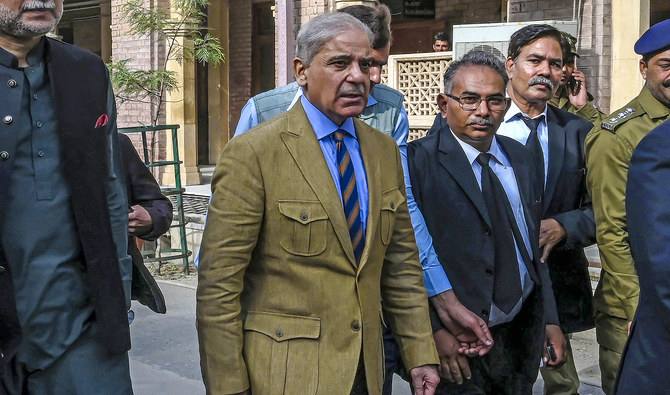
Pakistan Prime Minister Shehbaz Sharif, center, arrives at the High Court to attend a hearing in Lahore on November 16, 2019. (AFP/File)
Short Url
Updated 13 May 2022
Follow

Top investigating agency denies withdrawing money laundering case against PM Sharif

  • FIA says it only changed prosecutor in the case who submitted ‘opinion-based application’ in court
  • The application said FIA was not interested in pursuing Rs16 billion case against Sharif and his sons

ISLAMABAD: Pakistan’s Federal Investigation Agency (FIA) on Thursday denied withdrawing a high-profile money laundering case against Prime Minister Shehbaz Sharif, saying its proceedings were still continuing and the next day of hearing was May 14.

According to news reports based on court documents, the country’s top investigation agency said on Wednesday it did not want to pursue the Rs16 billion money laundering case against Sharif and his two sons three days before the special court in Lahore was scheduled to frame charges against them.

Sharif, who became prime minister last month after Imran Khan was ousted in a no-confidence vote in parliament, is the president of the ruling Pakistan Muslim League-Nawaz (PML-N) party.

Sharif, his sons Hamza, who is the chief minister of Punjab province, and Suleman, who resides in London, were booked by FIA in November 2020 under various sections of the Prevention of Corruption Act and Anti Money Laundering Act.

According to a written application submitted in court on Wednesday, the FIA director general (DG), via the investigating officer, told Special Prosecutor Sikander Zulqarnain Saleem not to appear in court as the “accused in the case are going to be elected the prime minister of Pakistan and chief minister of Punjab.”

“A fake news is circulating in media regarding withdrawal of the case against political leaders of a party in Lahore,” the FIA said in a statement. “The case has not been withdrawn. Proceedings are continuing in the Court. Next date of hearing is 14-05-2022.”

The statement said the prosecutor of the case submitted his “opinion-based application” in the court after he was instructed not to appear on behalf of prosecution.

“It was not a withdrawal application anyway,” it added.

The FIA said the document was submitted on April 11 when the new prime minister had not even taken oath.

“Change of prosecutor is a routine matter,” it continued. “In the time of previous government too, prosecutor was changed several times in this very case.”

Threatening to “legally proceed against the persons involved in spreading this fake news,” the FIA said “fake news may not be spread in this matter.”

The Sharifs have always said the cases against them are politically motivated and driven by now ex-PM Khan who won power in 2018 vowing to root out corruption among what he cast as a venal political elite.

While few dispute the need to clean up Pakistani politics, the anti-graft campaign by Pakistan’s National Accountability Bureau (NAB) in the last three and a half years has become a topic of fierce political debate, with many saying its focus was just on the government’s political foes.

The Khan government denied targeting political opponents.


No casualties as blast derails Jaffar Express train in Pakistan’s south

Updated 10 sec ago
Follow

No casualties as blast derails Jaffar Express train in Pakistan’s south

  • Passengers were stranded and railway staffers were clearing the track after blast, official says
  • In March 2025, separatist militants hijacked the same train with hundreds of passengers aboard

QUETTA: A blast hit Jaffar Express and derailed four carriages of the passenger train in Pakistan’s southern Sindh province on Monday, officials said, with no casualties reported.

The blast occurred at the Abad railway station when the Peshawar-bound train was on its way to Sindh’s Sukkur city from Quetta, according to Pakistan Railways’ Quetta Division controller Muhammad Kashif.

No group immediately claimed responsibility for the bomb attack, but passenger trains have often been targeted by Baloch separatist outfits in the restive Balochistan province that borders Sindh.

“Four bogies of the train were derailed due to the intensity of the explosion,” Kashif told Arab News. “No casualty was reported in the latest attack on passenger train.”

Another railway employee, who was aboard the train and requested anonymity, said the train was heading toward Sukkur from Jacobabad when they heard the powerful explosion, which derailed power van among four bogies.

“A small piece of the railway track has been destroyed,” he said, adding that passengers were now standing outside the train and railway staffers were busy clearing the track.

In March last year, fighters belonging to the Balochistan Liberation Army (BLA) separatist group had stormed Jaffar Express with hundreds of passengers on board and took them hostage. The military had rescued them after an hours-long operation that left 33 militants, 23 soldiers, three railway staff and five passengers dead.

The passenger train, which runs between Balochistan’s provincial capital of Quetta and Peshawar in the country’s northwest, had been targeted in at least four bomb attacks last year since the March hijacking, according to an Arab News tally.

Pakistan Railways says it has beefed up security arrangements for passenger trains in the province and increased the number of paramilitary troops on Jaffar Express since the hijacking in March, but militants have continued to target them in the restive region.

Balochistan, Pakistan’s southwestern province that borders Iran and Afghanistan, is the site of a decades-long insurgency waged by Baloch separatist groups who often attack security forces and foreigners, and kidnap government officials.

The separatists accuse the central government of stealing the region’s resources to fund development elsewhere in the country. The Pakistani government denies the allegations and says it is working for the uplift of local communities in Balochistan.