China In-Focus — Tesla denies halting production at Shanghai plant; Geely buys stake in Renault Korea

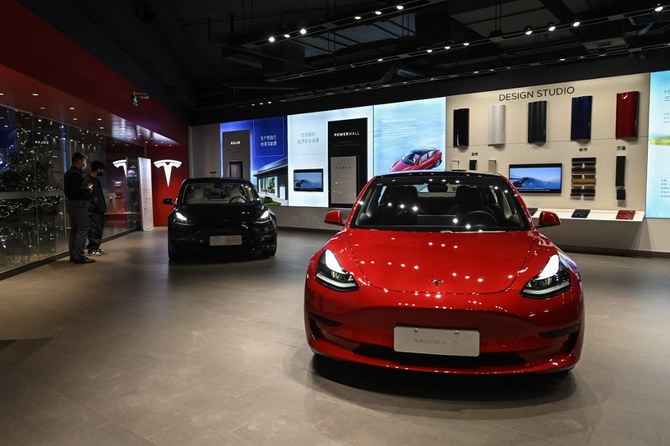
Tesla had planned as late as last week to increase output to pre-lockdown levels by next week. (AFP)
Short Url
Updated 10 May 2022
Follow

China In-Focus — Tesla denies halting production at Shanghai plant; Geely buys stake in Renault Korea

BEIJING: Electric vehicle maker Tesla has denied halting production at its Shanghai plant, despite reports it had ceased most activities due to problems in securing parts.

Reuters reported that according to an internal memo seen by the news agency, the plant plans to manufacture less than 200 vehicles Tuesday — far less than the roughly 1,200 units it has been building each day since shortly after it reopened on April 19 following a 22-day closure.

Two sources familiar with the matter had earlier said supply issues had forced the factory to halt production Monday.

The company has refuted the report, saying that it hasn’t halted output at the site, although a spokesperson for the US carmaker acknowledged that it is experiencing some disruption to logistics amid the city’s long-running Covid-19 lockdown.

Shanghai is in its sixth week of an intensifying COVID-19 lockdown that has tested the ability of manufacturers to operate amid hard restrictions on the movement of people and materials.

Tesla had planned as late as last week to increase output to pre-lockdown levels by next week.

It was not immediately clear when the current supply issues could be resolved, said the people, who asked not to be identified because the production plans are private.

China's Geely buys stake in Renault Korea

China’s Geely Automobile will buy just over a third of Renault’s Korea unit for roughly $200 million, potentially helping it boost US exports, and freeing up funds for the French automaker to invest in its electric business.

Renault, which can assemble 300,000 vehicles a year in its factory in Busan, South Korea, is in the middle of a turnaround aimed at increasing margins and separating its electric vehicle business to catch up with rivals such as Tesla.

The French firm’s move to sell the stake to Geely — which owns Volvo Cars and a 9.7 percent stake in Daimler AG — follows an announcement by the two companies in January to develop hybrid vehicles for South Korea and abroad, produced at the Busan plant.

For Geely, which has typically grown its business through global partnerships, the deal goes beyond selling cars in South Korea and is a way for the Chinese automaker to export cars made in South Korea to America, a person close to the company said.

“It is an open door into the US,” said the person who declined to be named because the plans are confidential.

(With input from Reuters) 


Saudi Arabia leads outcome-based education to prepare future-ready generations: Harvard Business Review

A Harvard sign is seen at the Harvard University campus in Boston, Massachusetts, on May 27, 2025. (AFP)
Updated 10 February 2026
Follow

Saudi Arabia leads outcome-based education to prepare future-ready generations: Harvard Business Review

  • The Riyadh-based school group developed a strategy that links every classroom activity to measurable student competencies, aiming to graduate learners equipped for the digital economy and real-world contexts

RIYADH: Saudi Arabia’s education system is undergoing a sweeping transformation aligned with Vision 2030, shifting from traditional, input-focused methods to outcome-based education designed to equip students with future-ready skills, Harvard Business Review Arabic reported.

The transformation is being adopted and spearheaded by institutions such as Al-Nobala Private Schools, which introduced the Kingdom’s first national “learning outcomes framework,” aimed at preparing a generation of leaders and innovators for an AI-driven future, the report said.

Al-Nobala has leveraged international expertise to localize advanced learning methodologies.

The Riyadh-based school group developed a strategy that links every classroom activity to measurable student competencies, aiming to graduate learners equipped for the digital economy and real-world contexts. The school’s group approach combines traditional values with 21st-century skills such as critical thinking, communication, innovation and digital fluency.

According to the report, the shift addresses the growing gap between outdated models built for low-tech, resource-constrained environments and today’s dynamic world, where learners must navigate real-time information, virtual platforms, and smart technologies.

“This is not just about teaching content, it’s about creating impact,” the report noted, citing how Al-Nobala’s model prepares students to thrive in an AI-driven world while aligning with national priorities.

The report noted that Saudi Arabia’s Ministry of Education has paved the way for this shift by transitioning from a centralized controller to a strategic enabler, allowing schools such as Al-Nobala to tailor their curriculum to meet evolving market and societal needs. This is part of the long-term goal to place the Kingdom among the top 20 global education systems.

Al-Nobala’s work, the report stated, has succeeded in serving the broader national effort to link education outcomes directly to labor market demands, helping to fulfill the Vision 2030 pillar of building a vibrant society with a thriving economy driven by knowledge and innovation.

Last February, Yousef bin Abdullah Al-Benyan, Saudi Arabia’s minister of education, said that the Kingdom was making “an unprecedented investment in education,” with spending aligned to the needs of growth and development. He said that in 2025, education received the second-largest share of the state budget, totaling $53.5 billion.