WASHINGTON: The United States will take steps to increase pressure on Afghanistan’s Taliban government to reverse some of its recent decisions restricting the rights of women and girls if the hard-line group shows no sign of rescinding the actions on its own.
“We’ve addressed it directly with the Taliban,” State Department spokesperson Ned Price said in a briefing on Monday. “We have a number of tools that, if we feel these won’t be reversed, these won’t be undone, that we are prepared to move forward with.”
He did not elaborate on the possible steps or indicate how the group, which has already implemented policies curbing 20 years of gains for girls’ and women’s rights, might have a change of heart.
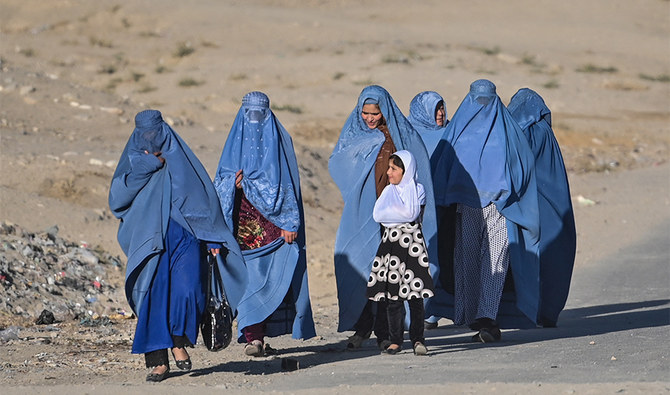
The Taliban on Saturday ordered women to cover their faces in public, a return to a signature policy of their past hard-line rule and an escalation of restrictions that are causing anger at home and abroad.
The ideal face covering was the all-encompassing blue burqa, the group said, referring to the garment that was obligatory for women in public during the Taliban’s previous 1996-2001 rule.
The international community has made the education of girls a key demand for any future recognition of the Taliban administration, which took over the country in August as foreign forces withdrew.
Despite that, the Taliban has restricted girls and women from working and limited their travel unless accompanied by a close male relative. Most girls were also barred from going to school beyond seventh grade.
“We’ve consulted closely with our allies and partners,” Price said. “There are steps that we will continue to take to increase pressure on the Taliban to reverse some of these decisions, to make good on the promises that they have made.”
A key piece of leverage held by Washington over the group is the $7 billion in frozen Afghan central bank assets on US soil — half of which the Biden administration is seeking to free up to help the Afghan people, the administration has said.
The United States and other countries have already cut development aid and sanctioned the banking system since the group took over, pushing Afghanistan toward economic ruin.
US Special Representative for Afghanistan Tom West expressed “deep concern” over the Saturday decision in a series of tweets, while the US Ambassador to the United Nations Linda Thomas-Greenfield said it was an “unconscionable” move.
Most women in Afghanistan wear a headscarf for religious reasons but many in urban areas such as Kabul do not cover their faces.

US says will increase pressure on Taliban after burqa edict, new restrictions on women
https://arab.news/wxfrd
US says will increase pressure on Taliban after burqa edict, new restrictions on women
- The Taliban on Saturday ordered women to cover their faces in public
- Most girls have also been barred from going to school beyond seventh grade
Filipinos celebrate Christmas on a budget amid soaring costs
- Filipinos are choosing modest Christmas gifts, scaling down year-end festivities
- Millions look to content creators for tips on how to spend less for Christmas dinner
MANILA: As the predominantly Catholic Philippines celebrates one of its most important annual holidays on Thursday, many Filipinos have been forced to rethink their traditional Christmas celebrations amid soaring prices.
This year, street food vendor Gemma Gracia is among those who will keep her business open during the holidays.
“As a vendor, I’ve felt the prices go up since I also still buy at the market for our needs and for our selling needs,” she told Arab News.
But as celebrating Christmas was important for her family, the 39-year-old has allocated 1,000 Philippine pesos ($17) for a family meal out at Jollibee, the Philippines’ biggest fast-food chain restaurant.
“When you don’t have food to share on the table on this holiday, it’s a sad day. That’s why we make sure that we always have something on the table each year,” she said.
For many Filipinos, the time-honored traditions of Noche Buena, or Christmas Eve, is the most awaited part of this holiday season, when dinner tables across the country are filled with a hearty selection of traditional dishes.
Noche Buena, which is Spanish for “the good night,” is the dinner that follows the last evening mass of the season, known as misa de gallo or simbang gabi.
In the Philippines, such festive staples include meaty Filipino-style spaghetti and hamonado, the local version of a Christmas ham that usually serves as the centerpiece of Christmas dinner tables.
But the pinch from rising prices has affected Filipino shoppers in recent years, forcing them to adjust according to their budget.
Although the country’s central bank said inflation had eased to 1.5 percent in November, many say the statistics do not reflect on-the-ground realities, where people reel from rising retail prices, shrinking portions and diminishing purchasing power of the peso.
Allan Manansala, a 48-year-old construction worker in Manila, told Arab News that he is expecting to spend 5,000 pesos for his family of five in 2025, nearly a third of his monthly wage and about a fifth higher than what he spent in previous years.
“I might have to skip giving my children gifts this year because of the costs,” he said.
To get around the high costs, Manansala is skipping the Noche Buena festivities altogether and has instead decided to splurge on New Year’s Eve dinner, which is also a significant occasion in the Philippines.
Others, like Allan Melenio, look for different ways to save up.
“Our relative owns a meat shop, so we’re able to save on that since the prices are quite low,” he told Arab News. “But everywhere else, a piece of meat can cost so much.”
While the economy has forced Filipinos to make smarter choices and get creative, content creators are among those offering ideas to address consumers’ woes, teaching people how to stretch their meager budgets for the holidays.
One such tip came from Ninong Ry, a food content creator who challenged himself to prepare an eight-dish Noche Buena dinner with a budget of 1,500 pesos. Posted about two weeks before Christmas, his one-hour YouTube video has since garnered more than 1.4 million views.
The video was also a response to comments from Philippine Trade Secretary Cristina Aldeguer-Roque, who suggested last month that 500 pesos was enough for a family of four to host a modest Christmas Eve dinner, sparking anger among Filipinos who said she was out of touch with reality.
Jelmark Toqueb, who works as a plumber in Manila, said that the 500-peso budget was unrealistic.
“It is clearly not enough. (Five hundred pesos) is not even enough for you to cook spaghetti with meat. Maybe just the noodles and the sauce,” he told Arab News.
For 32-year-old Toqueb and his wife, who works as a public school teacher, the holiday season remains a cherished occasion to spend quality time with the family. As their Christmas tradition involves gift-giving, he chose more modest presents this year to circumvent the high costs.
“The prices now are different even from last year, (when they were) already high,” Toqueb said. “Even if the gift is simple, it’s fine. It’s the thought that counts.”


