

President rejects PM’s advice to remove key Imran Khan ally as Punjab governor

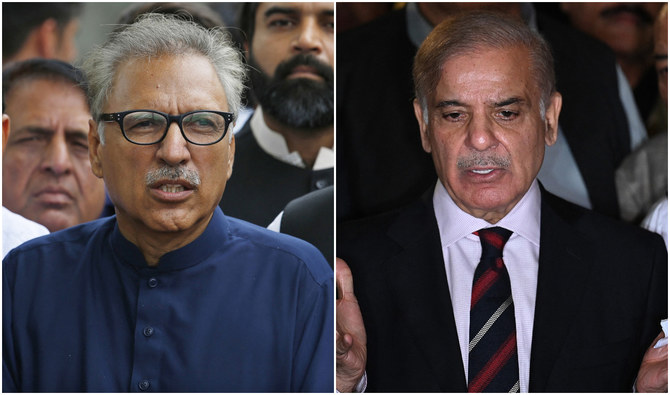
The collage shows Pakistan's President Dr. Arif Alvi (left) and Prime Minister Shehbaz Sharif. (Photo courtesy: AFP/File)
Short Url
Updated 09 May 2022
Follow

President rejects PM’s advice to remove key Imran Khan ally as Punjab governor

  • Omar Sarfraz Cheema was appointed governor last month amid no-confidence motion against ex-PM
  • Sharif-led government has sent summary to president nominating senior ruling party leader Baligh-ur-Rehman for governor

ISLAMABAD: Pakistani president Dr. Arif Alvi on Monday “strongly” rejected the advice of Prime Minister Shehbaz Sharif to remove a key ally of former premier Imran Khan from the post of governor of the province of Punjab, bringing deep political divisions to the fore.
Omar Sarfraz Cheema, a member of Khan’s Pakistan Tehreek-e-Insaf party since 1996, was appointed governor Punjab last month amid a no-confidence motion filed against Khan in parliament, which saw many of his allies, including then governor Chaudhry Mohammad Sarwar, jumping ship and joining the opposition.
Khan was subsequently ousted from office in the no-trust vote and Sharif appointed the new PM by parliament.
Last week, the Sharif-led government sent a summary to the president, also a close Khan aide, to remove Cheema, nominating a senior ruling party leader Baligh-ur-Rehman as his replacement.
“President Dr. Arif Alvi strongly rejects Prime Minister’s advice to remove Governor Punjab,” Alvi’s office tweeted. “The President has conveyed to the Prime Minister of Pakistan that Governor Punjab cannot be removed without his approval.”
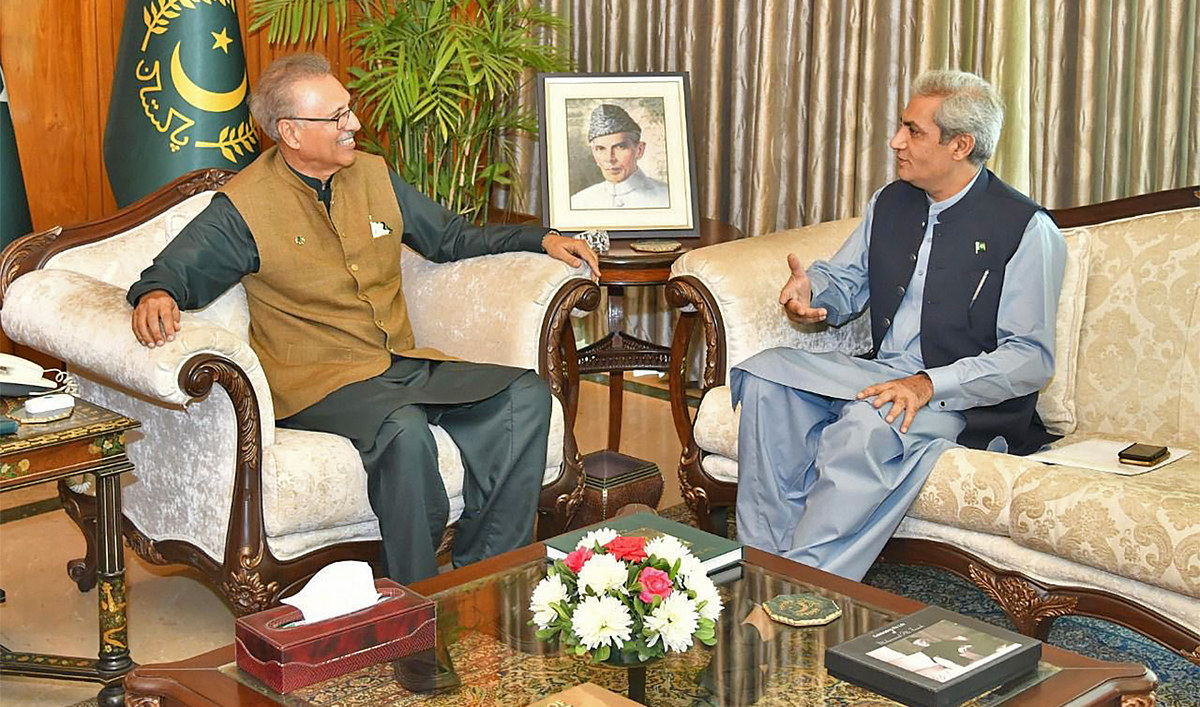


The file photo shows Pakistan's President Dr. Arif Alvi (left) meeting Governor of Punjab province Omar Sarfraz Cheema in Islamabad, Pakistan, May 7, 2022. (@OmarCheemaPTI/Twitter)

A governor in Pakistan is the appointed head of state of a province. He or she is appointed by the president on the advice of the prime minister and can serve for a tenure that lasts up to five years.
“Referring to clause 3 of Article 101 of the Constitution, he [Alvi stated that ‘the Governor shall hold office during the pleasure of the President’,” the president’s tweet said. “The incumbent governor cannot be removed as there was neither any allegation of misconduct nor conviction by any court of law or of any act committed by him contrary to the Constitution of Pakistan.”


Pakistan says 41 suspected militants killed in operations in restive Balochistan province

Updated 10 sec ago
Follow

Pakistan says 41 suspected militants killed in operations in restive Balochistan province

  • Military says intelligence-based raids carried out in Harnai and Panjgur districts
  • Islamabad repeats claim militants backed by New Delhi, an allegation India denies

ISLAMABAD: Pakistani security forces killed 41 suspected militants in two separate intelligence-based operations in the southwestern province of Balochistan, the military said on Thursday, alleging the fighters were linked to India. 

The operations were carried out in the districts of Harnai and Panjgur in Balochistan, Pakistan’s largest but least developed province and home to a long running separatist insurgency that frequently targets security personnel, government infrastructure and non-local residents.

“On 29 January 2026, 41 terrorists belonging to Indian proxy, Fitna al Khwarij and Fitna al Hindustan, were killed in two separate operations in Balochistan,” the military’s media wing, Inter-Services Public Relations (ISPR), said in a statement.

According to the ISPR, 30 militants were killed in Harnai district following a “heavy exchange of fire,” during which security forces also destroyed a cache of recovered weapons and explosives.

In a separate intelligence-based operation in Panjgur district, the military said 11 additional suspected militants were killed after security forces raided a hideout.

“Besides weapons and ammunition, looted money from bank robbery in Panjgur on 15 December 2025 were also recovered from the killed terrorists,” the statement said.
“The terrorists were involved in numerous terrorist activities in the past.”

Pakistan’s military and government frequently use the terms “Fitna al Khwarij” and “Fitna al Hindustan” to describe militant groups it associates with the Pakistani Taliban and alleged Indian support.

The ISPR said follow-up “sanitization operations” were underway to eliminate any remaining militants in the area, describing them as “Indian-sponsored terrorists.”

Islamabad has repeatedly accused India of backing separatist groups in Balochistan to destabilize Pakistan, an allegation New Delhi denies.

Earlier this month, Pakistan’s counterterrorism police said they killed five militants planning attacks on security forces and an attempt to block the Quetta–Sibi highway, a key transport route. On Jan. 25, the military also reported killing three militants, including a local commander, in an intelligence-based operation in Panjgur.

Balochistan is strategically important due to its vast mineral resources and its role as a transit corridor for the China-Pakistan Economic Corridor (CPEC), a multibillion-dollar infrastructure initiative linking Pakistan with China.

Separatist groups such as the Balochistan Liberation Army (BLA) accuse Islamabad of exploiting the province’s natural resources without fair local benefit, a claim the government rejects.