WASHINGTON: The Federal Reserve intensified its fight against the worst inflation in 40 years by raising its benchmark interest rate by a half-percentage point Wednesday — its most aggressive move since 2000 — and signaling further large rate hikes to come.
The increase in the Fed’s key short-term rate raised it to a range of 0.75 percent to 1 percent, the highest point since the pandemic struck two years ago.
The Fed also announced that it will start reducing its huge $9 trillion balance sheet, made up mainly of Treasury and mortgage bonds. Reducing those holdings will have the effect of further raising loan costs throughout the economy.
With prices for food, energy and consumer goods accelerating, the Fed’s goal is to cool spending — and economic growth — by making it more expensive for individuals and businesses to borrow. The central bank hopes that higher costs for mortgages, credit cards and auto loans will slow spending enough to tame inflation yet not so much as to cause a recession.
It will be a delicate balancing act. The Fed has endured widespread criticism that it was too slow to start tightening credit, and many economists are skeptical that it can avoid causing a recession.
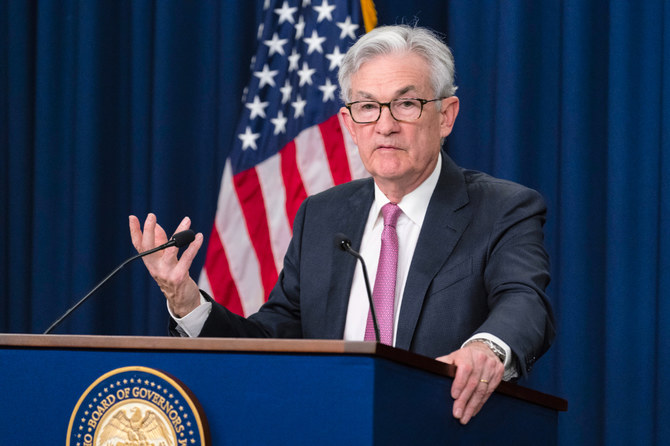
Speaking at a news conference Wednesday, Chair Jerome Powell made clear that further large rate hikes are coming. He said that additional half-point increases in the Fed’s key rate “should be on the table in the next couple of meetings” in June and July.
But Powell also sought to downplay any speculation that the Fed might be considering a rate hike as high as three-quarters of a percentage point.
“A 75-basis-point hike is not something that the committee is actively considering,” he said — a remark that appeared to cause stock indexes to jump. Before he spoke, the Dow Jones Industrial Average had risen modestly. Less than an hour later, the Dow was up 700-plus points.
At his news conference, Powell stressed his belief that “restoring price stability” — that is, curbing high inflation — is essential to sustaining the economy’s health.
In their statement Wednesday, the central bank’s policymakers noted that Russia’s invasion of Ukraine is worsening inflation pressures by raising oil and food prices. It added that “COVID-related lockdowns in China are likely to exacerbate supply chain disruptions,” which could further boost inflation.
Inflation, according to the Fed’s preferred gauge, reached 6.6 percent last month, the highest point in four decades. Inflation has been accelerated by a combination of robust consumer spending, chronic supply bottlenecks and sharply higher gas and food prices, exacerbated by Russia’s war against Ukraine.
Starting June 1, the Fed said it would allow up to $48 billion in bonds to mature without replacing them, a pace that would reach $95 billion by September. At September’s pace, its balance sheet would shrink by about $1 trillion a year. The balance sheet more than doubled after the pandemic recession hit as the Fed bought trillions in bonds to try to hold down long-term borrowing rates.
Powell has said he wants to quickly raise the Fed’s rate to a level that neither stimulates nor restrains economic growth. Fed officials have suggested that they will reach that point, which the Fed says is about 2.4 percent, by year’s end.
Some economists warn that some of the factors fueling inflation — notably, shortages of supplies and workers — are outside the Fed’s ability to solve.
“The Fed can’t fix supply-side challenges with higher interest rates,’’ said Jim Baird, chief investment officer at Plante Moran Financial Advisers. “Fed tightening doesn’t re-open Chinese factories, increase grain shipments from Ukraine, re-position container ships to where they are needed or hire truckers to move goods.’’
The Fed’s credit tightening is already having some effect on the economy. Sales of existing homes sank 2.7 percent from February to March, reflecting a surge in mortgage rates related, in part, to the Fed’s planned rate hikes. The average rate on a 30-year mortgage has jumped 2 percentage points just since the start of the year, to 5.1 percent.
Yet by most measures, the overall economy remains healthy. This is especially true of the US job market: Hiring is strong, layoffs are few, unemployment is near a five-decade low and the number of job openings has reached a record high.
Powell has pointed to the widespread availability of jobs as evidence that the labor market is tight – “to an unhealthy level” that would tend to fuel inflation. The Fed char is betting that higher rates can reduce those openings, which would presumably slow wage increases and ease inflationary pressures, without triggering mass layoffs.
For now, with hiring robust — the economy has added at least 400,000 jobs for 11 straight months — and employers grappling with labor shortages, wages are rising at a roughly 5 percent annual pace. Those pay raises are driving steady consumer spending despite spiking prices. In March, consumers increased their spending 0.2 percent even after adjusting for inflation.
Even if the Fed’s benchmark rate were to go as high as 2.5 percent by year’s end, Powell said last month, the policymakers may still tighten credit further — to a level that would restrain growth — “if that turns out to be appropriate.”
Financial markets are pricing in a rate as high as 3.6 percent by mid-2023, which would be the highest in 15 years. Shrinking the Fed’s balance sheet will add another layer of uncertainty surrounding how much the Fed’s actions may weaken the economy.
Complicating the Fed’s task is a slowdown in global growth. COVID-19 lockdowns in China are threatening to cause a recession in the world’s second-largest economy. And the European Union is facing higher energy prices and supply chain disruptions after Russia’s invasion of Ukraine.
What’s more, other central banks around the world are also raising rates, a trend that could further imperil global growth. On Thursday, the Bank of England is expected to raise its key rate for the fourth straight time. The Reserve Bank of Australia increased its rate Tuesday for the first time in 11 years.
And the European Central Bank, which is grappling with slower growth than in the United States or the United Kingdom, may raise rates in July, economists expect.


![]()

US Federal Reserve raises key rate by a half-point in bid to tame inflation
Short Url
https://arab.news/z5ygm
US Federal Reserve raises key rate by a half-point in bid to tame inflation

Latest updates


© 2026 SAUDI RESEARCH & PUBLISHING COMPANY, All Rights Reserved And subject to Terms of Use Agreement.