US Federal Reserve is set to raise rates four times this year: Goldman Sachs

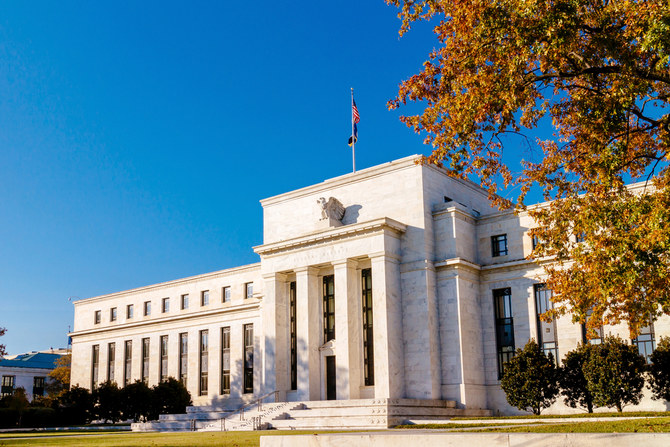
Federal Reserve Building, Washington DC, USA. (Shutterstock)
Short Url
Updated 10 January 2022
Follow

US Federal Reserve is set to raise rates four times this year: Goldman Sachs

Four hikes in the US interest rate, as well as the sale of the Federal Reserve’s assets, are expected this year, Goldman Sachs Group said.

The balance sheet runoff process – which is the reduction of an entity’s assets – could take place in July, or even earlier, Bloomberg reported, citing the investment bank.

This is compared to Goldman’s previous forecast that the process would start in December.

The firm said this shift in projections was driven by a momentum-gaining labor market and potential hawkish policies which were revealed in the minutes from the Dec. 14-15 Federal Open Market Committee meeting.

As inflation will probably remain above target, the New York-based firm predicts rate hikes in March, June, September and December. They also reversed their earlier projection, which stated that the start to the runoff won’t require a quarterly rate hike.

In its last meeting, the Federal Reserve indicated that it is pushing for a quicker tightening and normalization of monetary policy. This is to combat strong inflationary pressures and an economy approaching full employment.

Wages increased and the country’s unemployment rate declined to under 4 percent last month, signaling a tight labor market.


Saudi Arabia’s foreign reserves rise to a 6-year high of $475bn

Updated 22 February 2026
Follow

Saudi Arabia’s foreign reserves rise to a 6-year high of $475bn

RIYADH: Saudi Arabia’s foreign reserves climbed 3 percent month on month in January to SR1.78 trillion, up SR58.7 billion ($15.6 billion) from December and marking a six-year high.

On an annual basis, the Saudi Central Bank’s net foreign assets rose by 10 percent, equivalent to SR155.8 billion, according to data from the Saudi Central Bank, Argaam reported.

The reserve assets, a crucial indicator of economic stability and external financial strength, comprise several key components.

According to the central bank, also known as SAMA, the Kingdom’s reserves include foreign securities, foreign currency, and bank deposits, as well as its reserve position at the International Monetary Fund, Special Drawing Rights, and monetary gold.

The rise in reserves underscores the strength and liquidity of the Kingdom’s financial position and aligns with Saudi Arabia’s goal of strengthening its financial safety net as it advances economic diversification under Vision 2030.

The value of foreign currency reserves, which represent approximately 95 percent of the total holdings, increased by about 10 percent during January 2026 compared to the same month in 2025, reaching SR1.68 trillion.

The value of the reserve at the IMF increased by 9 percent to reach SR13.1 billion.

Meanwhile, SDRs rose by 5 percent during the period to reach SR80.5 billion.

The Kingdom’s gold reserves remained stable at SR1.62 billion, the same level it has maintained since January 2008.

Saudi Arabia’s foreign reserve assets saw a monthly rise of 5 percent in November, climbing to SR1.74 trillion, according to the Kingdom’s central bank.

Overall, the continued advancement in reserve assets highlights the strength of Saudi Arabia’s fiscal and monetary buffers. These resources support the national currency, help maintain financial system stability, and enhance the country’s ability to navigate global economic volatility.

The sustained accumulation of foreign reserves is a critical pillar of the Kingdom’s economic stability. It directly reinforces investor confidence in the riyal’s peg to the US dollar, a foundational monetary policy, by providing SAMA with ample resources to defend the currency if needed.

Furthermore, this financial buffer enhances the nation’s sovereign credit profile, lowers national borrowing costs, and provides essential fiscal space to navigate global economic volatility while continuing to fund its ambitious Vision 2030 transformation agenda.