

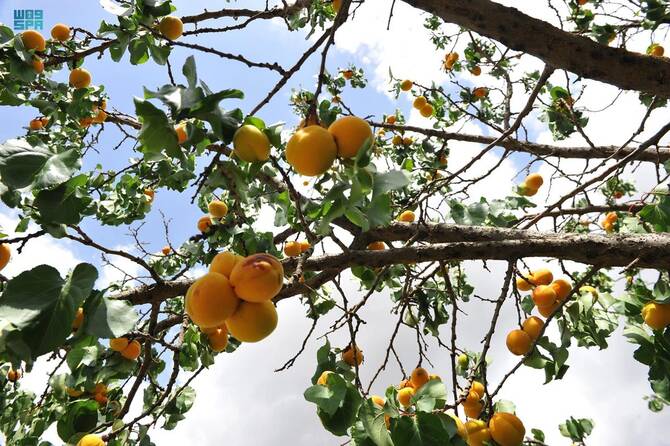
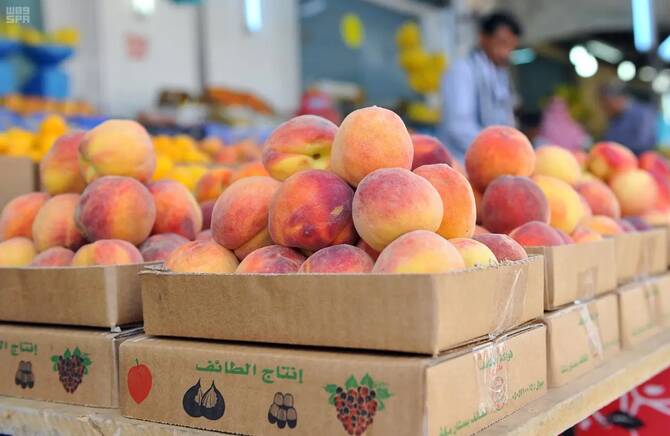


MAKKAH: Taif’s farms are becoming more than places of production, offering visitors a closer look at the orchards, harvests and agricultural traditions that have long defined the region.
As summer arrives, Taif’s orchards bring seasonal color to its agricultural terraces, valleys and highlands, producing almonds, peaches, apricots, pomegranates, grapes, mountain figs and prickly pears.
Fruit farms extend across several agricultural areas in Taif and Maysaan governorates. Official reports show that the two governorates produce a diverse range of seasonal fruits, with surplus harvests distributed to markets in Makkah, Jeddah, Riyadh and other cities across the Kingdom.
Atiyah Al-Thaqafi, a farm owner in southern Taif, says agriculture is more than a source of income for the region’s residents; it is a way of life deeply rooted in the land, water, and rhythm of the seasons.
Farms in the area produce successive crops, he explained, from early-season varieties to pomegranates, grapes and prickly pears, despite lower water availability this year compared with previous years.
Local almonds hold a particular place in Taif’s agricultural heritage, alongside apricots, peaches, plums and other traditional crops.
Al-Thaqafi said producing high-quality fruit requires careful attention from the earliest stages, including irrigation, fertilization and pruning, through to harvesting at the right time.
Farmers also consider how well the produce will reach consumers, particularly when harvests are shipped to other cities. Careful sorting, packaging and handling are increasingly important as Taif’s fruits reach markets beyond the region.
Abdullah Al-Humaidi, another farm owner, said the succession of fruit seasons gives Taif a distinct agricultural advantage, allowing farmers to maintain activity throughout the year rather than relying on a single crop.
Peaches, apricots, pomegranates, grapes and mountain figs are among the crops that attract visitors, he said, with some tourists choosing to visit farms and buy produce directly from growers.
Farmers are also paying greater attention to presentation, packaging and marketing as their produce reaches wider markets across the Kingdom, he said. During periods of abundant production, broader distribution helps them access new markets and absorb surplus harvests.
For Abdullah Al-Sakhiri, pomegranates and grapes are among the highlights of Taif’s agricultural season. He said producing high-quality fruit requires months of care, with pomegranates requiring close attention throughout their growth and grapes needing continuous cultivation to produce healthy clusters.
For farmers, he said, protecting the quality of the produce also means protecting the reputation Taif’s fruits have built among consumers.
Fahd Al-Hamdi, a farm owner, highlighted prickly pears, figs and other local crops as part of Taif’s agricultural diversity. Prickly pears, widely cultivated in the mountainous areas, have a distinct season and remain closely associated with the region’s agricultural heritage.
Agricultural sources identify prickly pears as a distinctive crop of Taif’s highlands, particularly Al-Shafa, while Maysaan is known for its almonds. Several southern areas are also distinguished by grapes, pomegranates, peaches, apricots and figs.
Beyond production and distribution, the farms are becoming part of Taif’s tourism appeal.
During harvest seasons, visitors can explore orchards, observe fruit trees, learn about cultivation and harvesting, and buy fresh produce directly from farmers.
From the terraced farms of southern Taif to its fertile valleys, each season brings a distinctive harvest.
As almonds, peaches, apricots, pomegranates, grapes, figs and prickly pears make their way to consumers across the Kingdom, they carry with them the flavors and agricultural identity of Taif.


