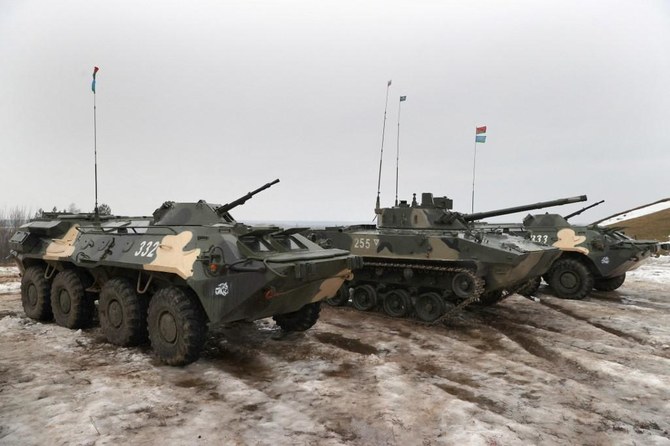
MOSCOW: Belarus, a Moscow ally that shares a border with Ukraine, launched “surprise” military maneuvers on Wednesday, to test the reactive capacity of its army, its defense ministry said.
Belarus military units were testing their capacity to “go on the alert, move to predetermined zones and undertake combat training,” the ministry said in a statement.
“The aim is to evaluate the readiness and ability of troops to react rapidly to a possible crisis,” it continued, describing the maneuvers as a “surprise” exercise.
It published photos of columns of vehicles, including tanks, moving along roads.
The exercise will be closely watched by Kyiv, which has repeatedly accused Belarus of planning to send troops into Ukraine to help Russia’s military operation against its pro-Western neighbor.
Belarus has been ruled with an iron fist by strongman Alexander Lukashenko, an ally of Russian President Vladimir Putin, for nearly 30 years. The country serves as an air and logistics base for Moscow.
Nevertheless, not all Belarusians are in favor of participation, however indirect, in the current conflict and there have been acts of sabotage in recent months and several suspects have been arrested.
In 2020, Belarus was rocked by protests over the allegedly fraudulent re-election of Lukashenko, who ordered a ferocious crackdown on the dissent.

Belarus launches ‘surprise’ military maneuvers
Short Url
https://arab.news/rjms5
Belarus launches ‘surprise’ military maneuvers
- Exercise closely watched by Kyiv, which has repeatedly accused Belarus of planning to send troops into Ukraine
Police target Ukrainians and Russian in ransomware probe
BERLIN: Police have carried out raids against two members of a ransomware group known as “Black Basta” in Ukraine, and issued an arrest warrant for its Russian head, German prosecutors said Thursday.
The group is accused of using malware to encrypt systems and then demanding money to restore them.
Between March 2022 and February 2025, its members extorted hundreds of millions of euros from around 600 companies and public institutions around the world, the prosecutors said in a statement.
The victims were mainly “companies in Western industrialized nations” but also included hospitals and other public institutions.
As part of a coordinated operation between Germany, the Netherlands, Switzerland, Ukraine and Britain, police searched the homes of two Ukrainian suspects and seized evidence, the prosecutors said.
Investigators have also identified and issued an arrest warrant for a Russian citizen accused of being the founder and head of the group, they said.
German police named the suspect as Oleg Evgenievich Nefedov, 35.
Nefedov “decided on targets, recruited employees, assigned them tasks, participated in ransom negotiations, managed the proceeds and used them to pay the members of the group,” the police said.
The searches in Ivano-Frankivsk and Lviv were directed against suspected members of the group accused of so-called hash cracking, a method of guessing passwords.
Ukrainian officials also searched the home of another member of the group near Kharkiv in August, whose job was allegedly to help ensure the malware was not detected by antivirus programs.
Black Basta extorted some 20 million euros ($23 million) from around 100 companies and institutions in Germany alone, the prosecutors said.
The group is accused of using malware to encrypt systems and then demanding money to restore them.
Between March 2022 and February 2025, its members extorted hundreds of millions of euros from around 600 companies and public institutions around the world, the prosecutors said in a statement.
The victims were mainly “companies in Western industrialized nations” but also included hospitals and other public institutions.
As part of a coordinated operation between Germany, the Netherlands, Switzerland, Ukraine and Britain, police searched the homes of two Ukrainian suspects and seized evidence, the prosecutors said.
Investigators have also identified and issued an arrest warrant for a Russian citizen accused of being the founder and head of the group, they said.
German police named the suspect as Oleg Evgenievich Nefedov, 35.
Nefedov “decided on targets, recruited employees, assigned them tasks, participated in ransom negotiations, managed the proceeds and used them to pay the members of the group,” the police said.
The searches in Ivano-Frankivsk and Lviv were directed against suspected members of the group accused of so-called hash cracking, a method of guessing passwords.
Ukrainian officials also searched the home of another member of the group near Kharkiv in August, whose job was allegedly to help ensure the malware was not detected by antivirus programs.
Black Basta extorted some 20 million euros ($23 million) from around 100 companies and institutions in Germany alone, the prosecutors said.
© 2026 SAUDI RESEARCH & PUBLISHING COMPANY, All Rights Reserved And subject to Terms of Use Agreement.


