MOSCOW: Belarus has granted political asylum to a US man wanted over the attack on the US Capitol by supporters of former president Donald Trump, according to the Belta news agency.
“US citizen Evan Neumann has obtained refugee status in Belarus,” it said late Tuesday.
According to local media, Neumann entered Belarus illegally from Ukraine in August and demanded political asylum in the former Soviet country a few months later.
“I feel safe in Belarus,” the Belta agency quoted him as saying. “I am calm, I like this country.”
According to the FBI website, a 49-year-old Evan Neumann was indicted in December, 2021 on 14 counts over the attack on the US Capitol.
He fled the US in February 2021 and is believed to have ties to Belarus and Ukraine.
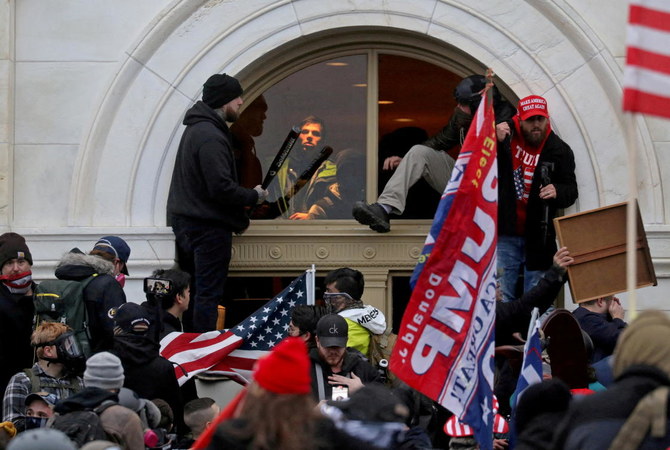
The storming of the US Capitol on January 6, 2021 left at least five people dead and 140 police officers injured and followed a fiery speech by Trump to thousands of his supporters near the White House.
More than 750 people have been arrested for their roles in the January 6 attack.


Belarus grants asylum to US man wanted over Capitol attack
https://arab.news/6fpcd
Belarus grants asylum to US man wanted over Capitol attack

- "US citizen Evan Neumann has obtained refugee status in Belarus,”
- "I feel safe in Belarus," the Belta agency quoted him as saying


UNICEF warns of rise in sexual deepfakes of children
- The findings underscored the use of “nudification” tools, which digitally alter or remove clothing to create sexualized images
UNITED NATIONS, United States: The UN children’s agency on Wednesday highlighted a rapid rise in the use of artificial intelligence to create sexually explicit images of children, warning of real harm to young victims caused by the deepfakes.
According to a UNICEF-led investigation in 11 countries, at least 1.2 million children said their images were manipulated into sexually explicit deepfakes — in some countries at a rate equivalent to “one child in a typical classroom” of 25 students.
The findings underscored the use of “nudification” tools, which digitally alter or remove clothing to create sexualized images.
“We must be clear. Sexualized images of children generated or manipulated using AI tools are child sexual abuse material,” UNICEF said in a statement.
“Deepfake abuse is abuse, and there is nothing fake about the harm it causes.”
The agency criticized AI developers for creating tools without proper safeguards.
“The risks can be compounded when generative AI tools are embedded directly into social media platforms where manipulated images spread rapidly,” UNICEF said.
Elon Musk’s AI chatbot Grok has been hit with bans and investigations in several countries for allowing users to create and share sexualized pictures of women and children using simple text prompts.
UNICEF’s study found that children are increasingly aware of deepfakes.
“In some of the study countries, up to two-thirds of children said they worry that AI could be used to create fake sexual images or videos. Levels of concern vary widely between countries, underscoring the urgent need for stronger awareness, prevention, and protection measures,” the agency said.
UNICEF urged “robust guardrails” for AI chatbots, as well as moves by digital companies to prevent the circulation of deepfakes, not just the removal of offending images after they have already been shared.
Legislation is also needed across all countries to expand definitions of child sexual abuse material to include AI-generated imagery, it said.
The countries included in the study were Armenia, Brazil, Colombia, Dominican Republic, Mexico, Montenegro, Morocco, North Macedonia, Pakistan, Serbia, and Tunisia.


