

Pakistani with hearing impairment tailors the way for workers with disabilities

1 / 4
Haroon Razzaq communicates with customers at this shop in Yat Road, Quetta, Balochistan, southwestern Pakistan, on April 24, 2022. (AN Photo)
2 / 4
Stitchers are busy at work at Haroon Razzaq's shop in Yat Road, Quetta, Balochistan, southwestern Pakistan, on April 24, 2022. (AN Photo)
3 / 4
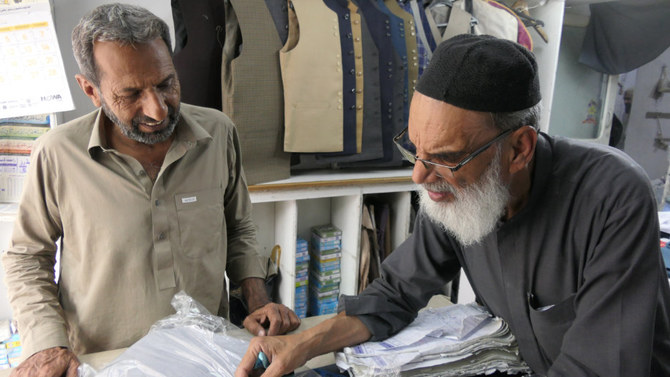
Customer Sohail Akhtar communicates in writing with deaf master tailor Haroon Razzaq at his shop in Yat Road, Balochistan, southwestern Pakistan, on April 24, 2022. (AN Photo)
4 / 4
Deaf stitcher Naveed is busy sewing orders for Eid Al-Fitr at Haroon Razzaq's shop in Yat Road, Balochistan, southwestern Pakistan, on April 24, 2022. (AN Photo)
Short Url
Updated 03 May 2022
Follow

Pakistani with hearing impairment tailors the way for workers with disabilities

  • Haroon Razzaq learned his profession at the age of 15 and has been sewing clothes for the past 50 years
  • Knowing socio-cultural and economic difficulties living with a disability poses in Pakistan, he started employing deaf workers

QUETTA: At Haroon Razzaq’s tailor shop in Quetta, there is little chatter. Workers are busy completing orders and only the whirring of sewing machines fills the space. Many of them, including the master outfitter, cannot hear it.

Born deaf, Razzaq learned his profession at the age of 15 and has been sewing clothes for the past 50 years.

Knowing the different socio-cultural and economic difficulties living with a disability poses in Pakistan when he opened his own shop in 1983, he also created a space where he could empower others.

“I started hiring deaf and hard-of-hearing workers in my shop to give them jobs,” Razzaq told Arab News at his shop on Yat Road, Quetta, the capital of Pakistan’s Balochistan.

“In our society, the majority of people with physical or other impairments start begging in order to sustain themselves, or their families consider them a burden.”

Razzaq currently employs 19 people. Half of them are deaf or hard of hearing.  

“They feel comfortable at my shop because I can communicate with them more quickly,” he said.

The nine disabled stitchers who work at his shop are not the only ones he has trained. There have been many more over the years and most of them have started their own careers.

“Many of my apprentices with speaking and hearing impairments are now working as professional stitchers in various tailor shops in Quetta,” Razzaq said.

Razzaq has hundreds of faithful customers in Quetta. One of them, Sohail Akhter, has been coming to his shop for the last 30 years.

He has never faced any problems in communicating with the tailor. He writes his request on paper and Razzaq answers in writing too.

“For the last three decades, the master tailor Haroon and his craftsmen have never given us a reason to complain,” he said.

“They have been sewing our clothes with perfection.”

Ejaz Qadri, a cutter at Razzaq’s shop who has no hearing impairments, said that in the first days it was difficult for him to communicate with him, but the barrier soon disappeared and for the past eight years he has been enjoying working at the shop where conditions and wages are better than elsewhere.

“I have worked at many tailor shops where masters mistreat their apprentices,” he said. “But Haroon helps and encourages his workers.”

Naveed, a 37-year-old who learned the craft from Razzaq over 10 years ago, said it gave him the chance to earn with dignity.

During Ramadan, ahead of the Eid Al-Fitr holiday season, when most Pakistanis buy new clothes for festive family celebrations, he said he earns even more than Rs45,000 ($240).

“I have found a teacher,” Naveed told Arab News.

“Haroon Razzaq is the only man in Balochistan who has been encouraging people of our community by providing them good job opportunities.”


North Korean POWs in Ukraine seeking ‘new life’ in South

Updated 56 min 50 sec ago
Follow

North Korean POWs in Ukraine seeking ‘new life’ in South

  • North Korea has sent thousands of troops to support Russia’s nearly four-year invasion of Ukraine, according to South Korean and Western intelligence agencies

SEOUL: Two North Korean prisoners of war held by Ukraine have said they hope to start a “new life” in South Korea, according to a letter seen by AFP on Wednesday.
Previous reports have indicated that the two men, held captive by Kyiv since January after sustaining injuries on the battlefield, were seeking to defect to the South.
But the letter represents the first time the two of them have said so in their own words.
“Thanks to the support of the South Korean people, new dreams and aspirations have begun to take root,” the two soldiers wrote in a letter dated late October to a Seoul-based rights group which shared it with AFP this week.
North Korea has sent thousands of troops to support Russia’s nearly four-year invasion of Ukraine, according to South Korean and Western intelligence agencies.
At least 600 have died and thousands more have sustained injuries, according to South Korean estimates.
Analysts say North Korea is receiving financial aid, military technology and food and energy supplies from Russia in return.
North Korean soldiers are instructed to kill themselves rather than be taken prisoner, according to South Korea’s intelligence service.
In the letter, the two prisoners thanked those working on their behalf “for encouraging us and seeing this situation not as a tragedy but as the beginning of a new life.”
“We firmly believe that we are never alone, and we think of those in South Korea as our own parents and siblings and have decided to go into their embrace,” they wrote.
The letter is signed by the two soldiers, whose names AFP has been asked to withhold to protect their safety.

- ‘Death sentence’ -

Under South Korea’s constitution, all Koreans — including those in the North — are considered citizens, and Seoul has said this applies to any troops captured in Ukraine.
The letter was delivered during an interview for a documentary film coordinated by the Gyeore-eol Nation United (GNU) rights group, which works to help North Korean defectors.
That interview took place at an undisclosed facility in Kyiv where the two POWs are being held after they were captured.
During the interview, the pair also pleaded to be sent to the South, according to GNU chief Jang Se-yul, himself a North Korean defector who fled the isolated country in the 2000s.
The video has not yet been made public but is expected to be released next month, Jang said.
Yu Yong-weon, a lawmaker who met with the prisoners during a visit to Ukraine in February, said the prisoners had described witnessing wounded comrades kill themselves with grenades.
Sending the soldiers back to the North would constitute “a death sentence,” Yu said.
South Korea’s foreign ministry has urged Ukraine not to “forcibly repatriate North Korean prisoners of war against their will” and has asked that their desire to go to the South be respected.