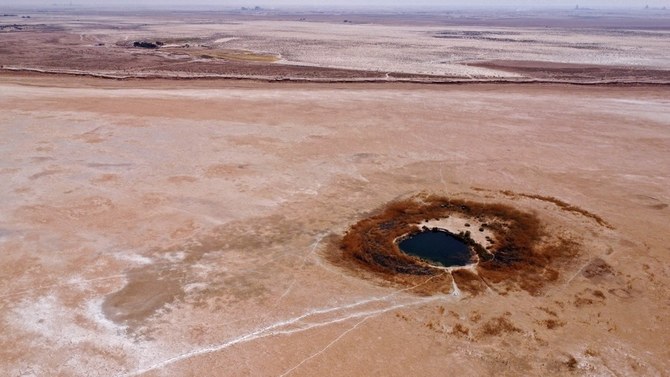
Overuse and climate change kill off Iraq’s Sawa Lake

“The lake is formed over limestone rock and is isolated by gypsum barriers surrounding the lake; its water chemistry is unique,” says Ramsar Convention on Wetlands. (AFP)
Short Url
Updated 27 April 2022
Follow

Overuse and climate change kill off Iraq’s Sawa Lake

SAWA LAKE, Iraq: A “No Fishing” sign on the edge of Iraq’s western desert is one of the few clues that this was once Sawa Lake, a biodiverse wetland and recreational landmark.
Human activity and climate change have combined to turn the site into a barren wasteland with piles of salt.
Abandoned hotels and tourist facilities here hark back to the 1990s when the salt lake, circled by sandy banks, was in its heyday and popular with newly-weds and families who came to swim and picnic.
But today, the lake near the city of Samawa, south of the capital Baghdad, is completely dry.
Bottles litter its former banks and plastic bags dangle from sun-scorched shrubs, while two pontoons have been reduced to rust.
“This year, for the first time, the lake has disappeared,” environmental activist Husam Subhi said. “In previous years, the water area had decreased during the dry seasons.”
Today, on the sandy ground sprinkled with salt, only a pond remains where tiny fish swim, in a source that connects the lake to an underground water table.
The five-square-kilometer (two-square-mile) lake has been drying up since 2014, says Youssef Jabbar, environmental department head of Muthana province.
The causes have been “climate change and rising temperatures,” he explained.
“Muthana is a desert province, it suffers from drought and lack of rainfall.”
A government statement issued last week also pointed to “more than 1,000 wells illegally dug” for agriculture in the area.
Additionally, nearby cement and salt factories have “drained significant amounts of water from the groundwater that feeds the lake,” Jabbar said.
It would take nothing short of a miracle to bring Sawa Lake back to life.
Use of aquifers would have to be curbed and, following three years of drought, the area would now need several seasons of abundant rainfall, in a country hit by desertification and regarded as one of the five most vulnerable to climate change.
The Ramsar Convention on Wetlands, a global treaty, recognized Sawa as “unique... because it is a closed water body in an area of sabkha (salt flat) with no inlet or outlet.
“The lake is formed over limestone rock and is isolated by gypsum barriers surrounding the lake; its water chemistry is unique,” says the convention’s website.
A stopover for migratory birds, the lake was once “home to several globally vulnerable species” such as the eastern imperial eagle, houbara bustard and marbled duck.
Sawa is not the only body of water in Iraq facing the perils of drought.
Iraqi social media is often filled with photos of grotesquely cracked soil, such as in the UNESCO-listed Howeiza marshes in the south, or Razzaza Lake in the central province of Karbala.
In Sawa, a sharp drop in rainfall — now only 30 percent of what used to be normal for the region — has lowered the underground water table, itself drained by wells, said Aoun Dhiab, a senior adviser at Iraq’s water resources ministry.
And rising temperatures have increased evaporation.
Dhiab said authorities have banned the digging of new wells and are working to close illegally-dug wells across the country.
Latif Dibes, who divides his time between his hometown of Samawa and his adopted country of Sweden, has worked for the past decade to raise environmental awareness.
The former driving school instructor cleans up the banks of the Euphrates River and has turned the vast, lush garden of his home into a public park.
He remembers the school trips and holidays of his childhood, when the family would go swimming at Sawa.
“If the authorities had taken an interest, the lake would not have disappeared at this rate. It’s unbelievable,” he said.
“I am 60 years old and I grew up with the lake. I thought I would disappear before it, but unfortunately, it has died before me.”


Israel says it has launched ‘broad wave’ of strikes on Iran, as Tehran widens its response across the region

Updated 14 min 22 sec ago
Follow

Israel says it has launched ‘broad wave’ of strikes on Iran, as Tehran widens its response across the region

  • ​US military says 17 Iranian navy ships destroyed, struck nearly ‌2,000 targets ‌in ​Iran thus far

JERUSALEM/DUBAI: Israel’s military said Wednesday that it launched a “broad wave of strikes” on targets in Iran, after the Islamic republic fired rounds of missile barrages at Israeli territory.
The military said the targets of its latest strikes include Iranian “launch sites, air defense systems, and additional infrastructure.”
The latest wave of strikes came after Iran struck back against Israel and across the Gulf region, targeting US embassies and disrupting energy supplies and travel.
Air raid sirens rang out across multiple parts of Israel overnight as the military worked to intercept incoming Iranian fire.
There were no immediate reports of significant impact, although police said munitions fell in the Tel Aviv area, where one woman suffered mild shrapnel injuries.
Four days into a war that President Donald Trump suggested would last several weeks or perhaps longer, nearly 800 people have been killed in Iran, including some Trump said he had considered as possible future leaders of the country.
The US military said it has ​destroyed 17 Iranian ships, including a submarine, and struck nearly ‌2,000 targets ‌in ​Iran thus far.
“Today, there is ⁠not a ‌single ‌Iranian ​ship ‌underway ‌in the Arabian Gulf, Strait of Hormuz, or ‌Gulf of Oman,” US ⁠Central Command chief Brad ⁠Cooper said in a video posted to X.


Explosions rang out Tuesday in Tehran and in Lebanon, where Israel said it retaliated against Hezbollah militants. The American embassy in Saudi Arabia and the US consulate in the United Arab Emirates came under drone attacks. Iran has fired dozens of ballistic missiles at Israel, though most of the incoming fire has been intercepted. Eleven people in Israel have been killed since the conflict began.
In other developments, the Pentagon identified four US Army Reserve soldiers killed in a drone strike Sunday at a command center in Kuwait. The strike also killed two other service members.
The spiraling nature of the war raised questions about when and how it would end.
The administration has offered various objectives, including destroying Iran’s missile capabilities, wiping out its navy, preventing it from obtaining a nuclear weapon and ensuring it cannot continue to support allied armed groups.
While the initial US-Israeli strikes killed Iranian Supreme Leader Ayatollah Ali Khamenei and Trump urged Iranians to overthrow their government, senior administration officials have since said regime change was not the goal.
Trump on Tuesday seemed to downplay the chances of the war ending Iran’s theocratic rule, saying that “someone from within” the Iranian regime might be the best choice to take power once the US-Israel campaign is finished.
Trump says people the US had in mind to lead Iran are dead
Speaking Tuesday from the Oval Office, Trump said Reza Pahlavi, the exiled son of Iran’s toppled shah, is not someone that his administration has considered in depth to take over.
As far as possible leaders inside Iran, “the people we had in mind are dead,” Trump said.
“I guess the worst case would be do this, and then somebody takes over who’s as bad as the previous person, right? That could happen,” Trump said. “We don’t want that to happen.”
Iran’s leaders are scrambling to replace Khamenei, who ruled the country for 37 years. It’s only the second time since the 1979 Islamic Revolution that a new supreme leader is being chosen. Potential candidates range from hard-liners committed to confrontation with the West to reformists who seek diplomatic engagement.
Israel and US strike nuclear facilities and other targets in Iran
Information coming out of Iran has been limited because of poor communications, round-the-clock airstrikes and tight restrictions on journalists. But explosions rang out across Iran’s capital.
The Israeli military said it conducted a wave of airstrikes on Iranian sites that produce and store ballistic missiles. It also said it destroyed what it called Iran’s secret, underground nuclear headquarters. Without providing evidence, it said the site was used for research “to develop a key component for nuclear weapons.”
“The regime attempted to rebuild its efforts and conceal them, thinking we wouldn’t notice. They were mistaken,” said Israeli military spokesman Brig. Gen. Effie Defrin.
There was no immediate public comment from the US or Iran about the site Israel named.
Iran has said it has not enriched uranium since June, though it has maintained its right to do so and says its nuclear program is peaceful.
Fears rise in Tehran as bombardment of capital intensifies
New rounds of US and Israeli airstrikes rattled Iran.
“Since midnight, I and my wife are hearing sound of explosions,” said Ali Amoli, an engineer living in north Tehran.
Satellite images published Tuesday by Colorado-based company Vantor showed the domed roof of Iran’s presidential complex in Tehran had been destroyed, supporting Israel’s claim of an overnight strike. Iran did not acknowledge the damage or report any casualties.
A north Tehran resident who spoke on condition of anonymity for fear of retaliation described growing fears amid the heavy bombardment. The resident said most stores in the normally bustling area of Tajrish were closed, though bakeries and supermarkets remained open.
Iran hits US Embassy in Riyadh and Washington pulls out staff
An attack from two drones on the US Embassy in Riyadh caused a “limited fire,” according to the Saudi Arabian Defense Ministry, and the embassy urged Americans to avoid the compound.
An Iranian drone struck a parking lot outside the US consulate in Dubai, sparking a small fire, Secretary of State Marco Rubio said in Washington. He said all personnel were accounted for.
The United Arab Emirates said it has intercepted the vast majority of more than 1,000 Iranian missile and drone attacks against it.
US embassies in Saudi Arabia, Kuwait and Lebanon said they were closed to the public.
The US State Department ordered the evacuation of non-emergency personnel and family in Kuwait, Bahrain, Iraq, Qatar, Jordan and the United Arab Emirates. And US citizens were urged to leave more than a dozen Middle Eastern countries, though many were stranded because of airspace closures.
The State Department said Tuesday it’s preparing military and charter flights for Americans who want to leave the Middle East. Several other countries also arranged evacuation flights for their citizens.
The US-Israeli strikes have killed at least 787 people in Iran, according to the Red Crescent Society. In Lebanon, where Israel launched retaliatory strikes on the Iranian-supported militant group Hezbollah, 50 people were killed, including seven children, Lebanon’s health ministry said.
In addition, three people were killed in the United Arab Emirates, and one each in Kuwait and Bahrain.
The US military has confirmed six deaths of American service members.
Four of the American soldiers killed were identified as Capt. Cody A. Khork, 35, of Winter Haven, Florida; Sgt. 1st Class Noah L. Tietjens, 42, of Bellevue, Nebraska; Sgt. 1st Class Nicole M. Amor, 39, of White Bear Lake, Minnesota; and Sgt, Declan J. Coady, 20, of West Des Moines, lowa, who received a posthumous promotion in rank. They were assigned to the Iowa-based 103rd Sustainment Command.
Turkish Foreign Minister Hakan Fidan on Tuesday criticized Iran’s attacks against Gulf neighbors that had worked to prevent war as an “incredibly flawed strategy” that threatened to widen the war if those states decide to retaliate.