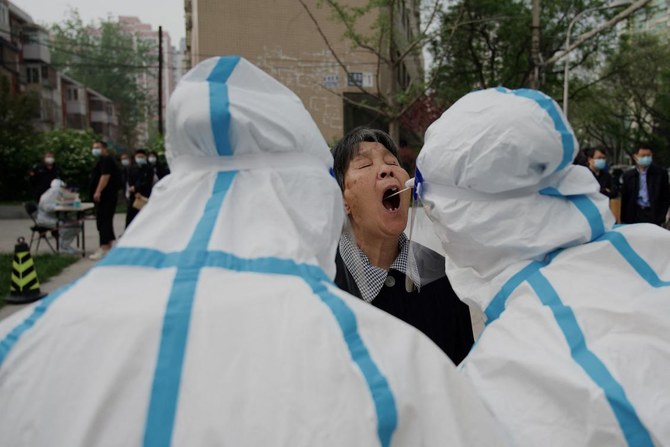
BEIJING: Beijing kicked off three rounds of COVID-19 testing for all residents of its biggest district Chaoyang on Monday after dozens of cases were reported, prompting people to stock up on food over fears of an eventual strict Shanghai-style lockdown.
Authorities in Chaoyang, home to 3.45 million people, late on Sunday ordered residents and those who work there to undergo testing this week as Beijing warned the virus had “stealthily” spread in the city for about a week before being detected.
Since Friday, Beijing has reported 47 locally transmitted cases, with Chaoyang accounting for more than half of them.
While the Chinese capital’s caseload is small compared to those globally and the hundreds of thousands in Shanghai, Chaoyang district told residents to reduce public activities and suspended in-person private tutoring classes.
However, most schools, stores and offices remained open.
The Chaoyang district is home to many wealthy residents, most foreign embassies as well as entertainment venues and corporate headquarters. It has little manufacturing.
“The current outbreak in Beijing is spreading stealthily from sources that remained unknown yet and is developing rapidly,” a municipality official said on Sunday.
More than a dozen buildings in Chaoyang have been put under lockdown. For the rest of the district, people will be tested on Monday and again on Wednesday and Friday.
People queued up at makeshift sites manned by medical workers in protective suits as testing began.
“I came as the notice suggested, at 6 a.m., for testing just to make sure that I can get to work on time,” said a man in his 30s queuing for a test in his residential compound.
Supermarket chains including Carrefour and Wumart said they had more-than-doubled inventories, and extended opening hours on Sunday, while Meituan’s grocery-focused e-commerce platform increased inventory and the number of staffers for sorting and delivery, according to the state-backed Beijing Daily.
In Shanghai, where most of its 25 million residents have been locked-down for weeks, the main food supply bottleneck has been a lack of enough couriers to make deliveries to homes.
A graduate student surnamed Zhang in Beijing’s Haidian district on Sunday placed online orders for dozens of packets of snacks and 10 pounds of apples, concerned about China’s tough policy against the virus and omicron’s transmissibility even though the current focus is on Chaoyang.
“I’m preparing for the worst,” he said.

Beijing’s biggest district begins COVID-19 mass testing
https://arab.news/4885b
Beijing’s biggest district begins COVID-19 mass testing
- Authorities in Chaoyang, home to 3.45 million people, order residents and those who work there to undergo testing this week
- Beijing has reported 47 locally transmitted cases, with Chaoyang accounting for more than half of them
UN chief launches first global, independent scientific panel on artificial intelligence
- Secretary-General Antonio Guterres nominates 40 experts to serve on body ‘dedicated to helping close the AI knowledge gap and assess the real impacts of AI’
- It will ‘help the world separate fact from fakes, and science from slop … at a moment when reliable, unbiased understanding of AI has never been more critical,’ he adds
NEW YORK CITY: UN Secretary-General Antonio Guterres on Wednesday formally launched what he described as the only global, independent scientific body focused on artificial intelligence, and submitted his recommendations for the experts to serve on it.
“It will be the first global, fully independent scientific body dedicated to helping close the AI knowledge gap and assess the real impacts of AI across economies and societies,” he told reporters in New York.
“And this could not be more urgent. AI is moving at the speed of light. No country can see the full picture alone.”
The Independent International Scientific Panel on Artificial Intelligence was established by the UN General Assembly through a resolution in August. Guterres said he has now submitted a list of 40 experts from all regions as his proposed candidates for the new body, which was mandated by world leaders under the UN’s Pact for the Future.
The panel is intended to provide authoritative, science-based analysis at a time when AI is developing rapidly and reshaping economies, governance and social life, but regulatory approaches remain fragmented.
Guterres underscored the need for shared understanding among countries to help develop effective safeguards, promote innovation for the common good, and strengthen international cooperation.
The UN said the panel would serve as a global reference point, helping policymakers and the public distinguish between reliable evidence and misinformation, and grounding debates on AI in independent scientific assessment.
The initiative comes amid growing concern over the societal, economic and security risks posed by unchecked technological competition.
“We need shared understandings to build effective guardrails, unlock innovation for the common good, and foster cooperation,” Guterres said.
“The panel will help the world separate fact from fakes, and science from slop. It will provide an authoritative reference point at a moment when reliable, unbiased understanding of AI has never been more critical.”
The proposed members of the panel were selected following an open global call that attracted more than 2,600 applicants, whose expertise spanned fields including machine learning, data governance, public health, cybersecurity, child development and human rights. The chosen candidates are expected to serve in a personal capacity, independent of governments, businesses or other institutions.
The panel will operate on an accelerated timeline, with its first report due in time to inform a Global Dialogue on AI Governance scheduled for July. UN officials said the findings were expected to support international efforts to build common ground on AI governance during a period of heightened geopolitical tensions and technological rivalry.
Guterres framed the initiative as part of a broader push to ensure that AI is shaped collectively, guided by scientific evidence and global solidarity, rather than allowing its development to outpace international cooperation.


