

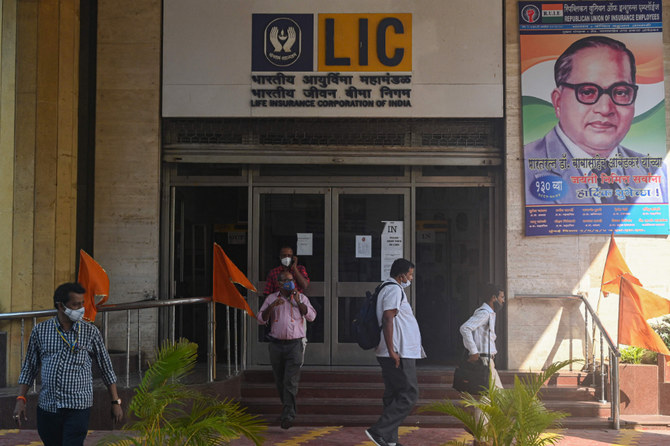
Indian insurance giant LIC's IPO fundraising goal slashed by half to $3.9bn: source

The government had initially wanted to list LIC in the last financial year that ended March 31 but had to delay the sale
Short Url
Updated 24 April 2022
Follow

Indian insurance giant LIC's IPO fundraising goal slashed by half to $3.9bn: source

NEW DELHI: New Delhi is halving its fundraising goal for Life Insurance Corporation of India’s IPO to 300 billion rupees ($3.9 billion), having had to cut its valuation estimates after feedback from investors, a government source said.


The drastic lowering of ambitions for the IPO — which would still be India’s largest to date — is a setback for Prime Minister Narendra Modi’s administration which had positioned the sale as the first and biggest of a wave of privatizations aimed at replenishing state coffers.


The state-owned insurance behemoth, also India’s largest domestic financial investor, is now valued at around 6 trillion rupees, according to the source, who declined to be identified as the IPO discussions were confidential.


Earlier government estimates had called for the insurer to be valued at around 17 trillion rupees.


“Investors have become very risk averse in the last few months.

After roadshows we realized there was no point in putting high valuation up front. Higher valuation can be discovered post the listing.

After all, the government will still hold nearly 95 percent of the issue,” said the source.


The government plans to sell a stake of just over 5 percent, he said. The source added that fresh regulatory approval for the listing process will need to be sought but did not elaborate.

The government had previously said it would sell a 5 percent stake.


The IPO is likely to be launched in the first week of May, investment banking sources said.


The finance ministry did not immediately respond to an email requesting comment.


The government had initially wanted to list LIC in the last financial year that ended March 31 but had to delay the sale after Russia’s invasion of Ukraine triggered a market rout.


The 66-year-old company dominates India’s insurance sector with more than 280 million policies.

It was the fifth-biggest global insurer in terms of insurance premium collection in 2020, the latest year for which statistics are available.


Investors have been concerned that LIC’s investment decisions, including those in loss-making state companies, could be influenced by government demands.


Industry leaders highlight Riyadh’s Metro, infrastructure as investment catalysts

Updated 29 December 2025
Follow

Industry leaders highlight Riyadh’s Metro, infrastructure as investment catalysts

RIYADH: Saudi Arabia’s capital, Riyadh, is experiencing a transformative phase in its real estate sector, with the construction market projected to reach approximately $100 billion in 2025, accompanied by an anticipated annual growth rate of 5.4 percent through 2029.

The Kingdom is simultaneously advancing its data center capacity at an accelerated pace, with an impressive 2.7 GW currently in the pipeline. This expansion underscores the critical role of strategic land and power planning in establishing national infrastructure as a cornerstone of economic growth.

These insights were shared by leading industry experts during JLL’s recent client event in Riyadh, which focused on the city’s macroeconomic landscape and emerging trends across office, residential, retail, hospitality, and pioneering sectors, including AI infrastructure and Transit-Oriented Development.

Saud Al-Sulaimani, Country Lead and Head of Capital Markets at JLL Saudi Arabia, commented: “Riyadh is positioned at the forefront of Saudi Arabia’s Vision 2030, offering unparalleled opportunities for both investors and developers. National priorities are continuously recalibrated to ensure strategic alignment of projects and foster deeper collaboration with the private sector.”

He added: “Recent regulatory developments, including the introduction of the White Land Tax and the rent freeze, are designed to stabilize the market and are expected to drive renewed focus on delivering premium-quality assets. This dynamic environment, coupled with evolving construction cost considerations in select segments, is fundamentally reshaping the market landscape while accelerating progress toward our national objectives.”

The event further underscored the transformative impact of infrastructure initiatives. Mireille Azzam Vidjen, Head of Consulting for the Middle East and Africa at JLL, highlighted Riyadh’s transit revolution. She detailed the Riyadh Metro, a $22.5 billion investment encompassing 176 kilometers, six lines, and 84 stations, providing extensive geographic coverage, with a depth of 9.8 km per 100 sq. km. This strategic development generates significant TOD opportunities, with properties in proximity potentially commanding a 20-30 percent premium. JLL emphasized the importance of implementing climate-responsive last-mile solutions to enhance mobility and accessibility, particularly given Riyadh’s extreme temperatures.

Gaurav Mathur, Head of Data Centers at JLL, emphasized the rapid expansion of the Kingdom’s AI infrastructure, signaling a critical area for technological investment and innovation.

Focusing on the construction sector, Maroun Deeb, Head of Projects and Development Services, KSA at JLL, explained that the industry is actively navigating complexities such as skilled labor availability, material costs, and supply chain dynamics.

He highlighted the adoption of Building Information Modeling as a key driver for enhancing operational efficiency and project delivery.